

Long queues behind manual work slowed account creation and authentication requests for 70,000+ users.
The client, a US state government, runs an IT environment that serves over 70,000 users spread across its departments and locations. The State had recently implemented Okta, an identity management and authentication platform, to streamline its IT operations and enhance security, putting identity at the center of how employees reach the applications and data their work requires.
The transition brought problems of its own: long lead times for user account creation and support requests. The existing Okta integration struggled to keep pace with the State’s dynamic environment, leading to delays and inefficiencies in user management and application access. Recognizing the need for expert assistance, the State turned to i3solutions to augment its IT capabilities and optimize its Okta environment.
A state government’s newly deployed identity platform still left tens of thousands of account requests stuck in manual queues. i3solutions optimized the Okta deployment so provisioning runs on automated triggers, scaling identity management to more than 70,000 users.
Automated, trigger-based provisioning cut account-creation lead times statewide, single sign-on now spans more than 30 integrated applications, and security posture improved with department-level MFA, country-IP blocklists, and least-privilege access.

A New Platform Outpaced by Its Own Rollout
The State had made the right platform decision and then hit the gap between owning Okta and running it well at scale. Account creation and authentication requests, the two most routine operations in identity management, had become the bottlenecks, and every day of lead time was a state employee waiting for access to the systems their job required.
The State committed to expert operational help: not an advisory engagement, but a partner to design, implement, and maintain an Okta architecture capable of supporting its vast user base and diverse application landscape, and to keep it working day to day.
This state government already had Okta in place; what changed was the architecture, security configuration, and operational discipline around it. If you already own the platform but haven’t operationalized it at scale, that’s a narrower engagement than a new deployment.
Seventy Thousand Users Feel Every Delay
At 70,000 users, identity friction multiplies into government-wide cost. Every slow provisioning cycle is an employee who cannot work, every backed-up support request is a department absorbing delay, and the queue itself becomes IT’s workload, crowding out the engineering that would fix the causes.
The security stake ran alongside the operational one. An identity platform that is behind on integrations pushes users and departments toward workarounds, and a state government holds data with public consequences: citizen records, department systems, and privileged accounts, where unauthorized access is a headline rather than an internal incident.
One Architecture, Every Department, No Downtime
The environment’s diversity was the defining constraint: departments with different security postures needed different multifactor authentication treatments, applied by Okta Groups, and the application estate spanned more than 30 third-party applications that had to reach single sign-on through a mix of the Okta Integrated Network and manual integration.
The architecture also had to respect what the State already ran. Okta synchronizes with Entra ID for user authentication, so user records stay consistent across the State’s IT environment; the State keeps the directory infrastructure it already owns, with Okta’s identity management running on top. Given the environment’s role in accessing critical resources, the configuration had to minimize downtime risk and hold performance at scale.
Senior Microsoft Specialists with Proven Delivery Depth
The job was operational, not advisory: run the architecture, keep it current, and keep it working for 70,000 users. That called for a firm that designs identity architecture, tunes it for scale, integrates applications in volume, and staffs the help desk that keeps daily operations moving.
The State engaged i3solutions, a Microsoft Partner with 30 years of delivery experience and 1,500+ Microsoft engagements, delivered by an all-senior, all US-based delivery team, senior engineers who run identity infrastructure as a discipline, from architecture design through day-to-day support.
i3solutions overhauled the State’s Okta environment across four fronts: architecture, security configuration, application integration, and daily operations.
PHASE 01
Architecture Design and Optimization
i3solutions designed the Okta architecture to be flexible and easily scalable, adapting to the State’s evolving needs without compromising performance or security, with configurations built to minimize downtime risk and performance tuning so sign-on stays responsive at 70,000 users.
PHASE 02
Security Configuration
i3solutions configured multifactor authentication options, Okta Push, RSA tokens, and voice authentication, applied to departments through Okta Groups, implemented do-not-allow lists based on country IPs to block unauthorized access attempts from specific regions, and applied privileged identity management principles so sensitive accounts run under least privilege, monitored and audited.
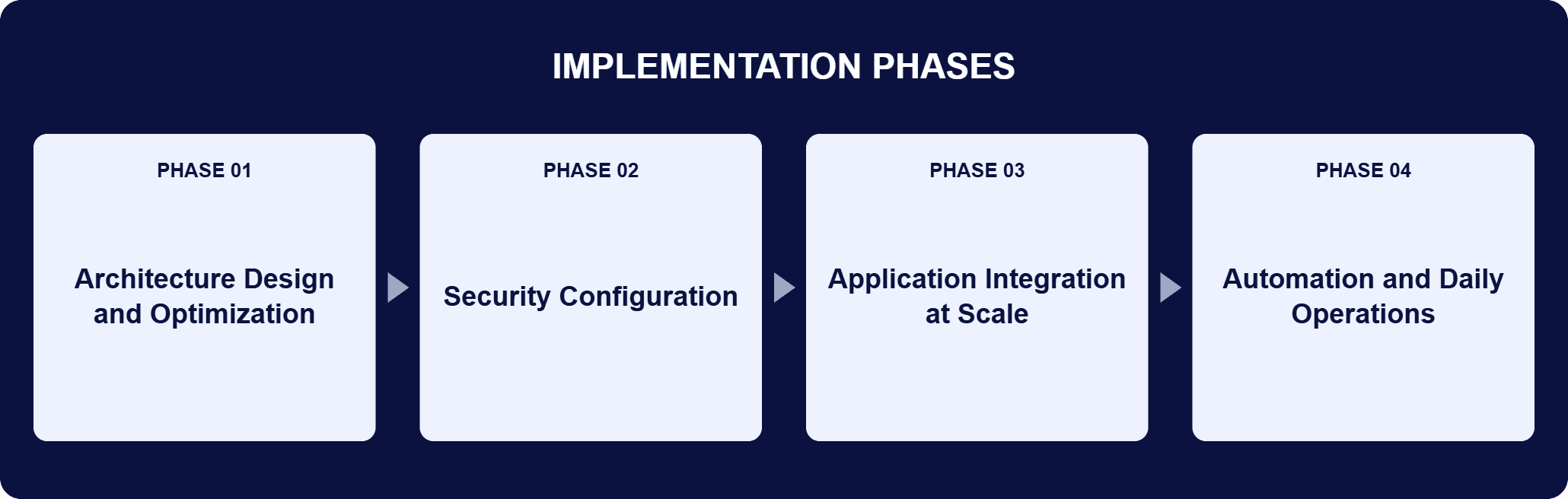
PHASE 03
Application Integration at Scale
i3solutions integrated over 30 third-party applications into Okta’s authentication services, using the Okta Integrated Network and manual integration, so users sign in once and reach everything they are authorized to use across the State’s application estate.
PHASE 04
Automation and Daily Operations
i3solutions used Okta Workflow to automate user onboarding, event-based workflows, and routine administrative tasks, and handled day-to-day Okta help desk tickets, providing timely support and resolution so an access problem handled the same day never becomes a backlog.
Okta is the foundation: a cloud-based identity and access management platform providing centralized user management, authentication, and access control across the State’s user base and application landscape. Okta synchronizes with Entra ID for user authentication, keeping user records consistent while the State retains the Windows domain directory infrastructure it already owns. Multifactor authentication runs through Okta Push, RSA tokens, and voice authentication, assigned by department through Okta Groups, with country-IP do-not-allow lists blocking access attempts from specific regions. More than 30 third-party applications are integrated for single sign-on through the Okta Integrated Network and manual integration. Okta Workflow automates user onboarding, event-based workflows, and routine administrative tasks, so work that used to wait on a person now runs on a trigger. Privileged identities, the accounts with authority for sensitive tasks, are monitored, managed, and audited under least privilege. Okta’s built-in reporting, analytics, and alerting give the State visibility into its identity operations, with custom reports, dashboards, and alerts supporting security monitoring, operational response, and compliance.
Two Bottlenecks, Removed
Optimizing the state’s existing Okta deployment cut account creation lead time and resolved authentication requests with same-day help desk coverage.
| Outcome | Before | After |
|---|---|---|
| Account creation lead time | Long, queued behind manual work | Cut, with provisioning running on triggers |
| Authentication and support requests | Backing up against a strained integration | Resolved timely, same-day help desk coverage |
| Application sign-on | Per-application credentials | SSO across more than 30 integrated applications |
| Security posture | Uneven across departments | MFA by department, country-IP blocklists, least privilege |
| Routine administration | Manual intervention | Automated through Okta Workflow |
| Operational visibility | Limited | Custom reports, dashboards, and alerts |
Employees get access to the systems they need sooner, and provisioning no longer queues behind manual work. Third-party applications integrated into Okta give employees single sign-on to everything they are authorized to use, with centralized access control behind it and multifactor authentication guarding sensitive data: access got easier for employees and harder to abuse.
Routine tasks run through Okta Workflow, user onboarding, access provisioning, incident response steps, so less manual intervention means faster response to IT requests and an IT team with time for the work that needs judgment. Okta’s reporting, analytics, and alerting give the State visibility into its identity operations, and the same data informs decisions about where the environment goes next.

[PENDING-CLIENT-QUOTE: Replace with approved direct or paraphrased statement from [role] at [organization type] before final publication. A missing client quote does not block publication but must be resolved within 30 days of go-live.]
[PENDING ATTRIBUTION]
[role], [organization type]
This engagement is relevant for
Less relevant for
Owning a Platform Is Not the Same as Running It
The engagement established the difference between implementing an identity platform and operating one at scale. The State owned Okta before i3solutions arrived; what changed came in three layers: the architecture underneath it, designed for scalability and tuned for performance; the security configuration on top of it, with MFA by department, country-IP controls, and least privilege on privileged identities; and the discipline around it, automation for the routine and help desk coverage for the daily. The result is an identity environment where the two original bottlenecks, account creation and authentication requests, stopped being bottlenecks, and where 70,000 users sign in once for more than 30 applications.
It is the full operational ownership of the identity layer: designing an Okta architecture that scales to the State’s user base of over 70,000, integrating its applications for single sign-on, configuring security appropriate to each department, and running the daily operations that keep it working. In this engagement that meant architecture design, implementation, and maintenance; multifactor authentication through Okta Push, RSA tokens, and voice authentication; synchronization with the State’s existing Entra ID directory; integration of more than 30 third-party applications; automation through Okta Workflow; and day-to-day help desk support for State employees. The job is operational, not advisory: the measure is whether provisioning, sign-on, and support actually run.
In this engagement, i3solutions treated scalability, reliability, performance, and security as the four design tests. The architecture was designed to be flexible and easily scalable, adapting to the State’s evolving needs; configurations were built to minimize downtime risk for an environment that gates access to critical resources; performance tuning kept sign-on responsive at 70,000 users; and security was layered, MFA assigned by department through Okta Groups, country-IP do-not-allow lists, and least-privilege management of privileged identities. Around the engineering sits daily discipline: automation through Okta Workflow for the routine, and help desk coverage so an access problem handled the same day never becomes a backlog.
Okta synchronizes with Entra ID, the directory service managing network resources in the State’s Windows domain environment, for user authentication. User records stay consistent across the State’s IT environment, and the State keeps the directory infrastructure it already owns and runs, with Okta’s identity management operating on top of it. From there, Okta is the foundation for centralized user management, authentication, and access control: applications integrate into Okta’s authentication services through the Okta Integrated Network or manual integration, users sign in once for everything they are authorized to use, and Okta Workflow automates onboarding and event-based tasks against those same identity records.
The returns in this engagement landed exactly where the pain was. Lead times for user account creation and authentication requests, the two bottlenecks that prompted the engagement, were cut: employees get access to the systems they need sooner, and provisioning no longer queues behind manual work. Routine administration moved to Okta Workflow, freeing the IT team for work that needs judgment. Security improved in the same motion, with MFA guarding sensitive data, single sign-on reducing credential sprawl, and privileged accounts under least privilege. A government sizing its own return should measure current provisioning lead time, help desk ticket volume tied to access, and the manual hours spent on routine identity administration.
i3solutions is a Microsoft Partner with 30 years of delivery experience and 1,500+ Microsoft engagements, with every engagement staffed by an all-senior, all US-based delivery team. Identity operations at government scale reward that seniority: this engagement spanned architecture design, MFA configuration across departments, integration of more than 30 applications, Entra ID synchronization, workflow automation, and the unglamorous daily discipline of help desk coverage, all for an environment serving over 70,000 users. A scoping conversation maps your identity environment against what a tuned deployment looks like at your scale, and you get a specific list of gaps and comparable engagements to reference when you build the internal case.
Multifactor authentication with Okta Push, RSA tokens, and voice authentication, applied per department through Okta Groups; do-not-allow lists based on country IPs; and privileged identity management principles so sensitive accounts are monitored and audited under least privilege.
Yes. The State’s Okta environment synchronizes with Entra ID, keeping user management consistent across both platforms.
The two original bottlenecks, account creation and authentication requests, stopped being bottlenecks once the platform was properly tuned. We’re glad to discuss what a comparable optimization would look like for your Okta environment.

US-Based | Est. 1997
© i3solutions. All rights reserved.
US-Based | Est. 1997
© i3solutions. All rights reserved.


