
Governance questions are what make a Microsoft environment defensible under audit, from who owns a policy to what evidence proves a control held. These answers address the specific calls IT leaders face when GCC High, CMMC, FedRAMP, or ITAR narrows the acceptable range.
Michael Branson
The Electronic Communications Plan can reach the IT Director after counsel and the executives have finished negotiating the mitigation agreement. It has a line about remote administration, monitoring and maintenance, and no one who wrote that line looked at who holds Global Administrator in the corporate Microsoft 365 tenant, whether the foreign parent’s tenant can still invite your users as guests, or whether some administrator accounts are still synced from a directory the parent once ran. The Facility Security Officer and the Government Security Committee will ask the IT Director to show that the separation holds, and the first technical decision behind that answer is which accounts may hold Global Administrator in the corporate tenant at all. This guide sets out what 32 CFR 117.11 says the agreement’s committee and plans must do, and how Microsoft Entra’s own constructs map to the administration side of that separation. Whether a particular company is under FOCI, which instrument applies, what its plan must say and whether a configuration will satisfy the cognizant security agency are determinations for the company, its counsel, its FSO and DCSA.
When the agreement is signed, IT inherits a committee to answer to, a set of plans to implement, and a reviewer who reads both. The eCFR text of § 117.11 Foreign Ownership, Control, or Influence (FOCI) sets out the instruments and what each changes at the board. Under a security control agreement, “At least one cleared U.S. citizen must serve as an outside director on the entity’s governing board.” Under a special security agreement, “The SSA preserves the foreign owner’s right to be represented on the entity’s board or governing body with a direct voice in the entity’s business management, while denying the foreign owner majority representation and unauthorized access to classified information.” And “The VT and the PA are arrangements that vest the voting rights of the foreign-owned stock in cleared U.S. citizens approved by the USG.”
The same section, § 117.11 Foreign Ownership, Control, or Influence (FOCI), creates the committee the IT Director will report through: “Under a VT, PA, SSA, or SCA, the contractor is required to establish a permanent committee of its board of directors, known as the GSC.” Paragraph (g)(1) seats trustees, proxy holders or outside directors and the officer directors found eligible for access to classified information, unless the cognizant security agency approves otherwise, and paragraph (g)(3) says “The contractor’s FSO will be the principal advisor to the GSC and attend GSC meetings.” For a Department of Defense contractor, the cognizant security agency is DoD, and its cognizant security office is DCSA: the eCFR text of § 117.6 Responsibilities says the Director, DCSA “Oversees and manages DCSA, which serves as the DoD CSO.” For the IT Director, that means the Entra design is reviewed through the FSO, who has to be able to explain it to DCSA.
Plans arrive as supplements to the agreement, and paragraph (h) of § 117.11 Foreign Ownership, Control, or Influence (FOCI) says supplements are not a formality: “When making use of supplements, the CSA does not consider the FOCI mitigation measure final until the CSA has approved the required supplements.” The rule lists the supplements they may include:
The technology control plan answers which non-U.S. citizen employees and visitors may reach which information; the export-control side of that question, and how a GCC High tenant carries it, is covered on the ITAR export-control compliance for Microsoft 365 page. This guide stays with the Electronic Communications Plan, whose paragraph (h)(2) in § 117.11 Foreign Ownership, Control, or Influence (FOCI) states its purpose plainly: “The purpose is to prevent the unauthorized disclosure of classified information to the foreign parent or its affiliates.” It then sets the contents: “The contractor will include in the ECP a detailed network description and configuration diagram that clearly delineates which networks will be shared and which will be protected from access by the foreign parent or its affiliates.” And: “The network description will address firewalls, remote administration, monitoring, maintenance, and separate email servers, as appropriate.”
Read the Electronic Communications Plan as a specification for your identity layer. Remote administration, monitoring and maintenance are role assignments before they are firewall rules: whoever holds a tenant-wide administrative role can change the settings every other control depends on. The corporate Microsoft 365 tenant is one of the electronic communications networks the plan describes, and this guide treats it as that and nothing more.
If the foreign parent runs its own Microsoft Entra tenant, the first gap can be the one no one configured. Microsoft’s Overview: Cross-tenant access with Microsoft Entra External ID, last updated March 28, 2025, states the starting point: “By default, B2B collaboration with other Microsoft Entra organizations is enabled, and B2B direct connect is blocked.” Left alone, the parent’s users can be invited into your tenant as guests, and your users can be invited into the parent’s tenant as guests, under the same default settings that govern every other Entra organization.
The same page, Overview: Cross-tenant access with Microsoft Entra External ID, gives the controls that change that. “Inbound access settings control whether users from external Microsoft Entra organizations can access resources in your organization.” “Outbound access settings control whether your users can access resources in an external organization.” You can add the parent and each affiliate as named organizations, and “Organizational settings take precedence over default settings.” Tenant restrictions are a separate control over the types of external accounts your users can use on the devices you manage: “Tenant restrictions are independent of other cross-tenant access settings, so any inbound, outbound, or trust settings you configure don’t affect tenant restrictions.”
Next to any plan to block everything, the same page carries a warning: “Changing the default inbound or outbound settings to block access could block existing business-critical access to apps in your organization or partner organizations.” That is where the affiliated operations plan earns its place. The agreement already decides which services pass between the company and the foreign interest; the cross-tenant settings should implement exactly that list and no more.
Where the parent’s tenant sits in a different Microsoft cloud, Microsoft’s Enable B2B collaboration across Microsoft clouds, last updated July 27, 2026, adds two limits: “B2B direct connect is not supported for collaboration with Microsoft Entra tenants in a different Microsoft cloud.” And for B2B collaboration across clouds, “Both organizations must enable collaboration with each other, as described in this article.” If the FOCI arose from an acquisition and the tenant strategy itself is still open, consolidating or keeping two tenants is a separate decision, covered on the dual-tenant Microsoft merger page.
Set an organization-specific inbound and outbound policy for the parent’s tenant and every affiliate tenant, rather than relying on the defaults, and write the reason for each allowed path into the Electronic Communications Plan so the FSO can match the setting to the agreement line by line.
The failure the plan’s remote administration line is meant to catch is a tenant-wide role held by someone the agreement never meant to reach the protected side. Microsoft’s Administrative units in Microsoft Entra ID, last updated October 29, 2024, describes the scoping tool: “Administrative units restrict permissions in a role to any portion of your organization that you define.” The default runs the other way: “if you assign a role to a user that is not a member of an administrative unit, the scope of the role is the entire tenant.” And the scope has a boundary worth writing into the plan in these words: “Administrative units apply scope only to management permissions.” An administrative unit decides who can manage an object. It does not decide who can read the data the object can reach.
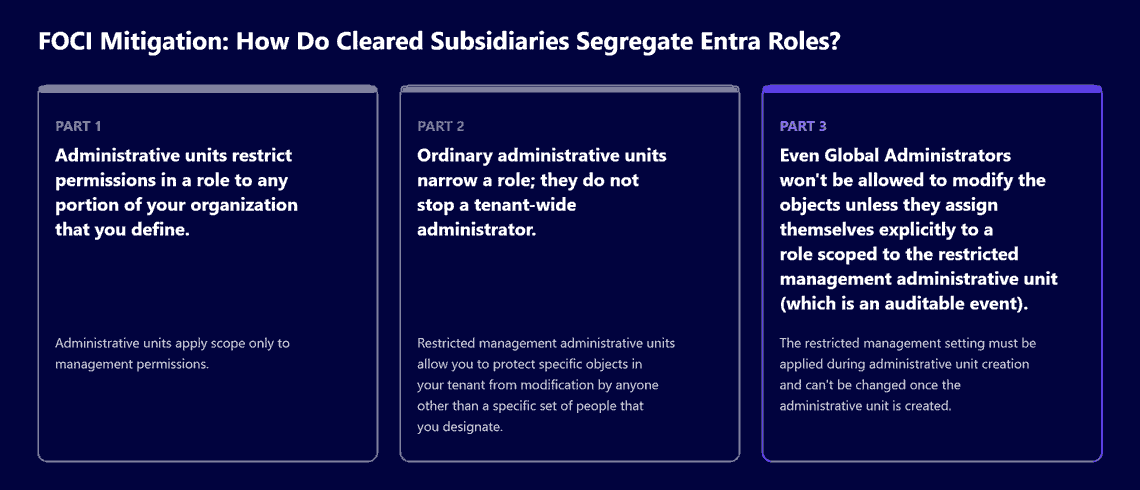
Ordinary administrative units narrow a role; they do not stop a tenant-wide administrator. Restricted management administrative units do. Microsoft’s Restricted management administrative units in Microsoft Entra ID, last updated March 4, 2026, says: “Restricted management administrative units allow you to protect specific objects in your tenant from modification by anyone other than a specific set of people that you designate.” And: “Even Global Administrators won’t be allowed to modify the objects unless they assign themselves explicitly to a role scoped to the restricted management administrative unit (which is an auditable event).” Users, devices and security groups can be members; Microsoft 365 groups, mail-enabled security groups and distribution groups cannot.
The same page, Restricted management administrative units in Microsoft Entra ID, sets the limits a design has to plan around:
Decide which objects go into a restricted management administrative unit before you create it, because the setting cannot be changed afterward. This guide’s recommendation is to consider the accounts of the committee members and the FSO, and the security groups that gate the resources the Electronic Communications Plan protects, one object at a time: an object placed there is protected from tenant-wide administrators and, by Microsoft’s own statement, can no longer be governed with Privileged Identity Management or access reviews, so weigh each object against the governance it would lose.
When the plan says remote administration is addressed, the question the FSO will eventually ask is who holds privileged roles right now, permanently, and from which directory. Microsoft’s Best practices for Microsoft Entra roles, last updated June 1, 2026, gives three recommendations that map directly onto that question. “As a best practice, Microsoft recommends that you assign the Global Administrator role to fewer than five people in your organization.” “Microsoft recommends that organizations have two cloud-only emergency access accounts permanently assigned the Global Administrator role.” And “Avoid using on-premises synced accounts for Microsoft Entra role assignments.” The page gives the reason for the last one: “If your on-premises account is compromised, it can compromise your Microsoft Entra resources as well.” That reason carries extra weight where the on-premises directory’s history runs through the foreign parent. These are Microsoft’s best practices, not requirements of 32 CFR 117.11.
Privileged Identity Management replaces standing assignments with activation. Microsoft’s What is Microsoft Entra Privileged Identity Management?, last updated April 23, 2026, says: “Privileged Identity Management provides time-based and approval-based role activation to mitigate the risks of excessive, unnecessary, or misused access permissions on resources that you care about.” An eligible administrator activates the role when a task needs it, and “Actions might include performing a multifactor authentication (MFA) check, providing a business justification, or requesting approval from designated approvers.” Per Best practices for Microsoft Entra roles, “Privileged Identity Management requires Microsoft Entra ID P2 or Microsoft Entra ID Governance, while entitlement management and access reviews require Microsoft Entra ID Governance or Microsoft Entra Suite (some capabilities operate with Microsoft Entra ID P2).”
Make every privileged role eligible rather than active, except the two emergency access accounts; restrict approvers to cleared U.S. staff the GSC has identified; and keep the emergency accounts cloud-only and outside any cross-tenant path the parent or an affiliate can reach. That is this guide’s recommendation; which people count as cleared and approved is the FSO’s and the committee’s determination.
Once a year, the committee has to put its name to what the IT Director built. Under paragraph (i)(1) of § 117.11 Foreign Ownership, Control, or Influence (FOCI), “The CSA will meet at least annually, and otherwise as required by circumstances, with the GSCs of contractors operating under a VT, PA, SSA, or SCA to review the purpose and effectiveness of the clearance arrangement”, and the review examines acts of compliance or noncompliance, problems with the practical application of the arrangement, and whether security controls, practices or procedures warrant adjustment. Under paragraph (i)(2), “the chairman of the GSC will submit to the CSA one year from the effective date of the agreement and annually thereafter, an implementation and compliance report.” The report’s listed contents include changes to security procedures and:
The Entra settings in this guide each leave a record the FSO can pull for that report. The mapping in the next table is this guide’s; the facts in each row come from the Microsoft pages linked in the earlier sections of this guide.
Decide now which of these records the FSO will pull for the annual report and who reviews them between reports, so that an act of noncompliance is found by the company before the review finds it. What the company reports, and how, stays with the committee chairman, the FSO and counsel.
If the corporate tenant runs in a US Government cloud, check each construct against Microsoft’s government availability page before designing on it. Microsoft’s Microsoft Entra feature availability, last updated January 15, 2026, says: “Microsoft Entra ID Governance is available in the US Government community cloud (GCC), GCC-High, and Department of Defense cloud environments.” Its feature table marks these rows as available:
The same page does not list administrative units or restricted management administrative units either way. Confirm their availability in your own tenant before the design depends on them, and treat the scoping and protected-object sections of this guide as a design to validate in a government cloud, not one to promise. For collaboration with a parent tenant in a different Microsoft cloud, the cross-cloud limits in Enable B2B collaboration across Microsoft clouds apply: B2B direct connect is not supported across clouds, and both organizations must enable B2B collaboration with each other.
If your situation matches one of these, start somewhere else.
Whether an outside firm does the identity work or your own team does, the same requests separate a design the FSO can defend from a slide.
When a cleared company takes this on, it needs a project with an end date: the identity inventory, the cross-tenant and privileged-role design, the restricted management and Privileged Identity Management implementation, and the evidence set, with embedded specialists where the internal team needs more hands for a period. i3solutions has deep experience implementing identity governance for enterprises in aerospace and defense manufacturing, financial services, and healthcare, including environments with CMMC and ITAR obligations. i3solutions governs identity and access for regulated Microsoft estates with senior, U.S.-based engineers and leaves an audit-defensible record. i3solutions installs and helps configure applications inside IL4 and IL6 government cloud environments and other government networks. i3solutions has been a Microsoft Partner with 30 years of enterprise technology delivery experience and has delivered 1,500+ Microsoft engagements across aerospace and defense, financial services, and health sciences. An i3solutions project engagement does not by itself include ongoing support of what it delivers, which i3solutions scopes separately as Application Managed Services, and it is not a replacement for the internal team, open-ended scope expansion, or vendor lock-in. This work sits within i3solutions’ identity and access management solutions.
No. The text of 32 CFR 117.11 names no product. It says the contractor will develop and implement an Electronic Communications Plan, subject to approval by the cognizant security agency, and for DoD, Part 117 names DCSA as the cognizant security office. Microsoft Entra is one way to build the identity layer that plan describes, and the configuration is evidence for the plan, not a substitute for it. i3solutions has deep experience implementing identity governance for enterprises in aerospace and defense manufacturing, financial services, and healthcare, including environments with CMMC and ITAR obligations.
According to 32 CFR 117.11, paragraph (h)(2), the plan verifies that electronic controls are in place for clear technical and logical separation of electronic communications and networks between the contractor, the foreign interest, and its affiliates. The regulation says: “The contractor will include in the ECP a detailed network description and configuration diagram that clearly delineates which networks will be shared and which will be protected from access by the foreign parent or its affiliates.” It adds: “The network description will address firewalls, remote administration, monitoring, maintenance, and separate email servers, as appropriate.”
A Global Administrator cannot change them without first assigning themselves to it. Microsoft’s page Restricted management administrative units in Microsoft Entra ID says: “Even Global Administrators won’t be allowed to modify the objects unless they assign themselves explicitly to a role scoped to the restricted management administrative unit (which is an auditable event).”
Yes, unless you change it. Microsoft’s page Overview: Cross-tenant access with Microsoft Entra External ID says: “By default, B2B collaboration with other Microsoft Entra organizations is enabled, and B2B direct connect is blocked.” Organization-specific settings for the parent’s tenant take precedence over the defaults.
Yes, according to Microsoft’s page Microsoft Entra feature availability, which says Microsoft Entra ID Governance is available in the US Government community cloud (GCC), GCC-High, and Department of Defense cloud environments, and marks Privileged Identity Management (PIM) as available in its feature table. The same page does not list administrative units, so confirm those in your own tenant.
According to 32 CFR 117.11, paragraph (i)(2), “the chairman of the GSC will submit to the CSA one year from the effective date of the agreement and annually thereafter, an implementation and compliance report.” Its listed contents include changes to security procedures and a detailed description of any acts of noncompliance, whether inadvertent or intentional, with remedial measures.
Michael Branson
Users who answer MFA by text message or phone call have been seeing prompts to register a passkey, and someone in the steering meeting has asked what enforcement means for the plant floor, the nursing stations, the field crews and the contractors who carry no company phone. The answer depends on the population, not the tenant: some people move to a passkey on a phone they already have, some need a credential that does not live on a phone at all, and a small, documented group may keep SMS or voice through a provider your organization buys. This page is for the IT leader who has to sort those people before the dates arrive. Every Microsoft page cited in this guide was read on October 20, 2026.
When the plan has one date in it, it is already wrong, because Microsoft set two retirement dates and assigns each user to one of them. Microsoft’s Passkeys by default and retirement of Microsoft-provided SMS and voice authentication page says “From February 1, 2027, Microsoft-provided telephony delivery for SMS and voice will be retired for all users except Global Administrators and external users.” and “For Global Administrators and external users, Microsoft-provided SMS and voice authentication will be retired on July 1, 2027.” Its Frequently asked questions about SMS and voice retirement page adds “Internal guest users aren’t included in that July 1 group and still follow the February 1, 2027 retirement date.”
The milestones, as published on Microsoft Learn and read on October 20, 2026:
What happens after each date is the part that strands people. The retirement page says “Users in scope for the February 1 retirement whose only available MFA method is SMS or voice are required to register a passkey during sign-in to continue accessing their account.” and “There is no opt out from this February 1 behavior for users in scope of the February 1 retirement.” The FAQ says “If customers do not configure a telephony provider by the applicable retirement date, users who still use SMS and voice will receive a blocking registration prompt to register a passkey.” A provider does not change that for anyone left behind: the FAQ says “If you configure a telephony provider through Microsoft Security Store and migrate all users who need SMS or voice before their applicable retirement date, those users won’t receive the blocking passkey registration prompt as part of the SMS and voice retirement enforcement.” and “Users who remain enabled for Microsoft-provided SMS or voice are still subject to the passkey registration requirement.”
The planning rule i3solutions recommends: a population is ready for its date only when every user in it holds a method other than SMS or voice, or has been moved onto a configured telephony provider before that date. A user who is still on Microsoft-provided SMS or voice when the date arrives meets the blocking prompt, whatever else the tenant has set up.
When a team is not ready for the passkey prompts, the opt-out looks like a way to buy time past February. It is not. Microsoft’s Passkeys by default and retirement of Microsoft-provided SMS and voice authentication page says “A temporary opt-out is available for the September 1, 2026 through February 1, 2027 changes.” The same page describes what it delays, the automatic passkey enablement and the Microsoft-managed registration campaign during that window, and then says “There is no opt out for enforcement.”
The planning rule i3solutions recommends: use the opt-out only to sequence your own migration or a telephony provider setup, and never as the plan for the retirement date. If the opt-out is on, the inventory and the replacement plan covered in the next two sections have to be further along, not less.
The failure in this retirement is an inventory that counts MFA registrations and misses the other places a text or a call is doing work. Microsoft’s Passkeys by default and retirement of Microsoft-provided SMS and voice authentication page says “To check who in your tenant still uses SMS or Voice, see Find active SMS or Voice users in your tenant” and points to a Microsoft script for that check. Start there, and then look in three more places.
External MFA methods are a different case. The FAQ answers “No, only SMS and voice authentication method policies and legacy MFA policies are retired.” to the question of whether external MFA methods are affected, unless the same users are also enabled for SMS or voice.
The planning rule i3solutions recommends: record the inventory by population (frontline, clinical, field, contractors, B2B guests, Global Administrators), not as a single user count, because each population gets a different answer in the next two sections.
When the plan assumes every user can register a passkey on a phone, it breaks on the people without a company phone, the people who will not use a personal phone for work, and the people who share a device. Microsoft’s Passkeys by default and retirement of Microsoft-provided SMS and voice authentication page describes device-bound passkeys as “the passkey is created and stored on a user’s device, such as Passkey in Microsoft Authenticator, Entra Passkey on Windows, FIDO2 hardware security key, and so on.” A hardware security key is on that list, and it does not depend on anyone’s phone.
Shared devices are where Windows Hello for Business stops fitting. Microsoft’s Plan a phishing-resistant passwordless authentication deployment in Microsoft Entra ID page says of it “It shouldn’t be used on kiosk devices that use a shared user account.” and “Windows Hello for Business supports up to 10 users per device.” It continues: “If your shared devices need to support more users, then use a portable credential instead, such as security keys.”
Frontline workers already on SMS sign-in have one more Microsoft option. Microsoft’s Configure and enable users for SMS-based authentication using Microsoft Entra ID page says “If you enable SMS authentication for frontline workers, we suggest you move to using QR code authentication.” Its QR code authentication method page says “QR code authentication is a single-factor method in which the PIN (something you know) is a credential.” and “Enforce phishing-resistant authentication or MFA when users access resources from outside of the store or workplace network.” The same page says “Printing a QR code costs less than a hardware key, which can be cost prohibitive for organizations with temporary frontline workers.”
The planning rules i3solutions recommends: give phoneless and shared-device workers a portable credential rather than assuming one person per phone, and if QR code sign-in is used on shared devices, keep it inside the workplace-network conditions Microsoft names. Which phishing-resistant method each group should hold, in what order to roll them out and how account recovery works is a separate decision from this retirement, and it is not settled on this page.
When a business unit says it cannot give up text messages, the option Microsoft offers is a provider your organization contracts, not a continuation of Microsoft’s service. Microsoft’s Passkeys by default and retirement of Microsoft-provided SMS and voice authentication page says “Microsoft recommends passkeys as the primary migration path for all users where possible.” and “Beginning October 30, 2026, customers who need to continue using SMS or voice can select and configure a telephony provider from Microsoft Security Store.” Microsoft’s Choose a telephony provider for SMS and voice authentication page sets the bar: “Use a telephony provider only for user populations that have a business, regulatory, or technical requirement for telephony-based authentication.”
What the option is, as of October 20, 2026, according to Microsoft’s Frequently asked questions about telephony providers in Microsoft Entra ID page:
What it moves onto your organization is the operating responsibility. On cost, the retirement FAQ says “Pricing varies by telephony provider and region.” and “However, migrating Microsoft provided SMS and voice users to Passkeys incur no additional cost.” Microsoft’s Microsoft Entra ID security updates: Passkeys are the default authentication method in Entra ID post says “Customers will be responsible for any associated telecom-related costs charged by the telecom partners.”
Configuring a provider protects only the users you move onto it. As the dates section quotes, the FAQ says users who remain enabled for Microsoft-provided SMS or voice “are still subject to the passkey registration requirement.”
The planning rule i3solutions recommends: size the exception by documented requirement, not by convenience, move every excepted user onto the provider before that user’s date, and test in evaluation mode first.
If your tenant is in GCC High or another non-public cloud, the public-cloud dates are not your dates. Microsoft’s Frequently asked questions about SMS and voice retirement page says “This timeline applies to public cloud environments, including GCC.” and “Other cloud environments will follow on a later schedule, and we will provide advance communications to help customers prepare for the transition.” Microsoft has published no date for those clouds on the pages cited in this guide, and this page does not supply one.
Customer identity tenants are outside this announcement. The same FAQ says “Azure AD B2C is out of scope and isn’t affected.” and “For Microsoft Entra External ID, this change comes next year, and a separate announcement will follow.”
Guests split across the two dates. External users are in the July 1, 2027 group with Global Administrators, while the FAQ says “Internal guest users aren’t included in that July 1 group and still follow the February 1, 2027 retirement date.” For the passkey side, the FAQ says “Passkey support for B2B users and internal guest users is planned to be available by the end of calendar year 2026.” That is a plan Microsoft has stated, not a feature this page reports as available.
The planning rule i3solutions recommends for a GCC High or other non-public cloud tenant: take the inventory now and plan on the public-cloud pattern, because Microsoft has said the change is coming to other clouds without giving a date.
When an auditor finds accounts still answering MFA by text, the first question is why, and the answer has to be on paper before the auditor asks. Microsoft’s Passkeys by default and retirement of Microsoft-provided SMS and voice authentication page tells customers to “Identify the specific user segments where you have a genuine regulatory or operational need for a telephony channel.” and “Document the requirement, such as the applicable regulation or scenario.” Microsoft’s Voice call authentication method page says “Microsoft recommends users move away from using text messages or voice calls for multifactor authentication.”
The planning rule i3solutions recommends: keep an exception record per population that names the regulation or scenario, records why each phishing-resistant method was ruled out, names the owner, and sets a review date. Which authenticators a NIST SP 800-53 baseline requires, and how they bind to roles, is covered in MFA and NIST baselines.
This page leans toward passkeys, and there are cases where that lean is wrong or early:
Whether the work is done by your own team or an outside firm, ask for these, in writing:
If the retirement needs outside support, the work is a project: the inventory by population, the replacement plan for phoneless and shared-device workers, the exception list and the telephony provider evaluation plan, handed to the owners you name.
i3solutions is a Microsoft Systems Integrator with experience implementing identity and access management solutions for enterprises in regulated industries. Configuring Entra ID multi-factor authentication, authentication methods and Conditional Access is part of the i3solutions Entra ID service line. Separately, i3solutions delivered an Entra ID integration engagement for a global consumer goods manufacturer. i3solutions has done hundreds of Okta to Entra ID conversions. Delivery is senior and US-based.
On the operating side, i3solutions designs the inventory, the replacement plan and the exception record, and does not run the telephony provider relationship, message delivery or your service desk as an ongoing managed service; specialists embedded inside your team are an engagement model i3solutions offers. An i3solutions project engagement does not by itself include ongoing support of what it delivers, which i3solutions scopes separately as Application Managed Services, and it is not a replacement for the internal team, open-ended scope expansion, or vendor lock-in.
The service line is described in Entra ID configuration and integration services, within identity and access management solutions.
On February 1, 2027 for all users except Global Administrators and external users and on July 1, 2027 for Global Administrators and external users, in public-cloud tenants, according to Microsoft Learn.
Microsoft says “From February 1, 2027, Microsoft-provided telephony delivery for SMS and voice will be retired for all users except Global Administrators and external users.”
Microsoft also says “Internal guest users aren’t included in that July 1 group and still follow the February 1, 2027 retirement date.”
The user has to register a passkey to keep signing in. Microsoft says “Users in scope for the February 1 retirement whose only available MFA method is SMS or voice are required to register a passkey during sign-in to continue accessing their account.” and “There is no opt out from this February 1 behavior for users in scope of the February 1 retirement.”
Yes, for users you move onto a telephony provider your organization contracts, according to Microsoft Learn: “Beginning October 30, 2026, customers who need to continue using SMS or voice can select and configure a telephony provider from Microsoft Security Store.” Microsoft adds “Users who remain enabled for Microsoft-provided SMS or voice are still subject to the passkey registration requirement.”
GCC, yes; GCC High, not on these dates. Microsoft says “This timeline applies to public cloud environments, including GCC.” and “Other cloud environments will follow on a later schedule, and we will provide advance communications to help customers prepare for the transition.”
Yes, both. Microsoft says “The retirement of native SMS and voice applies across Microsoft Entra, including SSPR.” and “However, users can still use SMS and voice through a telephony provider available in Microsoft Security Store.” For SMS sign-in, Microsoft says “CYOT supports SMS and voice as verification methods, not as primary sign-in.”
By Michael Branson
Microsoft’s documentation now places Subject Rights Requests work in Microsoft Purview eDiscovery: the Microsoft Priva service description lists Privacy Risk Management only, and the old Subject Rights Requests pages on Microsoft Learn now redirect to Purview eDiscovery and to Office 365 Data Subject Requests for the GDPR and CCPA, which tells administrators to use Microsoft Purview eDiscovery to search for a person’s data across Microsoft 365 and then export or delete it. Before rebuilding the runbook, scope the request: under California Civil Code section 1798.145, the California Consumer Privacy Act does not apply to personal information collected, processed, sold or disclosed subject to the Gramm-Leach-Bliley Act, or to protected health information collected by a HIPAA covered entity or business associate, but its employee-data exemption expired on December 31, 2022, according to the California Privacy Protection Agency’s Frequently Asked Questions, so the employee, applicant and marketing data of a bank or a health system can still sit inside a request. Under California Civil Code section 1798.130, the response is due within 45 days of receiving a verifiable consumer request, extendable once by another 45 days with notice given inside the first period, and which of the enterprise’s data a given request reaches is a determination for counsel.
A request reaches the IT Director in one of two ways: a privacy officer forwards a California consumer’s request, or the annual plan review reaches the line that names Priva Subject Rights Requests as the tool, and the Priva portal no longer offers what the plan assumed. Behind it sits a second assumption, that the enterprise’s standing under the Gramm-Leach-Bliley Act or HIPAA puts it outside the state law altogether, and that one is only partly true. This guide sets out what Microsoft’s documentation now says about Priva, how California’s statute draws its financial, health and employee-data lines, with Virginia as the one contrast in structure, how the Microsoft 365 share of a request is answered with eDiscovery, and where Privacy Risk Management fits. Whether a law applies to the enterprise, and how a given request must be answered, is for its privacy officer and counsel to determine, as Microsoft’s own Data Subject Requests and the GDPR and CCPA page puts it: “Consult with your own legal or compliance advisers regarding the proper disposition of any given DSR.”
If your plan names Priva Subject Rights Requests as the request tool, it now points at something Microsoft’s documentation no longer describes. The Microsoft Priva service description (last updated May 11, 2026) lists Privacy Risk Management as the Priva offering and carries no subject rights feature, and the Priva table of contents on Microsoft Learn documents the portal, its settings and the privacy risk management pages only.
Microsoft’s own addresses tell the same story. When this guide was checked on September 24, 2026, the old Subject Rights Requests overview on Microsoft Learn redirected to Learn about eDiscovery, and the old pages on creating a request, the request workflow and data review redirected to Microsoft’s Office 365 Data Subject Requests for the GDPR and CCPA guide, at its section on using search in eDiscovery to respond to requests. The Microsoft pages read for this guide give no date for the change, and this guide states none.
What remains is narrower. According to Learn about Microsoft Priva (last updated May 11, 2026), “Priva Privacy Risk Management, located in the Microsoft Priva portal, provides visibility into your organization’s data.” and “Priva evaluates data that is only within your organization’s Microsoft 365 environment.” The service description adds that “Priva Risk Management must be added on.” and lists the Office 365 and Microsoft 365 subscriptions it can be added to.
The planning consequence is simple to state: a runbook written around Priva Subject Rights Requests needs a new owner and a new tool named before the next request arrives, not after it.
The costly scoping error runs in both directions: treating the whole enterprise as exempt because it is a bank or a HIPAA covered entity, and missing an employee’s request, or building for every data set when the statute has already carved much of it out. California’s carve-outs are written around data and how it is handled, so scope by data set rather than by the enterprise’s regulator, and have counsel confirm the result. Each passage in this section is quoted from California Civil Code section 1798.145, in the text in force on January 1, 2026.
Financial data: the Gramm-Leach-Bliley Act carve-out follows the data. When a bank, insurer or broker-dealer assumes its Gramm-Leach-Bliley Act status settles the question, subdivision (e) of section 1798.145 is the text to read: “This title shall not apply to personal information collected, processed, sold, or disclosed subject to the federal Gramm-Leach-Bliley Act (Public Law 106-102), and implementing regulations”, and the same subdivision closes: “This subdivision shall not apply to Section 1798.150.” By its words the carve-out reaches personal information handled subject to that Act, not every record the institution holds. Website and marketing data, job applicants, employees and business contacts are not named by it.
Health data: the HIPAA carve-out is limited to patient information. Subdivision (c)(1) of section 1798.145 excludes medical information governed by California’s Confidentiality of Medical Information Act and “protected health information that is collected by a covered entity or business associate governed by the privacy, security, and breach notification rules” issued under HIPAA. It reaches a provider of health care or a covered entity itself only “to the extent the provider or covered entity maintains patient information in the same manner as” medical information or protected health information. A health system’s employee records, applicant files and marketing lists are not described by those words.
Employees and business contacts: the exemptions lapsed. This is where the question grows rather than shrinks. The California Privacy Protection Agency’s Frequently Asked Questions (FAQs) says: “The exemptions for employment-related personal information and personal information reflecting business-to-business transactions … expired on December 31, 2022.” Answering who has privacy rights under the CCPA, it says of California residents: “It includes California residents that are employees or job applicants, and contacts for business customers, vendors, or independent contractors.” For an enterprise on Microsoft 365, that data lives in Exchange, OneDrive, SharePoint and Teams.
Virginia draws the line at the entity. Virginia’s Consumer Data Protection Act is built the other way, which is why the patchwork cannot be scoped from one state’s reading. Its § 59.1-576 Scope; exemptions says the chapter shall not apply to any “financial institution or data subject to Title V of the federal Gramm-Leach-Bliley Act” and any “covered entity or business associate governed by the privacy, security, and breach notification rules” issued under HIPAA, and its § 59.1-575 Definitions says of a consumer: “It does not include a natural person acting in a commercial or employment context.” Virginia’s text can exempt the whole entity, not only its data, and leaves employees outside its consumer definition; California’s text does neither. This guide covers only these two states, and no other state’s law should be assumed to follow either model.
When a request is handled as an occasional favor rather than a timed process, it is the one that misses its date. California Civil Code section 1798.130, in the text in force on January 1, 2026, sets the response “within 45 days of receiving a verifiable consumer request from the consumer.” and says the period “may be extended once by an additional 45 days when reasonably necessary, provided the consumer is provided notice of the extension within the first 45-day period.” Build the runbook to finish inside the first 45 days, and treat the one extension as the exception, noticed inside the first period.
Once counsel has scoped which data sets a request reaches, the IT question is narrower: where in the tenant that person’s data sits, and who finds, reviews, exports or deletes it. Microsoft’s guide Office 365 Data Subject Requests for the GDPR and CCPA (last updated July 27, 2026) gives the instruction directly: “Use Microsoft Purview eDiscovery to search for personal data among all your organization’s data in Microsoft 365, or go directly to the native application where the data was created.” It also sets the roles: “In most cases, when users in your organization use Microsoft Office 365 products and services, you’re the data controller and Microsoft is the processor.”
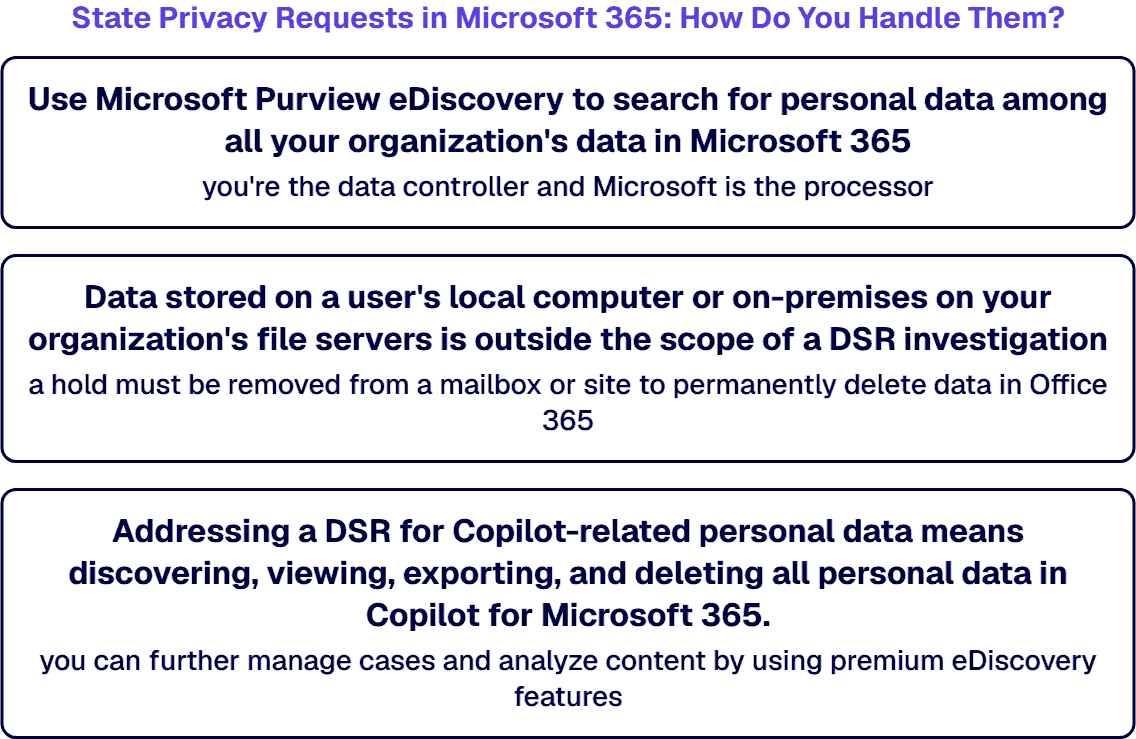
The same guide marks three limits a runbook has to carry. The first is scope: “Data stored on a user’s local computer or on-premises on your organization’s file servers is outside the scope of a DSR investigation for data stored in Office 365.” The second is holds: “If your organization has a requirement or policy that data be permanently deleted and unrecoverable in Office 365 in response to DSR, then a hold must be removed from a mailbox or site to permanently delete data in Office 365.” The third is Copilot: “Addressing a DSR for Copilot-related personal data means discovering, viewing, exporting, and deleting all personal data in Copilot for Microsoft 365.”
On licensing, Learn about eDiscovery (last updated June 29, 2026) says: “If your organization has an Office 365 E5 or Microsoft 365 E5 subscription (or related E5 add-on subscriptions), you can further manage cases and analyze content by using premium eDiscovery features.” Which eDiscovery tier the enterprise needs is a separate decision this guide does not make.
The planning rule for this section is about people, not features: name who on the IT Director’s team runs the search, who reviews the results, who approves an export or a deletion with the privacy officer, who speaks for any legal hold that stands in the way with counsel, and where the record of each response is kept.
The tempting reading is that Privacy Risk Management replaced Subject Rights Requests, and nothing in Microsoft’s documentation says so. Learn about privacy risk management (last updated May 11, 2026) says “Privacy Risk Management policies are meant to be internal guides” and lists what its policies do for an organization:
That is useful work before a request arrives: this guide’s reading is that less overexposed, transferred or unused personal data means less for a request search to find and review. It is not a request-handling workflow, it evaluates only data inside Microsoft 365, and the Microsoft Priva service description says it must be added on. Federal and government-cloud buyers should read two footnotes in the same service description’s feature table: “Preview features not available for GOV or EDU.” and, on its personal data insights row, “Features not available for GOV.”
Some requests arrive framed as a Priva Subject Rights Requests tooling problem when the decision behind them is a different one.
When an outside firm designs the request process, or your own team does, the same requests separate a plan the privacy officer can defend from a slide.
When a regulated enterprise takes this on, it needs a project with an end date: the Microsoft 365 data map, the eDiscovery request runbook with its roles tested, and Purview and Privacy Risk Management configuration where the enterprise has chosen them, handed over to the internal team, with embedded specialists where the team needs more hands for a period. i3solutions maps governance to named control families, enforces it in the platform through Entra ID, Purview, and Azure Policy, and evidences it continuously rather than reconstructing it at audit. i3solutions has been a Microsoft Partner with 30 years of enterprise technology delivery experience and has delivered 1,500+ Microsoft engagements across aerospace and defense, financial services, and health sciences. The people who do the work are senior and based in the US. An i3solutions project engagement does not by itself include ongoing support of what it delivers, which i3solutions scopes separately as Application Managed Services, and it is not a replacement for the internal team, open-ended scope expansion, or vendor lock-in. For a team whose eDiscovery is not yet ready to carry request handling, the starting point is Microsoft Purview readiness services. This work sits within i3solutions’ enterprise governance and compliance solutions.
The planning consequence is simple to state: a runbook written around Priva Subject Rights Requests needs a new owner and a new tool named before the next request arrives, not after it.
Not in Microsoft’s current documentation. As read on September 24, 2026, the Microsoft Priva service description lists Privacy Risk Management only, and Microsoft Learn redirects the old Subject Rights Requests pages to Learn about eDiscovery and to Office 365 Data Subject Requests for the GDPR and CCPA. The Microsoft pages read for this answer give no date for the change, so it states none; if a Microsoft message or contract gives your tenant a different path, that governs.
Microsoft Priva now documents Privacy Risk Management, which Microsoft’s Learn about Microsoft Priva page describes as providing visibility into your organization’s data from the Microsoft Priva portal. Its policies can detect overexposed personal data, limit transfers of personal data across departments or regional borders, and reduce unused personal data; it evaluates only data within Microsoft 365, and the service description says it must be added on.
California Civil Code section 1798.145(e) says the title does not apply to personal information collected, processed, sold, or disclosed subject to the Gramm-Leach-Bliley Act and its implementing regulations, and that the subdivision does not apply to Section 1798.150. The carve-out is written around that data, not around the institution, so an institution’s employee, applicant and marketing data are not named by it. Whether a particular institution or data set falls inside it is a determination for counsel.
The employee exemption in subdivision (m) is no longer in effect (the quick answer above gives the date, citing the California Privacy Protection Agency’s Frequently Asked Questions), and the California Privacy Protection Agency’s FAQ says the California residents with privacy rights under the CCPA include employees and job applicants. Whether a given hospital’s employee data is in scope is a determination for counsel.
The California Civil Code sets the response deadline from receipt of a verifiable consumer request, and allows one extension when reasonably necessary if the consumer is told within the first period. The quick answer above gives both periods with the Civil Code source.
Yes, for data in Microsoft 365. Microsoft’s guide Office 365 Data Subject Requests for the GDPR and CCPA tells administrators to use Microsoft Purview eDiscovery to search for personal data across the organization’s Microsoft 365 data, or to go to the native application where the data was created, and it says data on a user’s local computer or on on-premises file servers is outside the scope of that investigation.
By Michael Branson
When an SSP review reaches the cryptography requirement, it can start with one line: the system security plan’s entry for the cryptography requirement cites a FIPS 140-2 attestation from an earlier assessment, and someone now asks whether that line still holds after the move to the Historical List. Two bad answers circulate: replace every FIPS 140-2 module at once, or leave it all to Microsoft. NIST’s text supports neither.
This guide follows NIST’s own wording on what the move to the Historical List changed, separates existing systems from new ones, sets the two revisions of the cryptography requirement side by side, and shows how to find the certificate behind each Microsoft module your CUI relies on. If the Microsoft 365 cloud for your CUI is still undecided, settle that first: the Microsoft 365 cloud comparison for CUI covers that choice.
If your review started from a vendor email about the FIPS 140-2 transition, the dates it names have passed. NIST’s Cryptographic Module Validation Program (CMVP) page, as read on October 19, 2026, reads: “Modules validated as conforming to FIPS 140-2 can continue to be accepted by the Federal agencies of both countries for the protection of controlled unclassified information (United States) or Designated Information (Canada)”.
The same page’s schedule row for the FIPS 140-2 transition reads “FIPS 140-2 active modules can be used until this date for new systems.” and “After this date, FIPS 140-2 validation certificates will be moved to the Historical List.”
In plain terms, NIST accepted FIPS 140-2 modules for new systems during its transition period, and after that its schedule moves FIPS 140-2 certificates to the Historical List. On the CMVP database, the certificate for one Microsoft FIPS 140-2 module, the Cryptographic Primitives Library, showed the status Historical with the reason “Moved to historical list due to sunsetting” and the notice “The referenced cryptographic module should not be included by Federal Agencies in new procurements.”
NIST’s program page still used its earlier future tense (“will place”, “will be moved”) when read on October 19, 2026; the quotations on this page keep NIST’s words exactly as NIST wrote them.
The replacement standard is not new. NIST’s transition page says that “On March 22, 2019, the Secretary of Commerce approved” FIPS 140-3, which “supersedes FIPS 140-2”, and that it “became effective September 22, 2019”. As published by NIST for FIPS 140-3 certificates: “Upon validation, modules will be placed on the Active list for 5 years (or 2 years for Interim Validations) and may be used for new and existing systems.”
The wrong move, and an expensive one, is treating the Historical List as a removal order. NIST’s program page reads: “After that time CMVP will place the FIPS 140-2 validated modules on the Historical list, allowing agencies to continue using these modules for existing systems only.” It adds: “Agencies should continue to make use of FIPS 140-2 modules until replacement FIPS 140-3 modules become available.”
NIST’s Validated Modules page draws the same line: “If a validation certificate is marked as historical, Federal Agencies should not include these in new systems but can be procured for legacy systems.” Its transition page reads: “Even on the historical list, CMVP supports the purchase and use of these modules for existing systems.” And the Validated Modules page leaves the call on an existing system to the agency: “Agencies may make a risk determination on whether to continue using the modules on the Historical list based on their own assessment of where and how the module is used.”
Historical is not revoked. NIST’s Validated Modules page says that a Historical designation does not mean the certificates for these modules have been revoked. Microsoft’s Federal Information Processing Standard (FIPS) 140 page, last updated June 12, 2023, says the same: “When a FIPS 140 certificate gets moved to the historical list, it doesn’t mean that the certificate has been revoked.” and “The validation is still there; however, US federal agencies are advised not to include the corresponding crypto modules in new procurements.”
Revoked is a different status with a different consequence. NIST’s program page reads: “Should the cryptographic module be revoked, use of that module is no longer permitted.” One more rule catches modules that depend on each other. NIST’s Validated Modules page reads: “The movement to the Historical list of the binding module will coincide with the sunset date of the bound module, regardless of its own sunset date.”
The planning rules that follow from NIST’s text:
If your SSP’s cryptography line was written from memory, it may quote the wrong revision, because the wording changed between revisions. NIST SP 800-171 Rev. 2 reads: “3.13.11 Employ FIPS-validated cryptography when used to protect the confidentiality of CUI.” NIST’s page for that revision now reads “Withdrawn on May 14, 2024. Superseded by SP 800-171 Rev. 3”.
Which text binds your system is set by the contract, not by this page. DFARS 252.204-7012, in the clause dated “SAFEGUARDING COVERED DEFENSE INFORMATION AND CYBER INCIDENT REPORTING (MAY 2024)”, subjects the covered contractor information system, subject to the exceptions in its paragraph (b)(2)(ii), to the SP 800-171 “in effect at the time the solicitation is issued or as authorized by the Contracting Officer.” Confirm the revision with the contracting officer before you rewrite the SSP line. If the contract carries a CMMC Level 2 requirement, 32 CFR 170.14(c)(3) reads “The security requirements in CMMC Level 2 are identical to the requirements in NIST SP 800-171 R2.” and the CMMC scoring methodology at 32 CFR 170.24 reads “FIPS-validated encryption (CMMC Level 2 security requirement SC.L2-3.13.11) is required to protect the confidentiality of CUI.”
Either way, NIST’s program page explains why validation carries weight: “In essence, if cryptography is required, then it must be validated.” and “Non-validated cryptography is viewed as providing no protection to the information or data”. Which Office 365 subscription can carry the rest of the requirement set is a separate question, covered on the Office 365 CMMC compliance page.
An SSP that says “FIPS” without saying which of three claims it means fails the first follow-up question. Microsoft’s Federal Information Processing Standard (FIPS) Publication 140-2 page defines the validated and compliant claims.
The third claim is the mode the module runs in. The same Microsoft page says: “To comply with FIPS 140-2, your system must be configured to run in a FIPS approved mode of operation, which includes ensuring that a cryptographic module uses only FIPS-approved algorithms.” Microsoft’s Windows FIPS 140 validation page, last updated September 2, 2026, adds: “To use Windows and Windows Server in a FIPS 140 approved mode of operation, all the specific configuration and security rules outlined in the module Security Policy documents must be followed.”
Keep FIPS 199 and FIPS 140 apart while editing. FIPS 199 is a security categorization standard, not a cryptographic module standard. Microsoft’s Office 365 GCC High and DoD service description says the environment “Is assessed using the National Institute of Standards and Technology (NIST) Special Publication 800-53 controls at a FIPS 199 High Categorization.” That sentence says nothing about FIPS 140.
The planning rule: every SSP line that says “FIPS-validated” names a module, its certificate number, its status on the date you read it, and the mode it runs in.
The SSP cannot cite a certificate for the cloud as a whole, and Microsoft says so. Microsoft’s Federal Information Processing Standard (FIPS) 140 page says: “While the current CMVP FIPS 140 implementation guidance precludes a FIPS 140 validation for a cloud service, cloud service providers can obtain and operate FIPS 140 validated cryptographic modules for the computing elements that comprise their cloud services.”
So the evidence is per module and per release. Microsoft’s FIPS 140 validated modules in Windows Server 2022 page, last updated September 8, 2026, lists “Windows Server 2022 Build: 10.0.20348.1668.” with CMVP certificates #5404 to #5410, and Microsoft’s FIPS 140 validated modules for Windows 11 page lists the same range for “Windows 11, version 22H2 Build: 10.0.22621.1.” When read on the CMVP database on October 19, 2026, each certificate in that range showed the standard FIPS 140-3 and the status Active, with a sunset date in August 2031. That range is an example of the method, not a list of every Microsoft certificate; the Windows Server 2022 page also lists an earlier build with its own certificates, so match the build you run.
When a certificate you rely on has gone historical, Microsoft’s Federal Information Processing Standard (FIPS) 140 page says: “You should review the publicly available Modules in Process List to check the status of Microsoft submissions if the Windows FIPS 140 certificate of interest has been moved to historical status.”
Microsoft’s Federal Information Processing Standard (FIPS) Publication 140-2 page still says “Microsoft online services that include components that are FIPS 140-2 validated include, among others:” and lists Azure and Azure Government, Dynamics 365 and Dynamics 365 Government, and Office 365, Office 365 U.S. Government, and Office 365 U.S. Government Defense. That is a FIPS 140-2 statement, not a statement of FIPS 140-3 coverage. No Microsoft page read for this guide names which FIPS 140-3 certificates cover Microsoft 365 GCC High, Microsoft 365 DoD or Azure Government as a whole service, so ask Microsoft for the module list behind the services your CUI uses rather than assuming one.
Keys are the second place to look. Microsoft’s About keys page, last updated July 30, 2026, says: “Two HSM platforms are available: HSM Platform 1 protects key versions with FIPS 140-2 Level 2, and HSM Platform 2 protects key versions with FIPS 140-3 Level 3 HSMs.” It adds “HSM Platform 2 now protects all new keys and key versions.” and “To determine which HSM platform protects a key version, get its hsmPlatform attribute.” The same page’s compliance table lists software-protected keys (HSM Platform 0) in vaults at FIPS 140-2 Level 1. Microsoft’s What is Azure Key Vault Managed HSM? page, last updated October 14, 2026, says: “We have updated our HSM fleet to a FIPS 140-3 level 3 validated firmware for both Azure Key Vault Managed HSM and Azure Key Vault Premium.” These are validation facts for the SSP, not a recommendation of any key custody model.
Export-controlled data has its own text. As published in the eCFR, the ITAR definition at 22 CFR 120.54(a)(5)(iii) names FIPS 140-2 “or its successors”, and the ITAR export-control compliance program page covers the program that sits around it.
An SSP refresh after the move to the Historical List is a short list of edits, each tied to a NIST or Microsoft statement quoted on this page.
If a FIPS 140-2 module sits in an existing system with no FIPS 140-3 replacement yet, the honest counter-case is to leave it where it is for now.
Whoever prepares your evidence, the deliverables are checkable. Ask for:
When this evidence work sits inside your Microsoft estate, it is i3solutions work. i3solutions delivers the Microsoft implementation and evidence with senior, U.S.-based engineers; CUI stays on U.S. soil.
i3solutions runs migrations against named control families across CMMC, HIPAA, SOC 2, and NIST 800-171, producing artifacts auditors can review. i3solutions plans and runs GCC High migrations for regulated defense organizations, including security baseline configuration, and coordinates licensing with the customer’s AOS-G supplier rather than provisioning the tenant itself.
The i3solutions Federal Compliance Assessment evaluates a client tenant against NIST SP 800-53 and CMMC using automated tenant configuration scripts and a 42-point security checklist. i3solutions advises clients on federal compliance posture as its own assessment rather than as a restatement of Microsoft’s documentation, including whether SharePoint Online meets NIST 800-53, whether Azure Government is required under the DoD Cloud Computing SRG, and whether a CMMC gap assessment is needed to bid.
i3solutions is not a C3PAO and does not grant certification. An i3solutions project engagement does not by itself include ongoing support of what it delivers, which i3solutions scopes separately as Application Managed Services, and it is not a replacement for the internal team, open-ended scope expansion, or vendor lock-in. i3solutions does not run a customer’s key management or cryptographic operations as an ongoing managed service.
The service behind this work is CMMC technology readiness services, within the wider practice described on the governance and compliance solutions page.
In existing systems, yes; NIST says not to include them in new systems. NIST’s Validated Modules page reads “If a validation certificate is marked as historical, Federal Agencies should not include these in new systems but can be procured for legacy systems.” and NIST’s transition page reads “Even on the historical list, CMVP supports the purchase and use of these modules for existing systems.”
No. According to NIST’s Validated Modules page, a Historical designation does not mean the certificates for these modules have been revoked. Revocation is different: “Should the cryptographic module be revoked, use of that module is no longer permitted.”
Not as a whole service, by Microsoft’s own description. Microsoft Learn says “While the current CMVP FIPS 140 implementation guidance precludes a FIPS 140 validation for a cloud service, cloud service providers can obtain and operate FIPS 140 validated cryptographic modules for the computing elements that comprise their cloud services.” Microsoft’s FIPS 140-2 page, last updated June 2, 2026, lists Office 365 U.S. Government Defense among online services that “include components that are FIPS 140-2 validated”, which is a FIPS 140-2 statement.
The earlier revision reads “Employ FIPS-validated cryptography when used to protect the confidentiality of CUI.” The later revision reads “Cryptographic Protection Implement the following types of cryptography to protect the confidentiality of CUI:” and the organization defines which types of cryptography apply; its discussion says “FIPS-validated cryptography is recommended for the protection of CUI.” DFARS 252.204-7012 binds the SP 800-171 “in effect at the time the solicitation is issued or as authorized by the Contracting Officer.” For CMMC Level 2, 32 CFR 170.24 reads “FIPS-validated encryption (CMMC Level 2 security requirement SC.L2-3.13.11) is required to protect the confidentiality of CUI.”
Read the key version’s hsmPlatform attribute. Microsoft Learn’s About keys page explains that there are two HSM platforms, an older one that protects key versions with FIPS 140-2 Level 2 and a newer one that protects key versions with FIPS 140-3 Level 3 HSMs. It adds that the newer platform now protects all new keys and key versions, and that the hsmPlatform attribute of a key version shows which platform protects it.
Michael Branson
As of October 2026, the Justice Department’s Title II rule at § 35.200 Requirements for web and mobile accessibility requires a public entity with a total population of 50,000 or more, other than a special district government, to bring the web content and mobile apps it provides to WCAG 2.1 Level AA by April 26, 2027, and a public entity under 50,000 or any special district government to do so by April 26, 2028, and ADA.gov’s State and Local Governments: First Steps Toward Complying with the Americans with Disabilities Act Title II Web and Mobile Application Accessibility Rule gives a utility district as an example of a special district government. In a Microsoft estate that reaches the public SharePoint pages, Power Pages portals, Power Apps and posted PDF, Word, PowerPoint and Excel files the public uses, subject to the five exceptions in § 35.201 Exceptions (archived web content, preexisting documents no longer used to reach a service, content posted by an unaffiliated third party, individualized secured documents, and preexisting social media posts), and the third-party exception does not cover content a vendor or contractor posts for the entity. Microsoft’s Accessibility in Power Pages article says “Power Pages conforms to the WCAG 2.2 accessibility standard” and, in the same article, “When you customize your Power Pages site, you’re responsible for meeting accessibility standards”, and its Web Content Accessibility Guidelines page says “Your organization is wholly responsible for ensuring compliance with all applicable laws and regulations”, so the templates, forms, apps and documents the entity built are its own remediation list, and which date and which exceptions apply to a given entity is its counsel’s determination.
If you keep only a few points, these summarize the rule text at § 35.200 Requirements for web and mobile accessibility and the sources cited throughout this guide:
The ADA coordinator’s email asks IT two things: which Title II date applies to the utility, and the number of documents in the SharePoint libraries that have to be fixed before it. The extension the Justice Department granted this year bought time, and much of it has been used. You suspect the public website is the easy part. The hard part is the document estate: rate schedules, service and outage forms, board packets, patient forms and billing notices posted as PDF, Word and PowerPoint files, a Power Pages portal where customers or patients sign in, and a few Power Apps the public uses. Go wrong one way and the team leans on the exceptions and on Microsoft’s platform statements, the date passes, and a complaint lands on a bill-pay form or a portal page the team customized. Go wrong the other way and the budget goes to remediating every file ever posted, including archived and individualized documents the rule excepts, and runs out before the portal and the forms are fixed.
This guide describes how the rule and the Justice Department’s own guidance are structured, and what Microsoft’s documentation does and does not cover. Whether a given entity is covered, which date applies and whether a document qualifies for an exception are determinations for the entity’s counsel and ADA coordinator.
Before your budget is set, the first question is which date the entity answers to, and the rule splits on population and on the form of the entity, not on the number of people it employs. Under § 35.200 Requirements for web and mobile accessibility, “Beginning April 26, 2027, a public entity, other than a special district government, with a total population of 50,000 or more shall ensure that the web content and mobile apps that the public entity provides or makes available, directly or through contractual, licensing, or other arrangements, comply with Level A and Level AA success criteria and conformance requirements specified in WCAG 2.1”, and the same sentence continues with a condition for an entity that can demonstrate that compliance would result in a fundamental alteration of a service, program or activity or in undue financial and administrative burdens. The next paragraph of the section reads “Beginning April 26, 2028, a public entity with a total population of less than 50,000 or any public entity that is a special district government shall ensure” the same standard, under the same condition.
Those are not the dates the rule first carried. The Justice Department’s interim final rule, Extension of Compliance Dates for Nondiscrimination on the Basis of Disability; Accessibility of Web Information and Services of State and Local Government Entities (91 FR 20902, April 20, 2026), states “The compliance date for State and local government entities with a total population of 50,000 or more is extended from April 24, 2026, to April 26, 2027.” It also said “The Department invites public comment on the updated compliance dates included in this IFR.” and the comment period closed on June 22, 2026. The same document says “While this IFR is limited to extending the 2024 final rule’s compliance dates, the Department plans to engage in future rulemaking processes related to the substantive requirements of the 2024 final rule.” As of October 2026, the Federal Register lists no later Justice Department document amending, delaying or rescinding the rule, and the dates quoted from § 35.200 are the ones in the Code of Federal Regulations.
ADA.gov’s guidance names the kinds of entity the rule reaches without deciding any particular one. Its Fact Sheet: New Rule on the Accessibility of Web Content and Mobile Apps Provided by State and Local Governments lists public hospitals and public healthcare clinics among its examples of state and local government entities, and its first-steps guide says a special district government “Might be, for example, a mosquito abatement district, utility district, transit authority, water and sewer board, zoning district, or other similar state or local government entity that has a specific function.” Under § 35.104 Definitions, a public entity includes any department, agency, special purpose district or other instrumentality of a state or local government, and a special district government is a public entity, other than a county, municipality, township or independent school district, that state law authorizes to provide one function or a limited number of functions, with enough administrative and fiscal autonomy to be a separate government, and whose population the Census Bureau does not calculate. A department of a city or county is part of that government; a special district government is on the April 26, 2028 date whatever its size. Headcount does not move either answer, and the first-steps guide’s own example says “The number of employees does not determine the parks and recreation department’s population for the rule.”
Two neighboring rules are separate questions from the Title II rule and its § 35.104 Definitions. A public hospital that receives financial assistance from the Department of Health and Human Services may also answer to Section 504, a separate HHS rule with its own dates that this guide does not cover. Federal agencies answer to Section 508 under a different standard; this guide covers state and local public entities. Whether an organization is a public entity at all, what its total population is, and whether it is a special district government are determinations for its counsel, not for this guide.
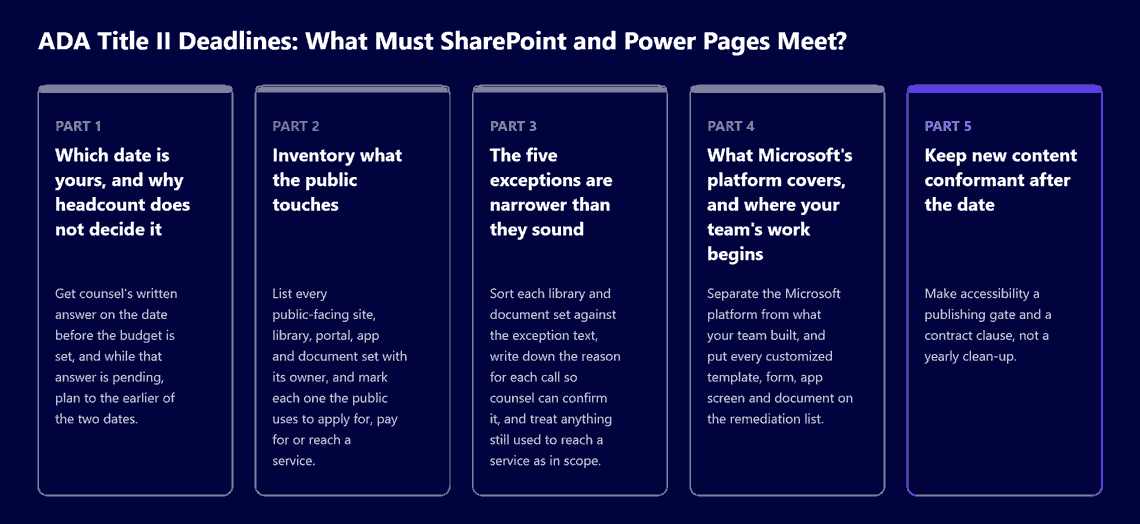
Get counsel’s written answer on the date before the budget is set, and while that answer is pending, plan to the earlier of the two dates.
Remediation budgets go wrong first at the inventory, because the rule reaches more than the site the communications team maintains. § 35.200 Requirements for web and mobile accessibility applies to the web content and mobile apps a public entity “provides or makes available, directly or through contractual, licensing, or other arrangements”, and ADA.gov’s State and Local Governments: First Steps Toward Complying with the Americans with Disabilities Act Title II Web and Mobile Application Accessibility Rule says “Your public entity needs to make sure that any content or mobile apps a vendor or contractor provides or posts on its behalf complies with WCAG 2.1 Level AA.” That guide’s own first steps run in this order:
In a Microsoft estate, that inventory is a planning list the entity builds, not a list the Justice Department wrote:
An inventory of this kind can run long. i3solutions assessment engagements routinely find 20 to 40 percent more SharePoint sites during Phase 1 than the client internal inventory lists. That finding is about SharePoint site inventories in general, not about accessibility; it is a reason to build the list from the tenant rather than from memory.
Leave the employee intranet off this list until counsel rules on it. The rule’s text and ADA.gov’s guidance speak to web content and mobile apps an entity provides or makes available; whether an employee-only intranet falls under this rule is not stated there, and is a question for counsel.
List every public-facing site, library, portal, app and document set with its owner, and mark each one the public uses to apply for, pay for or reach a service.
If your remediation budget is misread anywhere, it is at the exceptions, in both directions. § 35.201 Exceptions sets out five kinds of content the requirements do not reach:
Archived content has to meet all four conditions in § 35.104 Definitions: it was created before the entity’s compliance date, or reproduces paper documents or other physical media created before it; it is kept only for reference, research or recordkeeping; it is not altered or updated after it is archived; and it is kept in a dedicated area clearly identified as archived. ADA.gov’s first-steps guide is direct about the label: “Just putting content into an archive isn’t enough to make the content qualify for this exception.”
A second condition can decide the status of a SharePoint library that holds older documents. § 35.201 Exceptions excepts “Conventional electronic documents that are available as part of a public entity’s web content or mobile apps before the date the public entity is required to comply with this subpart, unless such documents are currently used to apply for, gain access to, or participate in the public entity’s services, programs, or activities.” A rate schedule posted years ago that customers still use to choose a service, or an intake form a patient still downloads, is the kind of document to put in front of counsel under that condition.
Individualized documents are excepted; the pages around them are not. ADA.gov’s Fact Sheet: New Rule on the Accessibility of Web Content and Mobile Apps Provided by State and Local Governments gives the example: “A PDF version of a water bill for a person’s home that is available in that person’s secure account on a city’s website would probably fall under the exception.” It then adds: “However, the exception does not apply to the city’s website itself.” For a public hospital, the first-steps guide says “The public hospital generally needs to make sure that its password-protected portal and any html content in it meets WCAG 2.1 Level AA.”
Third-party content is excepted only when no arrangement stands behind it. § 35.201 Exceptions reads “Content posted by a third party, unless the third party is posting due to contractual, licensing, or other arrangements with the public entity.” Social media posts are excepted only if they were posted before the entity’s compliance date.
Sort each library and document set against the exception text, write down the reason for each call so counsel can confirm it, and treat anything still used to reach a service as in scope.
When your team reads a Microsoft platform statement as a finished answer, Microsoft’s own pages say otherwise. Microsoft’s Accessibility in Power Pages article states “Power Pages conforms to the WCAG 2.2 accessibility standard.” and “The controls included in basic forms are built to follow WCAG 2.2.” The same article says “When you customize your Power Pages site, you’re responsible for meeting accessibility standards.” and “The person making the changes to the Liquid templates and Content snippets is responsible for ensuring that the content they add is accessible.” For reports embedded in a portal, it adds that “as a Power BI report and dashboard author, you should make sure your Power BI reports and dashboards are accessible.”
The rule’s standard is WCAG 2.1 Level AA. Microsoft’s statement describes the Power Pages platform; it does not say, and this guide does not say, that an entity’s customized site conforms to anything. Microsoft’s Web Content Accessibility Guidelines compliance page says “Microsoft publishes WCAG reports that reflect the complete product or service.” and “Your organization is wholly responsible for ensuring compliance with all applicable laws and regulations.”
Canvas apps draw the same line in a different place. Microsoft’s Create accessible canvas apps article says “Power Apps themes are designed to meet accessibility standards.” and then describes the maker’s side: “AccessibleLabel property defines what the screen reader will announce.” It also says “Use the Accessibility Checker to help review potential accessibility issues in your app.” and covers keyboard-only use, tab order, headings set through the Role property, captions through ClosedCaptionsUrl, and a typed alternative to a drawn signature.
For SharePoint pages, Microsoft’s support article Make your SharePoint site accessible to people with disabilities says “Headings are meant to be scanned, both visually and with assistive technology.” Its Applies To line reads SharePoint Server 2013 Enterprise, although the article also carries a tab for the modern experience, so read its checks as general practice rather than as a statement about a particular SharePoint version: built-in heading styles in web parts, alt text on images, enough contrast in section backgrounds, descriptive link text, and no tables used for layout.
The documents themselves get the same instruction. Microsoft’s Improve accessibility with the Accessibility Checker article says “Before you send an Outlook email message or share a Word document, Excel spreadsheet, PowerPoint presentation, or OneNote notebook, run the Accessibility Checker to make your content easier for people to read and edit.”
Where the public portal is built on Power Pages, the build side is described on Power Pages development services. Separate the Microsoft platform from what your team built, and put every customized template, form, app screen and document on the remediation list.
If your only evidence is a clean automated report, it is a false comfort. ADA.gov’s State and Local Governments: First Steps Toward Complying with the Americans with Disabilities Act Title II Web and Mobile Application Accessibility Rule says “You won’t be able to use automated testing tools alone, because those tools can’t test for all aspects of accessibility, so you’ll want to use some combination of automated and manual assessments.” Microsoft’s Accessibility in Power Pages article recommends its own checks for a portal:
For canvas apps, the Create accessible canvas apps article adds keyboard-only use, headings, captions and a typed alternative to a drawn signature. These are Microsoft’s recommendations for its own products; none of them is a conformance test for the rule.
Fix in the order the public depends on the content: first the forms, portal pages and documents people use to apply for, pay for or reach a service, such as bill pay, starting and stopping service, outage reporting, patient intake and patient billing; then the highest-traffic pages; then the rest of the library content.
After the date passes, a remediation push with no publishing control behind it starts to slip with the next posting. ADA.gov’s Fact Sheet: New Rule on the Accessibility of Web Content and Mobile Apps Provided by State and Local Governments says “After this time, state and local governments must continue to make sure their web content and mobile apps meet WCAG 2.1, Level AA.”
A publishing step closes that gap. In SharePoint, a library that feeds the public site can route new documents through an approval flow in Power Automate, with the author running the Accessibility Checker in Word, Excel or PowerPoint before submitting and an owner reviewing before the file reaches the public library. Canvas apps get the same treatment with the Power Apps Accessibility Checker before each publish. This is a design for the entity to adopt, described in this guide as planning.
Contracts carry the rest. Content a vendor or contractor posts for the entity is the entity’s to answer for, as the first-steps guide says, so the requirement belongs in the contract. Where content cannot be made accessible directly, § 35.202 Conforming alternate versions allows a conforming alternate version “only where it is not possible to make web content directly accessible due to technical or legal limitations.”
Make accessibility a publishing gate and a contract clause, not a yearly clean-up.
If your team hopes to plan around the rule’s safety valves, the text makes each one a decision the entity has to prove. Each date in § 35.200 Requirements for web and mobile accessibility carries its fundamental-alteration and undue-burden condition, and § 35.204 Duties says that decision is made by the head of the public entity or a designee after considering all resources available, and “must be accompanied by a written statement of the reasons for reaching that conclusion.” Even then, the entity takes any other action that avoids the alteration or burden while still giving people with disabilities the benefits or services to the maximum extent possible.
§ 35.205 Effect of noncompliance that has a minimal impact on access treats an entity as meeting the requirements only “in the limited circumstance in which the public entity can demonstrate that the noncompliance has such a minimal impact on access” that people with disabilities can still get the same information, interactions, transactions and services with substantially equivalent timeliness, privacy, independence and ease of use. Whether either provision applies is counsel’s call.
Do not build the budget around these provisions.
Some readers arrive with a different question, and this guide would mislead them if they read on. It follows the definitions in § 35.104 Definitions, and it does not fit these cases:
Whether your team does the work or brings in an outside team, hold it to the same evidence, set against the rule’s text in § 35.201 Exceptions and ADA.gov’s guidance:
i3solutions designs and builds Power Pages sites with senior, US-based engineers and the table-permission, web-role, and governance model an external site requires. i3solutions builds secure external Power Pages portals for regulated enterprises, owning authentication, role-based access, data protection, and audit evidence rather than handing over a template. On this rule, the work is a project, with specialists embedded in your team where it needs them: inventorying the public SharePoint, Power Pages and Power Apps estate, building and reworking the Microsoft-side templates, forms and apps the entity is responsible for, and setting up the publishing path that routes documents through the Accessibility Checker. An i3solutions SharePoint consulting engagement produces named deliverables: a governance documentation package, architecture artifacts, and runbooks. The determinations stay with the entity: whether it is covered, which date applies, which exceptions hold and whether its content meets the standard are for its counsel and ADA coordinator. i3solutions has been a Microsoft Partner with 30 years of enterprise technology delivery experience and has delivered 1,500+ Microsoft engagements across aerospace and defense, financial services, and health sciences. Delivery is senior and US-based. Ongoing operation after the handover is a separate Application Managed Services engagement with its own scope; the accessibility remediation work itself does not replace the internal team, run open-ended, or create vendor lock-in. For how this fits a wider SharePoint program, see SharePoint development services.
According to the eCFR text of the Justice Department’s rule, “Beginning April 26, 2028, a public entity with a total population of less than 50,000 or any public entity that is a special district government shall ensure that the web content and mobile apps that the public entity provides or makes available, directly or through contractual, licensing, or other arrangements, comply with Level A and Level AA success criteria and conformance requirements specified in WCAG 2.1”. According to the Justice Department’s definitions, a department of a city or county is part of that government. Whether a particular utility is a special district government is a determination for its counsel.
Yes. According to the Justice Department’s interim final rule in the Federal Register, the compliance date for entities with a “total population of 50,000 or more is extended from April 24, 2026, to April 26, 2027”. The same Federal Register document says “The compliance date for public entities with a total population of less than 50,000, or any special district government, is extended from April 26, 2027, to April 26, 2028.” The Federal Register document says “Written comments must be submitted on or before June 22, 2026.” It also says “While this IFR is limited to extending the 2024 final rule’s compliance dates, the Department plans to engage in future rulemaking processes related to the substantive requirements of the 2024 final rule.”
Not always, and not by age alone. According to the Justice Department’s exceptions, a document posted before the entity’s compliance date is excepted unless it is currently used to apply for, gain access to, or participate in the entity’s services, programs, or activities, and archived content qualifies only if it meets all four conditions of the definition, including storage in a dedicated area clearly identified as archived. According to ADA.gov, putting content into an archive is not enough by itself. Which documents qualify is a call for counsel.
According to ADA.gov’s fact sheet, an individualized document in a person’s secure account can fall under an exception, but the website around it does not. A public hospital that receives HHS funding may also answer to a separate HHS rule with its own dates.
Not on that statement alone. According to Microsoft Learn, “Power Pages conforms to the WCAG 2.2 accessibility standard”, and the same article says that when you customize your Power Pages site, you are responsible for meeting accessibility standards. According to Microsoft Learn, the organization is “wholly responsible” for compliance with all applicable laws and regulations. According to the eCFR text of the Justice Department’s rule, web content and mobile apps must “comply with Level A and Level AA success criteria and conformance requirements specified in WCAG 2.1”, and whether a customized portal meets it is a question for testing and for counsel.
No, not alone. According to ADA.gov’s first-steps guide, automated testing tools cannot test for all aspects of accessibility, so a public entity will want some combination of automated and manual assessments. According to Microsoft Learn, Microsoft’s own recommended checks for Power Pages add testing with Narrator and zooming to 400 percent to its scans.
Michael Branson
Quick answer. As of October 2026, yes, BES Cyber System Information can be stored in a cloud service under NERC’s CIP-011-3, effective January 1, 2024, and its companion CIP-004-7, provided your information protection program identifies it, protects it with methods such as encryption and key management, and your access management program authorizes, verifies at least every 15 calendar months and revokes every individual’s provisioned access, including any access the cloud provider’s personnel have. Microsoft states that Azure and Azure Government are “suitable for registered entities deploying certain workloads subject to compliance with NERC CIP standards, including BCSI workloads”, that its NERC guidance “is directly applicable to Azure only”, and, for Microsoft 365, “If you’re interested in deploying BCSI in Office 365 (Microsoft 365), contact your Microsoft account team for assistance.” Compliance stays with you: NERC’s cloud guidance says the provider’s security roles “do not suggest or imply transference of compliance responsibilities from the Responsible Entity to a third-party”, and Microsoft says “you’re ultimately responsible for compliance with NERC CIP standards according to your own facts and circumstances.”
The question rarely arrives as a policy decision. It arrives as a request from engineering to put one-line diagrams, procedures and configuration files in SharePoint and Teams, or from a project that wants Azure for analysis work. One camp says BES Cyber System Information can never leave the building; another says the cloud provider has already settled the question. Neither answer survives an audit. NERC’s cloud guidance says CIP-011-3 and CIP-004-7 were modified “to clarify and provide a secure path towards utilization of modern” off-premises storage and analysis systems such as cloud services, with a program behind them. This guide sets out what NERC’s standards and its cloud guidance ask, what Microsoft states for Azure and for Microsoft 365, and which controls and evidence carry each requirement. Whether a given program meets a requirement is the registered entity’s determination and its auditor’s, not this guide’s.
A program written to the wrong version of the standard fails on its first read, so settle the versions before the architecture. According to NERC’s version history for its successor standard, the CIP-011-3 entry lists an effective date of 1/1/2024. NERC’s version histories show CIP-004-7 and CIP-011-3 adopted by the NERC Board of Trustees on 8/12/21 and each approved in one FERC order dated 12/7/21, Docket No. RD21-6-000; the CIP-004-7 row reads “FERC Order issued approving CIP-004-7” and its purpose line reads “Revised to enhance BES reliability for entities to manage their BCSI.”
Both standards came through one implementation plan. NERC’s Implementation Plan, Project 2019-02 BES Cyber System Information Access Management gives each the same rule: “the standard shall become effective on the first day of the first calendar quarter that is twenty-four (24) months after the effective date of the applicable governmental authority’s order approving the standard”. CIP-004-7 itself says “Effective Dates: See Implementation Plan for CIP-004-7.”
Successors are already approved. According to NERC’s version history in CIP-011-4.1, a FERC order approving CIP-011-4.1 was issued on March 19, 2026, Docket No. RM24-8-000. NERC’s Implementation Plan, Project 2016-02 Modifications to CIP Standards lists CIP-004-7 and CIP-011-3 among the standards requested for retirement and says the revised standards “shall become effective on the later of: (1) April 1, 2026; or (2) the first day of the first calendar quarter that is twenty-four (24) months after the effective date of the applicable governmental authority’s order approving the Revised CIP Standards and Definitions”. According to NERC, the information protection and access management wording in CIP-011-4.1 and CIP-004-8 carries forward, with Shared Cyber Infrastructure (SCI) added to the systems each part applies to.
Write the program to CIP-011-3 and CIP-004-7 now, and take the successors’ effective date from NERC’s standard pages for your jurisdiction rather than computing it, because the BCSI obligations carry forward either way.
The failure to avoid is moving files first and deciding afterward which of them were BCSI. NERC’s CIP-011-3 Requirement R1 opens: “Each Responsible Entity shall implement one or more documented information protection program(s) for BES Cyber System Information (BCSI)”. Its Part 1.1 asks for “Method(s) to identify BCSI.” and NERC’s measures for that part still include “Storage locations identified for housing BCSI in the entity’s information protection program.”
NERC’s Usage of Cloud Solutions for BES Cyber System Information (BCSI) guidance, dated June 21, 2023, turns that into cloud examples. A designated location can be “a specific site or folder within an application that has been designated as a BCSI repository.” Its other examples include “File-level tagging via metadata or labels” and “Application-level whereby the entire application has been designated as a BCSI storage location”. In Microsoft 365 terms, that is a designated SharePoint site or Teams team, a sensitivity label, or both.
Part 1.2 of NERC’s CIP-011-3 asks for “Method(s) to protect and securely handle BCSI to mitigate risks of compromising confidentiality.” Its measures list, as examples of evidence for off-premise BCSI, “Implementation of electronic technical method(s) to protect electronic BCSI (e.g., data masking, encryption, hashing, tokenization, cipher, electronic key management)” and “Implementation of administrative method(s) to protect BCSI (e.g., vendor service risk assessments, business agreements).” Encryption is one listed technical example, beside administrative methods; the program chooses and documents the mix.
Two Microsoft 365 controls map to the encryption and key-management examples. Microsoft’s Overview of Service encryption with Microsoft Purview Customer Key says “Customer Key helps you meet compliance or regulatory requirements by letting you control the root encryption keys at the application level.” and that its coverage “includes data from Microsoft Exchange, SharePoint, OneDrive, Teams, and Windows 365 Cloud PCs (Enterprise)”. Microsoft’s What is Double Key Encryption (DKE)? says “It uses two keys to protect data; one key in your control and a second key you store securely in Microsoft Azure.” and “Viewing data protected with Double Key Encryption requires access to both keys.”
NERC’s guidance also lists “Technical tools that prevent BCSI from being transmitted in clear text outside of an encrypted container” as a technical method. Data loss prevention policies do that job in Microsoft 365; tuning them so they block BCSI without flooding users is a separate piece of work.
Designate the BCSI locations and labels before migration, not after, so the first file that lands already sits inside the program.
Once BCSI sits encrypted in a cloud service, the next question an auditor asks is who can use the key. According to NERC’s cloud guidance, its evidence examples for CIP-011-3 Part 1.2 name four key arrangements and what each needs:
Microsoft’s Azure Government page for NERC, NERC CIP standards and cloud computing, last updated May 2023, says “You can use customer-managed keys (CMK) with Azure Key Vault to have sole control over encryption keys stored in HSMs.” Microsoft’s What is Azure Key Vault Managed HSM? says “Azure Key Vault Managed HSM (Hardware Security Module) is a fully managed, highly available, single-tenant, standards-compliant cloud service that enables you to safeguard cryptographic keys for your cloud applications, using FIPS 140-3 Level 3 validated HSMs.”
Customer-held keys do not mean the service stops processing the data. The Customer Key overview says “You explicitly authorize Microsoft 365 to use your encryption keys to deliver value-added services like eDiscovery, anti-malware, anti-spam, and search indexing.” That authorization belongs in the information protection program as a recorded decision. Double Key Encryption is the Microsoft 365 option where viewing content needs a key you hold.
The same Azure Government page says “Azure Government provides an extra layer of protection to registered entities through contractual commitments regarding storage of customer data in the United States and limiting potential access to systems processing customer data to screened US persons.” What a move from Azure commercial to Azure Government involves is covered in Azure Government migration.
Pick the key arrangement per BCSI location and write down who can use each key, because NERC’s CIP-004-7 lists encryption keys among the forms of provisioned access.
The access list an auditor reads is longer than the membership of your SharePoint site. NERC’s CIP-004-7 Requirement R6 says “To be considered access to BCSI in the context of this requirement, an individual has both the ability to obtain and use BCSI.” It continues: “Provisioned access is to be considered the result of the specific actions taken to provide an individual(s) the means to access BCSI (e.g., may include physical keys or access cards, user accounts and associated rights and privileges, encryption keys).”
NERC’s cloud guidance says “If CSP personnel has access to BCSI in the Overlay and/or the Underlay, then this should be accounted for and addressed by the Responsible Entity’s Information Protection Program.” It names access paths to identify, including “eDiscovery tools typically utilized by legal staff”, “Administrator roles within the cloud environment that provide access to BCSI” and “Emergency/ Break-Glass accounts that provide access to BCSI.” Which eDiscovery tier a legal team uses is its own decision; for this program, what matters is that every eDiscovery role that can search a BCSI location is on the access list.
For software services, NERC’s guidance works through three scenarios:
Customer Lockbox is Microsoft’s approval step for engineer access. Microsoft’s Microsoft Purview Customer Lockbox page says “Customer Lockbox ensures that Microsoft can’t access your content to do service operations without your explicit approval.” and “Customer Lockbox supports requests to access data in Exchange Online, SharePoint, OneDrive, Teams, and Windows 365.” For Azure, Microsoft’s Customer Lockbox for Microsoft Azure says it “provides an interface for your organization to review and approve or reject customer data access requests.” Microsoft’s NERC page adds that “Cloud service providers and third-party vendors aren’t subject to NERC CIP standards”, which is why the entity’s program has to carry the provider’s access.
List every role, tool and support path that can reach a BCSI location, and assign each one either to a CIP-004-7 R6 authorization or to the CIP-011-3 program.
Access management fails in the cloud when groups grow by copy and no one can say who approved whom. NERC’s CIP-004-7 Requirement R6 reads: “Each Responsible Entity shall implement one or more documented access management program(s) to authorize, verify, and revoke provisioned access to BCSI”. The three parts read:
NERC’s guidance says the verification should cover shared break-glass accounts, and that exception reports can serve as evidence if the entity can show the logic behind them. Among its evidence examples is “Evidence of an access review of each role and the associated individuals with provisioned access.” Microsoft’s What are access reviews? page says “User access can be reviewed regularly to make sure only the right people have continued access.” For revocation, NERC’s guidance tells entities whose cloud accounts synchronize from an on-premises directory to review the synchronization cycles against NERC’s next-calendar-day deadline, and to change break-glass passwords a terminated person may know.
Administrator access is the hardest part to keep small. Activating administrator roles only when needed, for a set time, keeps standing administrative access to BCSI locations to a short list the review can read. How i3solutions approaches identity as a governed capability is set out in identity and access management.
Make the BCSI groups the unit of review, so the periodic verification is one report, and wire termination to group removal so revocation does not wait on a ticket queue.
When the program document goes to the CIP Senior Manager, each requirement part should point to a control and to the evidence it leaves. The first column is NERC’s text; the control columns are this guide’s mapping, resting on NERC’s guidance and Microsoft’s pages cited in this guide; the evidence column names records NERC’s guidance lists as examples.
| NERC requirement part | What NERC asks | Microsoft 365 control | Azure control | Evidence the entity keeps |
|---|---|---|---|---|
| CIP-011-3 Part 1.1, identify | “Method(s) to identify BCSI.” | Designated SharePoint sites or Teams teams; sensitivity labels (“File-level tagging via metadata or labels”) | A designated subscription or resource group (“A designated container/space within a CSP-provided environment”) | The program’s list of designated BCSI locations and labels |
| CIP-011-3 Part 1.2, protect (technical) | “Method(s) to protect and securely handle BCSI to mitigate risks of compromising confidentiality.” | Customer Key for service encryption; Double Key Encryption for labeled items; data loss prevention | Customer-managed keys in Azure Key Vault or Managed HSM | Key and encryption configuration records, per location |
| CIP-011-3 Part 1.2, protect (administrative) | “Implementation of administrative method(s) to protect BCSI (e.g., vendor service risk assessments, business agreements).” | Service agreement terms and provider risk assessment | Service agreement terms and provider risk assessment | Agreements, risk assessments and third-party audit reports; NERC’s guidance names “FedRAMP Audit reports, SOC 2 Type 2 reports or similar” |
| CIP-004-7 Part 6.1, authorize | “Prior to provisioning, authorize (unless already authorized according to Part 4.1.) based on need, as determined by the Responsible Entity, except for CIP Exceptional Circumstances:” | Approval before a user is added to a BCSI group | Approval before a role assignment on a BCSI resource | Dated authorization records |
| CIP-004-7 Part 6.2, verify | According to NERC, “Verify at least once every 15 calendar months that all individuals with provisioned access to BCSI:” | Access reviews on BCSI groups | Access reviews on BCSI role assignments | Completed review records and reconciliation actions |
| CIP-004-7 Part 6.3, revoke | “by the end of the next calendar day following the effective date of the termination action.” | Group removal and account disablement tied to termination | Role removal tied to termination | Termination date, revocation record with date and time |
| Provider personnel access | “If CSP personnel has access to BCSI in the Overlay and/or the Underlay, then this should be accounted for and addressed by the Responsible Entity’s Information Protection Program.” | Customer Lockbox for Microsoft 365 | Customer Lockbox for Microsoft Azure | Customer Lockbox request and approval log, or the scenario evidence NERC’s guidance lists |
| Key custody | “Provisioned access is to be considered the result of the specific actions taken to provide an individual(s) the means to access BCSI (e.g., may include physical keys or access cards, user accounts and associated rights and privileges, encryption keys).” | Customer Key or Double Key Encryption, with named key custodians | Customer-managed keys in Azure Key Vault or Managed HSM, with named key custodians | Key access list and the detection or notification records NERC’s guidance describes |
Before BCSI moves into SharePoint, Teams or Exchange, read Microsoft’s two NERC pages for what they cover. Microsoft’s North American Electric Reliability Corporation (NERC) compliance page, last updated April 20, 2023, says “Neither Azure nor Azure Government constitutes a BES or BES Cyber Asset; however, both Azure and Azure Government are suitable for registered entities deploying certain workloads subject to compliance with NERC CIP standards, including BCSI workloads.” The same page says “Information in this article, including all referenced guidance documents, is directly applicable to Azure only.” and “If you’re interested in deploying BCSI in Office 365 (Microsoft 365), contact your Microsoft account team for assistance.”
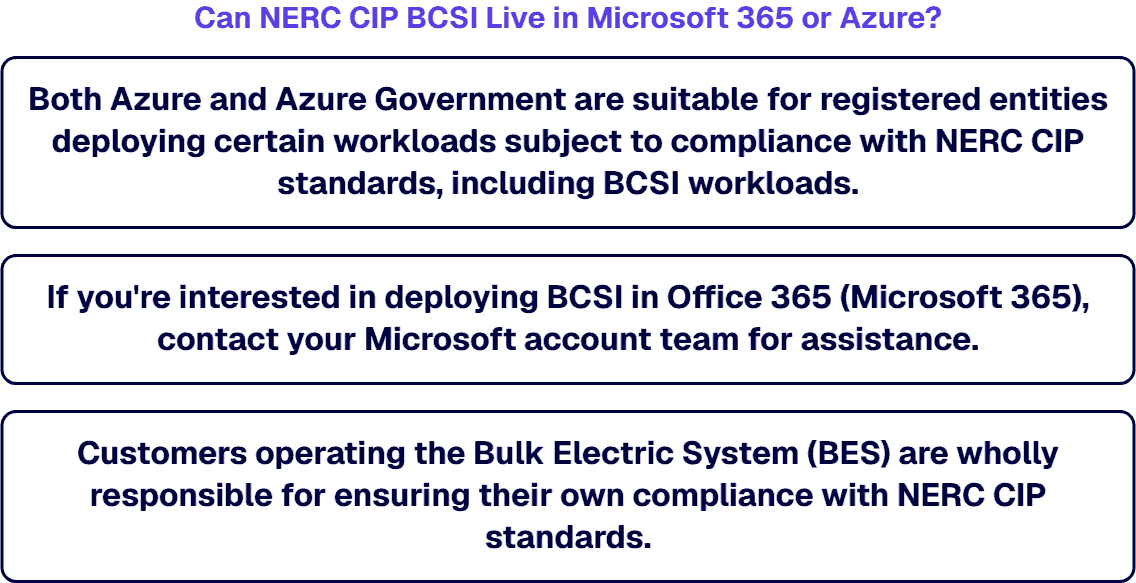
That page also says “NERC reviewed Azure control implementation details and FedRAMP audit evidence related to NERC CIP-004-6 and CIP-011-2 standards that are applicable to BCSI.” CIP-004-6 and CIP-011-2 are the versions CIP-004-7 and CIP-011-3 replaced; according to NERC, CIP-011-3 took effect on January 1, 2024. Read that review as history, not as a review of the current standards. The page also says “You can download the Cloud implementation guide for NERC audits under a non-disclosure agreement (NDA) from the Service Trust Portal (STP).”
Microsoft’s Azure Government NERC page places the design work with you: “you’re responsible for designing your applications to use end-to-end data encryption that meets NERC CIP standards requirements. Microsoft doesn’t inspect or approve your Azure applications.” It also says “Customers operating the Bulk Electric System (BES) are wholly responsible for ensuring their own compliance with NERC CIP standards.”
For Microsoft 365, NERC’s own cloud guidance is the working reference: its appendix lists “Microsoft 365 (includes apps such as SharePoint Online, Exchange Online, Teams, etc.)” as an example of software as a service, and lists Microsoft Azure under both platform and infrastructure services, while saying the list “should not be considered as an endorsement of any kind.”
Ask the Microsoft account team for the Microsoft 365 position in writing before BCSI moves into SharePoint, Teams or Exchange, and file it with the program.
Some readers should stop and answer an earlier question first.
If a BCSI program in Microsoft 365 or Azure is going to hold up, someone has to design, configure and evidence its controls. i3solutions designs platform-aligned governance for Microsoft environments with Entra ID, Purview and Azure Policy. i3solutions maps governance to named control families, enforces it in the platform through Entra ID, Purview, and Azure Policy, and evidences it continuously rather than reconstructing it at audit. i3solutions governs identity and access for regulated Microsoft estates with senior, U.S.-based engineers and leaves an audit-defensible record.
For a registered entity, that work is the control set in the requirement-to-control table: designated BCSI locations and labels, encryption and customer-held keys, Entra ID access provisioning, access reviews and revocation, Customer Lockbox, Azure Policy, and the evidence the platform produces in its audit logs and access review records. Where BCSI repositories have to move, i3solutions plans and runs governed Azure and Microsoft 365 migrations with senior, U.S.-based engineers. As a Microsoft-focused application development and integration firm, i3solutions also connects those controls to the systems around them. The work is delivered as a project by senior, US-based people, with embedded specialists inside your team where it needs them. Whether the program meets NERC’s requirements stays your determination and your auditor’s.
Microsoft 365 compliance work under other regimes is covered in Microsoft 365 compliance consulting. The wider governance practice is described in enterprise governance and compliance.
The standards allow it with a program behind it; Microsoft’s NERC guidance covers Azure only. NERC’s CIP-011-3 requires “one or more documented information protection program(s) for BES Cyber System Information (BCSI)”, and NERC’s cloud guidance lists “Microsoft 365 (includes apps such as SharePoint Online, Exchange Online, Teams, etc.)” as an example of software as a service. Microsoft says its NERC article “is directly applicable to Azure only” and “If you’re interested in deploying BCSI in Office 365 (Microsoft 365), contact your Microsoft account team for assistance.”
Encryption is one listed example, not the only method. NERC’s CIP-011-3 asks for “Method(s) to protect and securely handle BCSI to mitigate risks of compromising confidentiality.” Its measures list “Implementation of electronic technical method(s) to protect electronic BCSI (e.g., data masking, encryption, hashing, tokenization, cipher, electronic key management)” beside “Implementation of administrative method(s) to protect BCSI (e.g., vendor service risk assessments, business agreements).”
Only if they can obtain and use it, and the program must account for it either way. NERC’s CIP-004-7 says “To be considered access to BCSI in the context of this requirement, an individual has both the ability to obtain and use BCSI.” NERC’s cloud guidance says “If CSP personnel has access to BCSI in the Overlay and/or the Underlay, then this should be accounted for and addressed by the Responsible Entity’s Information Protection Program.” Microsoft says “Customer Lockbox ensures that Microsoft can’t access your content to do service operations without your explicit approval.”
CIP-004-7 and CIP-011-3, with successors approved but taking effect under NERC’s implementation plan. According to NERC’s version history, the CIP-011-3 entry lists an effective date of 1/1/2024, and CIP-004-7 was approved in the same FERC order dated 12/7/21. According to NERC’s version history, a FERC order approving CIP-011-4.1 was issued on March 19, 2026, and NERC’s implementation plan says the revised standards “shall become effective on the later of: (1) April 1, 2026; or (2) the first day of the first calendar quarter that is twenty-four (24) months after the effective date of the applicable governmental authority’s order approving the Revised CIP Standards and Definitions”.
No. Microsoft says “Cloud service providers and third-party vendors aren’t subject to NERC CIP standards” and “you’re ultimately responsible for compliance with NERC CIP standards according to your own facts and circumstances.” Its Azure Government page says “Customers operating the Bulk Electric System (BES) are wholly responsible for ensuring their own compliance with NERC CIP standards.” NERC’s cloud guidance says the provider’s security roles “do not suggest or imply transference of compliance responsibilities from the Responsible Entity to a third-party.”
Compliance has forwarded the HHS rule with a date attached and one question: are we covered? A common first answer in the room is that the portal runs on Power Pages so it must already be fine, or that someone should commission a test report. Both skip the question you have to answer, which is what your portal serves to patients and who built it. The platform your portal runs on and the pages your team or a contractor built on top of it are two different things, and the rule reaches the content patients use, whoever built it.
If compliance sent you this rule in the last few months, it is because HHS moved the dates, not the obligation. On May 11, 2026, the Federal Register published the HHS Office for Civil Rights interim final rule Extension of Compliance Dates for Nondiscrimination on the Basis of Disability; Accessibility of Web Content and Mobile Applications of Recipients of Departmental Financial Assistance, document 2026-09266. It took effect May 7, 2026, and it extends the compliance dates for the web content and mobile app accessibility requirements that HHS “adopted on May 9, 2024.”
Under Federal Register document 2026-09266, the compliance date is May 11, 2027 for recipients with 15 or more employees and May 10, 2028 for recipients with fewer than 15 employees. The rule states the new dates in two sentences: “The compliance date for recipients with fifteen (15) or more employees is extended from May 11, 2026, to May 11, 2027. The compliance date for recipients with fewer than fifteen (15) employees is extended from May 10, 2027, to May 10, 2028.” HHS issued it as an interim final rule with a request for comments, so read the dates on this page as the rule stated them and check the Federal Register for any later change before you plan against them.
HHS gives an example close to a patient portal. It writes that “a clinic with 15 employees that requires patients to schedule vaccination appointments online would have to ensure that the web content used for such scheduling conforms with the success criteria of WCAG 2.1 and can be used by a person who is blind and uses a screen reader.” Scheduling, intake and messaging flows are where your portal meets that sentence.
This page describes what the rule says and by when. Whether your organization is a covered recipient is a determination for your counsel, and the section on when this guide is the wrong starting point explains where that definition lives.
When you read the rule for scope, three sentences do the main work. The first sets what is covered: “Subpart I of the 2024 final rule set forth technical requirements for the web content and mobile apps that recipients provide or make available, directly or through contractual, licensing, or other arrangements.” Subpart I of 45 CFR Part 84 carries the title “Web, Mobile, and Kiosk Accessibility”, and the dates themselves sit in 45 CFR 84.84(b).
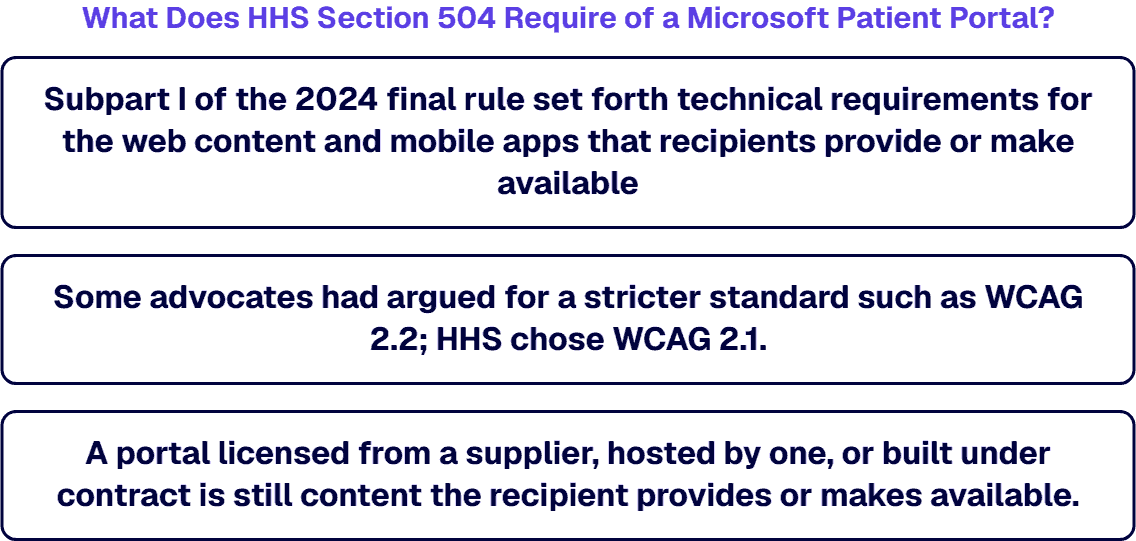
The second sets the standard. The 2024 rule “adopted the Web Content Accessibility Guidelines” at version 2.1 Level AA “as the technical standard for web content and mobile app accessibility under section 504.”
A third sentence limits the reach of the first two. The 2024 rule also included “provisions identifying circumstances when certain web content and content in mobile apps may not need to meet the technical standard.” Those provisions sit in 45 CFR 84.84 through 84.89, and this guide does not restate them. Read them before you decide that an archive, a document set or a third-party feed is in or out of your test scope.
One planning rule follows from the first sentence: the obligation follows the recipient, not the vendor. A portal licensed from a supplier, hosted by one, or built under contract is still content the recipient provides or makes available. The rule records that risk in its own summary of concerns from counties, which noted “there may be difficulty ensuring that the third party contractors, on which they rely, make counties’ web content conform to the success criteria of WCAG 2.1.” Health systems and health plans that rely on contractors for portal pages carry the same exposure.
If your portal runs on Power Pages, Microsoft has published a platform statement you can cite. Its page Accessibility in Power Pages, last updated April 22, 2025, says: “Power Pages conforms to the WCAG 2.2 accessibility standard.” The same page says “The controls included in basic forms are built to follow WCAG 2.2.” WCAG 2.2 is a later version than the WCAG 2.1 the rule names; Microsoft’s compliance page on the Web Content Accessibility Guidelines, last updated June 2, 2026, records that the W3C “updated it to WCAG 2.1 in June 2018.”
That statement is about the platform. It does not cover the content your organization adds, and Microsoft’s own page puts that responsibility on the content author for two surfaces. On custom markup: “The person making the changes to the Liquid templates and Content snippets is responsible for ensuring that the content they add is accessible.” On embedded reports: “as a Power BI report and dashboard author, you should make sure your Power BI reports and dashboards are accessible.” Microsoft also writes: “It’s important to make sure that customizations adhere to the required policies, such as WCAG 2.1, US Section 508, or ETSI EN 301 549.”
The planning rule we draw from this, stated as our reasoning and not as a Microsoft claim: platform conformance and content conformance are separate claims. Every custom page, customized form, Liquid template, uploaded document, embedded report and third-party widget on the portal is a surface your organization has to test on its own. The same applies with more force to a portal built on Microsoft 365 or as a custom Azure application, where the pages a patient sees can be built entirely by your team or a contractor. Microsoft’s Power Pages statement covers none of that, and this page does not assert or deny any other Microsoft conformance report.
When the budget conversation starts, the inventory is what keeps the test scope honest. Before anyone scopes testing, list what the portal serves and who built each piece:
Microsoft names its own tool on the same Power Pages page: “Use the Microsoft Accessibility Insights tool to perform two types of scans:” FastPass, which “automatically checks for compliance with dozens of accessibility requirements”, and Assessment, which “measures compliance with WCAG 2.2 Level AA success criteria.” Microsoft also suggests testing with a screen reader such as Windows Narrator and with Immersive Reader in Microsoft Edge. Treat a scan as a first pass on the custom surfaces in the inventory, and map every finding to the WCAG 2.1 Level AA success criteria the rule names, since the Assessment scan is framed against WCAG 2.2.
If you are unsure which date applies, the rule’s own threshold decides it: 15 or more employees means May 11, 2027, and fewer than 15 employees means May 10, 2028. A hospital system or health plan with thousands of employees is well over the threshold, but confirm your organization’s count against the rule’s own wording with counsel before you plan against either date; this page does not make that determination for you. The rule itself has been in effect since May 7, 2026, and it replaced the 2024 rule’s original dates of May 11, 2026 and May 10, 2027.
Work back from the date that applies. The inventory comes first, then testing of the custom surfaces, then remediation sized to what the testing finds, then a retest. Contracted content sits on the same clock, so any change a supplier has to make belongs in the plan from the start.
If one of these describes your situation, start somewhere else:
When you bring in a team, internal or external, hold the work to these criteria:
When a portal owner brings this question to i3solutions, the work is scoped as a project with embedded specialists alongside the portal team: the inventory of what the portal serves and who built it, the separation of platform statements from custom content, a test plan for the custom surfaces against the rule’s standard, and a remediation plan sized to what testing finds. Power Pages is one example of the platforms this covers: i3solutions builds secure external Power Pages portals for regulated enterprises, owning authentication, role-based access, data protection, and audit evidence rather than handing over a template. i3solutions delivers its full service portfolio into the healthcare vertical exactly as it does into defense manufacturing and finance, including identity work with Okta and Entra ID, AI work, Power Platform, and Dynamics 365 integration. i3solutions has been a Microsoft Partner with 30 years of enterprise technology delivery experience and has delivered 1,500+ Microsoft engagements across aerospace and defense, financial services, and health sciences.
Delivery is senior and US-based. The portal’s accessibility after the project stays with your team. For the wider governance and compliance practice this work sits in, see Governance, Compliance and Security services.
HHS extended the compliance dates in a later Federal Register rule, and the date it sets depends on the recipient’s size: recipients with fewer employees have a later date than larger recipients. The rule moved the dates, not the obligation.
WCAG 2.1 Level AA. HHS adopted it as the technical standard for web content and mobile app accessibility under Section 504, and the later rule changed the compliance dates, not the standard. The section above on what the rule requires quotes the adoption of the standard with its source.
Microsoft states that Power Pages conforms to the WCAG 2.2 accessibility standard, and the section above on what the Microsoft platform already gives you quotes that statement with its source. That is a statement about the platform. The custom pages, Liquid templates, content snippets, documents and embedded reports your portal serves are content your organization adds. Microsoft’s page makes the person who changes Liquid templates and content snippets responsible for the accessibility of what they add, as the section above quotes with its source, and the rest of that content still needs testing against WCAG 2.1 Level AA as well.
The rule covers web content and mobile apps that recipients provide or make available directly or through contractual, licensing or other arrangements, so a vendor-hosted or contractor-built portal is still in scope for the recipient. Put the supplier’s content in the inventory and the test plan, and confirm coverage questions with counsel.
Start with every custom or customized page, form and template, then scheduling and intake flows, uploaded documents such as PDF forms, third-party embeds and contracted content, embedded reports and any mobile app, each marked with who built it. Those are the surfaces a platform statement does not cover.
Michael Branson
Quick answer. As of September 2026, the DoD Zero Trust Strategy’s deadline, Target-level outcomes no later than the end of FY2027 (September 30, 2027), is written for DoD Components, which DoD defines as its own organizations, and no DFARS clause or CMMC rule yet puts Zero Trust into a contractor’s contract, so it does not bind a defense contractor by itself, according to the DoD Zero Trust Strategy and DoD’s Zero Trust Capabilities and Activities. DoD expects the Defense Industrial Base to adopt Zero Trust and planned to carry it into contracts, and the NSA’s January 2026 implementation guidelines are written for the Defense Industrial Base to use at its own discretion, so the real test is whether a specific contract, program office or prime adds it. What the Microsoft tenant must show today is the NIST SP 800-171 Rev 2 evidence that DFARS 252.204-7012 and CMMC Level 1 and Level 2 self-assessment require, and what it should be sequenced to show next is the 91 Target-level activities, starting with the 14 Discovery activities that inventory users, applications, assets and data.
Every fact in these takeaways is drawn from the DoD Zero Trust Strategy, DoD’s Zero Trust Capabilities and Activities, the NSA’s primer, the suspension directive, DFARS part 252 and 32 CFR part 170, each re-read on September 25, 2026:
A program manager forwards an article saying every company in the Defense Industrial Base has to reach Zero Trust Target level by the end of FY2027. The board asks whether that is a contract risk. A security vendor has already quoted a platform to meet the mandate. You own the Microsoft tenant and the evidence behind the company’s CMMC self-assessment, you have read the contracts, and none of them mentions Zero Trust, but you need to be able to show why, in the words of the documents themselves. This guide reads those documents, as re-read at their sources on September 25, 2026: the DoD Zero Trust Strategy, the NSA’s guidelines, DFARS, the CMMC rule and Microsoft’s own guidance, and then sets out what your tenant should show now and what it should be sequenced to show next.
If you are asked whether the deadline is in your contract, start with the sentence that sets it. The DoD Zero Trust Strategy states: “Components must achieve the intended Target level outcomes of each DoD Zero Trust Capability and execution enabler no later than the end of FY2027.” DoD restated the date in a later publication: its Zero Trust Capabilities and Activities says “the mandated deadline to achieve Target Level Zero Trust remains the end of FY2027.” According to the U.S. Code, as published at Cornell’s Legal Information Institute, the federal fiscal year ends on September 30, so the end of FY2027 is September 30, 2027.
The word that decides who is bound is “Components,” and DoD defines it. The same Capabilities and Activities publication says a Component “Refers to OSD, the Chairman, Joint Chiefs of Staff and the Joint Staff, the DoD Inspector General, the Military Departments,” and the list continues through the Defense Agencies, the DoD Field Activities, the Combatant Commands and other DoD organizations. No contractor appears in it. According to the NSA, the Department of War is an authorized secondary title for the Department of Defense, which is why DoD’s library now sits at dowcio.war.gov; the Strategy and your contracts say DoD, and this guide does too.
In the Strategy, the Defense Industrial Base appears as a stakeholder rather than a Component. The DoD Zero Trust Strategy says “stakeholders throughout the DoD ZT Ecosystem, including the Defense Industrial Base (DIB), will need to embrace and execute beginning with FY2023 through FY2027 and in the future.” It also sets an objective to “Incorporate ZT requirements into DoD-wide and Component-specific strategies, policies, frameworks, and directives, and contracts by end of FY2023 and next iteration through FY 2027.” That is a plan to reach contractors through contracts, not a clause in one. DoD’s own DIB Cybersecurity Strategy, “covering Fiscal Year (FY) 2024 through FY 2027,” uses the phrase “zero trust” 0 times, as read on September 25, 2026.
Read the deadline as a signal of where DoD is going and ask where it reaches you, not as a date already written into your contract. If you want the Zero Trust approach itself, rather than the question of who is bound by DoD’s date, see identity and access management.
When a prime or a vendor points you to the NSA’s Zero Trust Implementation Guidelines, read who they are written for before you read what they say. The NSA’s Zero Trust Implementation Guideline Primer, published in January 2026, states: “The ZIGs are intended to assist the DoW, Defense Industrial Base (DIB), NSS, and affiliated organizations with incorporating ZT principles into their processes.” It also says “the ZIGs provide the tools and guidance to assist in refining ZT implementation plans at the organization’s discretion.” The Defense Industrial Base is a named audience, and the use is discretionary.
One word in the primer means something different from the Strategy. In the NSA’s guidelines, “Component refers to the organization implementing ZT.” That is why a contractor reading them meets the word Component on every page. It is not DoD’s definition, which names DoD organizations only, and reading the NSA’s sense into the Strategy’s deadline is one way the claim that contractors are bound by FY2027 gets made.
For the counts, go to the same NSA primer. The primer says the DoD CIO’s Zero Trust Framework “defines 152 Activities (91 Target-level),” and the primer counts “Target-level Capabilities (42) and Target-level Activities (91).” The NSA splits the 91 into three guideline phases:
The NSA says Phase Three and Phase Four, the Advanced-level phases, may be developed at a later date, and it is plain about the status of the phases themselves: “These phases are not doctrinal but are a structured approach to organize the ZT Activities.” According to the NSA primer, the Discovery phase exists to collect information about the environment: its data, applications, assets and services, and its users and non-person entities.
Use Discovery as the first year’s work because it is inventory, and inventory is evidence you need whether or not Zero Trust ever reaches your contract.
Before you decide what Zero Trust work is required, read what your contracts already require, because that is where the obligation sits. DFARS 252.204-7012 says, in DFARS part 252, that “The Contractor shall implement NIST SP 800-171.” DoD’s directive implementing the suspension of CMMC Phase II, dated July 13, 2026, confirms that “The cybersecurity requirements outlined in the clause at DFARS 252.204-7012, Safeguarding Covered Defense Information and Cyber Incident Reporting, remain in effect.”
On CMMC, the same directive states: “The upcoming November 2026 transition to Phase 2 of CMMC implementation is suspended.” It adds that “during this suspension the Department will enforce baseline compliance with NIST SP 800-171 Rev 2 through CMMC Level 1 and CMMC Level 2 self-assessment and select Government-led assessments.” The CMMC rule itself, 32 CFR part 170 in the eCFR, states: “The security requirements in CMMC Level 2 are identical to the requirements in NIST SP 800-171 R2.” For the CMMC schedule and what the suspension means for your level, see CMMC requirements and timeline.
Zero Trust is not in that text. As read on September 25, 2026, the phrase “zero trust” appears 0 times in DFARS part 204, 0 times in DFARS part 239, 0 times in DFARS part 252 and 0 times in 32 CFR part 170. That describes the regulation as it stands; it does not say no clause will be written.
The route by which Zero Trust could reach a specific award is also in the directive: “The Program Managers and requiring activities may require additional cybersecurity protections as commensurate with law and regulation.” Which compliance regime applies to your company as a whole, CMMC, FedRAMP, ITAR or GCC High, is a separate question from this one.
Read each active contract and solicitation for DFARS 252.204-7012, the CMMC level and any added cybersecurity clause before you decide what Zero Trust work is required, and ask the contracting officer where the text is unclear. That determination belongs to the contract and the contracting officer, not to this guide.
The failure to avoid is building two separate programs, one for the NIST SP 800-171 Rev 2 evidence your contracts require and one for Zero Trust, when the first year of each asks for the same thing: an inventory drawn from the tenant. DoD’s own activity text shows why, without any claim about how much the two frameworks share: one DoD activity is an inventory. Microsoft’s guidance for the DoD Zero Trust user pillar reproduces one DoD activity as “Accounts both centrally managed by an IdP/ICAM and locally on systems will be identified and inventoried.” Microsoft’s guidance for it reads: “Identify regular and privileged users in your organization using the Microsoft Entra admin center or Microsoft Graph API.” It also says: “We recommend you use cloud-only users for privileged access.”
This guide’s own planning structure, not DoD’s and not the NSA’s, follows from that and from the phases in the NSA’s Zero Trust Implementation Guideline Primer. It is a sequence for the tenant, not a mapping between frameworks:
The counts behind that sequence are the NSA’s, in its Zero Trust Implementation Guideline Primer: 14 Discovery activities, then 36 in Phase One and 41 in Phase Two. No DoD or NSA document read for this guide maps NIST SP 800-171 Rev 2 or CMMC Level 2 to those activities, so this guide states no share of Target level that your CMMC evidence covers.
Produce the user, privileged-user, device, application and data inventories from the tenant this year, because they serve the NIST SP 800-171 Rev 2 evidence and Discovery at once, and keep them current rather than rebuilding them for each request.
The trap is reading Microsoft’s DoD Zero Trust guidance as a statement about your tenant. According to Microsoft Learn’s overview of Microsoft services for the DoD Zero Trust Strategy, “Guidance is scoped to features generally available (GA) or in public preview in Microsoft 365 DoD cloud and Azure for US Government cloud.” Microsoft’s Office 365 GCC High and DoD service description says “only Department of Defense entities might purchase licenses for the Office 365 DoD environment,” while “Non-Department of Defense entities who meet the appropriate eligibility requirements might purchase licenses for the Office 365 GCC High environment.” A contractor reading Microsoft’s DoD guidance is reading guidance written for a cloud it cannot buy, so which Target-level activities a GCC High tenant can meet is a separate read from this one.
If any of these describes your company, the reading in this guide changes, and so does what you do.
Whoever does this work with you, inside the company or outside it, hold it to these criteria, stated as what they should be able to show you against the suspension directive and the NSA’s primer:
No provider, product, assessor or consultancy is named or compared in that list.
We manage GCC High migrations end-to-end: from eligibility validation and licensing coordination with your AOS-G supplier through identity architecture, data migration, security baseline configuration, and post-migration governance. i3solutions plans and runs these migrations for regulated defense organizations, structuring each phase around the compliance evidence assessors expect.
For this question, the work is a project, with embedded specialists where your team needs them: reading your contracts’ cybersecurity requirements with you, evidencing NIST SP 800-171 Rev 2 in the Microsoft tenant, building the Discovery inventories from the tenant, and sequencing the Target-level activities as a roadmap your team owns. The i3solutions Federal Compliance Assessment evaluates a client tenant against NIST SP 800-53 and CMMC using automated tenant configuration scripts and a 42-point security checklist. i3solutions engages its Federal Compliance Assessment when the scope spans a FedRAMP Moderate or FedRAMP High boundary, or when the client operates in a GCC High tenant. i3solutions advises clients on federal compliance posture as its own assessment rather than as a restatement of Microsoft’s documentation, including whether SharePoint Online meets NIST 800-53, whether Azure Government is required under the DoD Cloud Computing SRG, and whether a CMMC gap assessment is needed to bid.
i3solutions maps governance to named control families, enforces it in the platform through Entra ID, Purview, and Azure Policy, and evidences it continuously rather than reconstructing it at audit. i3solutions governs identity and access for regulated Microsoft estates with senior, U.S.-based engineers and leaves an audit-defensible record. i3solutions has been a Microsoft Partner with 30 years of enterprise technology delivery experience and has delivered 1,500+ Microsoft engagements across aerospace and defense, financial services, and health sciences.
An i3solutions project engagement does not by itself include ongoing support of what it delivers, which i3solutions scopes separately as Application Managed Services, and it is not a replacement for the internal team, open-ended scope expansion, or vendor lock-in. Advising on your posture is not certifying it: i3solutions is not your CMMC assessor, and the determination of what a specific contract requires stays with your contracting officer.
For how this fits your wider governance program, see enterprise governance and compliance.
Not by itself. According to the DoD Zero Trust Strategy, Components must achieve Target-level outcomes no later than the end of FY2027, and according to DoD’s Zero Trust Capabilities and Activities, a Component is a DoD organization, with no contractor in the definition. According to the same Strategy, DoD planned to carry Zero Trust requirements into contracts, so it reaches a contractor through a specific contract, program office or prime flow-down, which the contracting officer confirms.
According to acquisition.gov and the eCFR, as read on September 25, 2026, the phrase “zero trust” appears 0 times in DFARS parts 204, 239 and 252 and 0 times in 32 CFR part 170, the CMMC rule. That describes the regulation as it stands; it does not say no clause will be written, and a program office may still require additional cybersecurity protections in a specific award.
According to the NSA, Phase Three and Phase Four cover the Advanced level and may be developed at a later date, and the phases are not doctrinal but a structured way to organize the activities.
No DoD or NSA document read for this guide says so. According to 32 CFR part 170, the security requirements in CMMC Level 2 are identical to the requirements in NIST SP 800-171 R2, and no DoD or NSA document read for this guide maps them to the Target-level activities, so this guide states no overlap.
Michael Branson
Every fact in these takeaways is drawn from CISA’s BOD 26-04 and its implementation guidance, and from Microsoft Learn’s remediation guide, Windows Autopatch FAQ and Intune government service description, all re-read on October 19, 2026:
The memo from the CIO’s office carried a number, three days, and one question under it: does Intune already do this, and does it matter which government cloud the tenant sits in? The number is real, but it is conditional. CISA attaches it to four criteria and to forensic triage, not to every patch, and the Microsoft tools that carry it work differently in GCC than in GCC High or DoD, according to CISA’s BOD 26-04 and Microsoft Learn. This guide sets out what CISA requires and by when, who it binds, the two Microsoft workflows that carry the timeline, where the government cloud changes the answer, and the tagging work underneath all of it.
An agency that schedules every patch on one monthly ring is working to a model CISA has now replaced. CISA’s BOD 26-04: Prioritizing Security Updates Based on Risk, issued June 10, 2026, sets three phases, and Phase III is the one with a compliance date. It tells agencies to “Remediate each vulnerability as quickly as possible and no later than the timelines set forth in Table 1: Remediation Timelines.” Counted from the June 10, 2026 issuance, that phase applies from December 7, 2026. The same directive supersedes and revokes BOD 19-02 and BOD 22-01, according to CISA, so a program still organized around the old catalog deadlines is working to rules that no longer stand.
Which vulnerabilities land in the fastest tier is decided by four questions that CISA lists in BOD 26-04, each answered per vulnerability:
The top of the scale is stated in CISA’s implementation guidance for BOD 26-04: “Agencies must then identify whether the vulnerability meets the remediation threshold in fewer than three days and requires forensic triage to assess whether the systems or network infrastructure have been impacted or compromised.” That is the only day count this guide states. The remaining day counts sit in CISA’s Table 1 on CISA’s own pages; confirm them there before you write an internal due date for any tier below the top one.
A contractor’s IT director who reads the directive looks for one sentence, and it is conditional. CISA’s BOD 26-04 states: “Unless directed by the governing procurement contract, this Directive does not apply to contractors, but FCEB agencies must review all contracts to determine what modifications are necessary to comply with the required actions of this Directive, in consultation with the Contracting Officer.” The answer for any one contractor therefore sits in its contract, and the route to it runs through the agency’s Contracting Officer. This guide does not say whether a given contract carries the requirement.
Defender flags a KEV-listed vulnerability on a publicly exposed server, and the question becomes how that finding turns into dated work on the IT side. Microsoft’s guide to remediating vulnerabilities with Defender Vulnerability Management describes a hand-off, not an automatic fix: “Security admins like you can request for the IT Administrator to remediate a vulnerability from the Recommendation pages to Intune.”
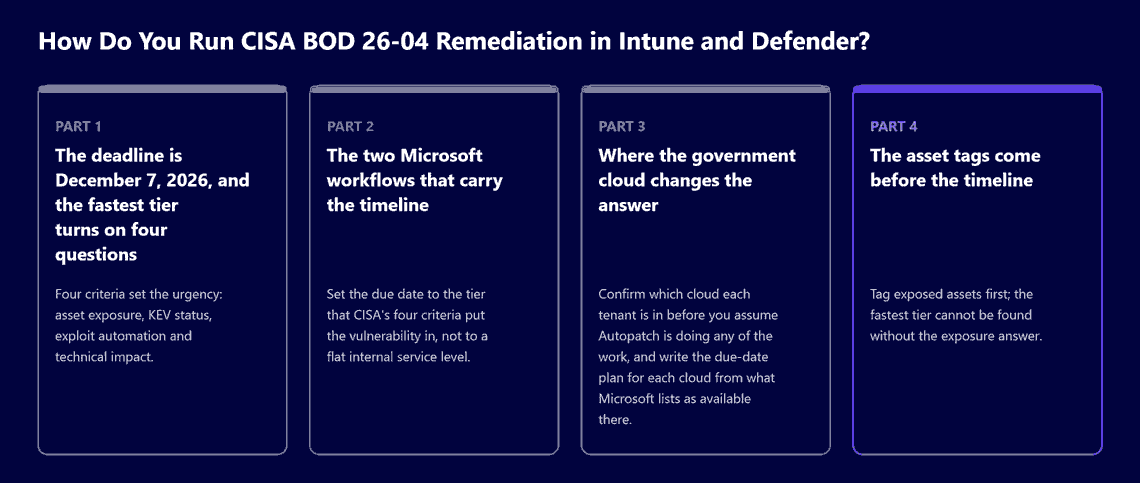
The request form carries the fields a tiered timeline needs. Microsoft’s remediation guide states: “Fill out the form, including what you are requesting remediation for, whether to open a ticket in Intune, priority, due date, and optional notes.” Set the due date to the tier that CISA’s four criteria put the vulnerability in, not to a flat internal service level.
Choose the request option with care. Microsoft’s remediation guide states: “If you choose the attention required remediation option, you can’t select a due date because that option doesn’t create a remediation action to track.” For a vulnerability on a timed tier, that option leaves nothing to track against the deadline.
The Intune side has a prerequisite. Microsoft’s remediation guide states: “If you have the Intune connection enabled, you get an option to create an Intune security task when creating a remediation request.” According to Microsoft Learn, that connection is off by default and is turned on in the Microsoft Defender portal under Settings, Endpoints, General, Advanced features.
Once submitted, the request is tracked in two places. Microsoft’s remediation guide states: “A security task is created that can be tracked on a Remediation page, and a remediation ticket is created in Microsoft Intune.” The due date is a field on that ticket and is visible on the Remediation page; Microsoft’s page does not describe it as an enforcement mechanism, so the team’s own review of open tickets against their due dates is what holds the timeline.
The second workflow keeps Windows devices current before a request is needed at all. Microsoft’s overview of Windows Autopatch states: “Using Windows quality and feature update reports, you can monitor and remediate managed devices that are Not up to Date and resolve any device alerts to bring managed devices back into compliance.” Where Autopatch is available, use those reports to find the devices that are Not up to Date, and use the remediation request for the specific vulnerability that the four criteria put on a clock.
The same agency can have Windows Autopatch in one tenant and no Autopatch at all in another, depending on which government cloud the tenant sits in. In GCC, Microsoft’s Windows Autopatch FAQ states: “Windows Autopatch is included automatically for Government Community Cloud (GCC) customers using Microsoft 365 G3 GCC, Microsoft 365 GCC G5, or Microsoft 365 GCC G5 without WDATP/CAS Unified.” GCC also runs on the same Intune service that commercial customers use. Microsoft’s Intune for US Government GCC High and DoD service description states: “GCC is the same instance as Microsoft Intune in the commercial space.”
In GCC High and DoD, Microsoft’s Windows Autopatch FAQ states: “Windows Autopatch is not currently supported in US Government Community Cloud High (GCC High) or Department of Defense (DoD) environments.” The Intune page goes further. Microsoft’s Intune for US Government GCC High and DoD service description states: “The following features are currently not available and aren’t supported in GCC High and DoD clouds.” On that page, last updated October 2, 2026 and re-read for this guide on October 19, 2026, the list under that sentence names Windows Autopatch, Feature updates for Windows in Intune, Quality updates for Windows in Intune, Expedite updates for Windows in Intune and Driver updates for Windows in Intune. In GCC High and DoD, then, neither Windows Autopatch nor those four update policies is available to carry BOD 26-04’s timeline. The Microsoft pages read for this guide do not name a replacement for them, so confirm with Microsoft how Windows updates will reach GCC High and DoD devices before you commit a due date that depends on them.
What stays in place across all three clouds is the request side of the workflow. Microsoft’s page on Defender for Endpoint for US Government customers states: “This offering is available to GCC, GCC High, and DoD customers and is based on the same prevention, detection, investigation, and remediation as the commercial version.” Its table lists Defender Vulnerability Management core and premium capabilities for GCC, GCC High and DoD, and its note, as read on October 19, 2026, names two Defender Vulnerability Management functions that are not available in those clouds: Report inaccuracy and Request CVE support. The remediation request is not one of the two. Intune itself serves GCC High and DoD from a separate government instance: Microsoft’s Intune service description states: “In the government cloud, the Intune service instance is shared with GCC High and DoD tenants.”
Confirm which cloud each tenant is in before you assume Autopatch is doing any of the work, and write the due-date plan for each cloud from what Microsoft lists as available there.
An agency that has not tagged its internet-facing assets cannot say which vulnerabilities meet the Asset Exposure criterion, so it cannot say which ones are on the fastest clock. CISA’s BOD 26-04 tells agencies to “Continuously identify and tag all agency-owned assets that can be reached from outside the agency network and using a routable IP address.” According to CISA, the tags must include:
Reporting runs on its own clock. CISA’s BOD 26-04 states: “Agencies that have not fully automated their vulnerability reporting through the CDM Program must regularly report this information to CISA every seven days using a CISA-approved, machine-readable format and following CISA reporting instructions.” This guide’s own recommendation, not CISA’s: build the exposure tag first, because the fastest tier cannot be identified for an asset whose exposure is unknown.
Some readers should stop and start somewhere else.
Hold anyone who builds it, internal or external, to these criteria:
i3solutions plans and runs governed Azure and Microsoft 365 migrations with senior, U.S.-based engineers. For BOD 26-04 the work is a project: assess the tenant’s Intune, Defender Vulnerability Management and Windows Autopatch set-up against CISA’s four criteria, design the asset-tagging taxonomy, configure the remediation-request-to-Intune workflow and its due dates, confirm which government cloud each tenant is in and what Microsoft lists as available there, test the response time, and hand the configuration and runbooks to the agency’s own team, with embedded specialists where that team needs them. The agency’s team runs the remediation program after the hand-off. i3solutions plans and runs Intune migrations for enterprises moving domain-joined Windows devices off on-premises Group Policy. i3solutions is a Microsoft Solutions Partner. i3solutions has been a Microsoft Partner with 30 years of enterprise technology delivery experience and has delivered 1,500+ Microsoft engagements across aerospace and defense, financial services, and health sciences.
For how this fits wider governance work, see enterprise governance and compliance solutions.
According to CISA, BOD 26-04: Prioritizing Security Updates Based on Risk was issued June 10, 2026, supersedes and revokes BOD 19-02 and BOD 22-01, and requires Federal Civilian Executive Branch agencies to remediate each vulnerability no later than the timelines in its Table 1, with that phase applying from December 7, 2026.
According to CISA, urgency turns on Asset Exposure (is the asset publicly exposed), KEV Status (is the vulnerability on the Known Exploited Vulnerabilities Catalog), Exploit Automation (can an adversary automate every step of exploitation) and Technical Impact (does an adversary gain partial or total control). According to CISA’s implementation guidance, a vulnerability that meets the remediation threshold in fewer than three days also requires forensic triage.
According to CISA, unless directed by the governing procurement contract, BOD 26-04 does not apply to contractors, but FCEB agencies must review all contracts to determine what modifications are necessary, in consultation with the Contracting Officer. Whether a specific contract carries it is answered by that contract.
No. According to Microsoft Learn, a security admin requests remediation from the Defender Vulnerability Management Recommendation pages, the request carries a priority and a due date, and it creates a remediation ticket in Microsoft Intune for the IT administrator; the attention required option creates no action to track and takes no due date.
No. According to Microsoft Learn, Windows Autopatch is not currently supported in GCC High or DoD, and the Intune government service description, last updated October 2, 2026, lists Windows Autopatch and the Feature, Quality, Expedite and Driver update policies for Windows in Intune as currently not available in GCC High and DoD. According to Microsoft Learn, Windows Autopatch is included automatically in GCC for Microsoft 365 G3 GCC, Microsoft 365 GCC G5, or Microsoft 365 GCC G5 without WDATP/CAS Unified, and its reports show the devices that are Not up to Date.
According to Microsoft Learn, Defender Vulnerability Management core and premium capabilities are listed for GCC, GCC High and DoD, and the page names two functions that are not available there: Report inaccuracy and Request CVE support. The remediation request is not one of the two, and Microsoft Learn describes Intune for GCC High and DoD as a shared government-cloud instance.
By Michael Branson
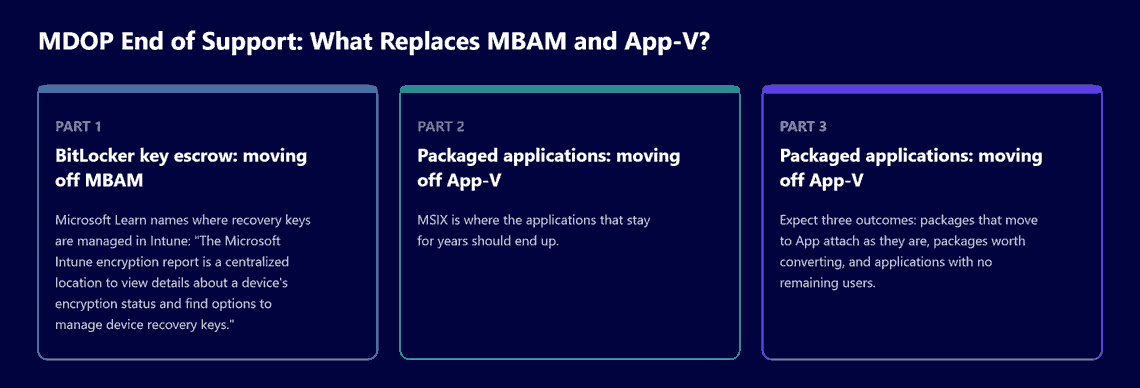
When an assessor asks where BitLocker recovery keys are escrowed, or a ticket shows that the App-V infrastructure has not been patched in months, the console behind both is one Microsoft stopped supporting in April. A console that still works is not the same as a console that is still supported. This guide sets out what Microsoft ended on April 14, 2026 and what it did not, where Microsoft puts recovery-key escrow and packaged applications instead, and the order that moves the most exposure first. Whether a given estate meets a particular control is the organization’s own determination and its assessor’s, not this guide’s.
The components ended together, but they did different jobs, and one piece of App-V did not end at all.
Microsoft’s lifecycle page Ending Support in 2026 lists the products “governed by the Fixed Policy” that end support during the year. The Microsoft Desktop Optimization Pack (MDOP) entries in its April 14, 2026 row are Microsoft Advanced Group Policy Management 4.0, Microsoft Application Virtualization 5.0 and 5.1, Microsoft Application Virtualization Hosting 5.0 and 5.1 for Windows Desktops, Microsoft BitLocker Administration and Monitoring 2.5, Microsoft Diagnostics and Recovery Toolset 10.0, and User Experience Virtualization (UE-V) 2.1.
The product pages say the same thing in plainer words. Microsoft’s lifecycle page for Microsoft Application Virtualization 5.0 notes “Support for this product has been extended through April 14, 2026.” The lifecycle page for Microsoft BitLocker Administration and Monitoring 2.5 gives the same extended end date. Microsoft’s App-V overview, Application Virtualization (App-V) for Windows client overview, still carries the note it published in advance: “Extended support for MDOP ends on April 14, 2026.” That date has passed, so an estate still running any of these components has been running them outside Microsoft support since April.
What did not end is the App-V client in Windows 10 and Windows 11. The same Microsoft App-V overview says the App-V client follows the lifecycle of its Windows version, and fixed extended support for App-V server continues through October 9, 2029. The practical reading is that the packaged applications on the desktop still have a supported client while the MDOP releases and hosting components that surrounded them do not.
Advanced Group Policy Management, Diagnostics and Recovery Toolset and UE-V share the April 14, 2026 date. None of the Microsoft pages cited in this guide names a replacement for them, so this guide names none; list them in the inventory and decide each one on its own facts.
If a device asks for its recovery key tomorrow, the service desk will look it up wherever the key was escrowed, and in an estate that has not moved, that is still an MBAM database behind a console Microsoft no longer supports. A Microsoft Community Hub guide by ms-foxworks, Migrating BitLocker Recovery Key Management from ConfigMgr to Intune: A Practical Guide (May 18, 2025), describes a common starting point: “In many organizations, BitLocker encryption and key management is handled via MBAM Standalone or the Configuration Manager BitLocker feature.”
Microsoft Learn names where recovery keys are managed in Intune: “The Microsoft Intune encryption report is a centralized location to view details about a device’s encryption status and find options to manage device recovery keys.” It adds a condition worth reading before planning: “The recovery key options that are available depend on the type of device you’re viewing.” For Windows, the same page, Monitor device encryption with Intune, says “For Windows devices, Intune only shows Status details for devices that run the Windows 10 April 2019 Update or later, or Windows 11.” A device on an older build will not show the detail an assessor asks to see, so the device inventory comes before the cutover.
The order of the move matters more than any single setting. The same Community Hub guide, written for “Entra-Hybrid-Joined devices that are co-managed”, starts with the workload, not the policy: “First, set Endpoint Protection workload authority to Intune. Assign your devices to a staging collection.” It notes that this step “will not immediately change BitLocker policies on the device” and “prepares the system to receive policy from Intune.” It also states that “Intune does not require the MBAM-Agent to manage and control Disk-Encryption”. That walkthrough is a practitioner guide, not formal product documentation, and its author states that “The sample scripts are not supported under any Microsoft standard support program or service.” This guide takes the order of work from it and nothing command-level.
Call the move complete when every device’s recovery key is visible in the Intune encryption report, the service desk retrieves keys there rather than in MBAM, and the MBAM console is switched off without anyone asking for it. i3solutions’ standing BitLocker management work sits on its Intune readiness services page.
The App-V plan stalls on one assumption: that every package has to be rebuilt as MSIX before the MDOP App-V infrastructure can be retired. Microsoft’s own announcement points the other way. In Announcing App-V support in App attach on the Microsoft Community Hub (JimMoyle, November 19, 2024), Microsoft acknowledged that “the impending April 2026 deprecation is weighing heavily on IT pros” and announced that “Microsoft Application Virtualization (App-V) for Windows is now supported by App attach in Azure Virtual Desktop”. The same post says “IT admins can now manage and deploy their App-V applications just as easily as they would with MSIX or AppX packages” and that “App-V is shifting to an extended support phase, making it easier for admins to move their business-critical applications to Azure Virtual Desktop using App attach.”
Read together, those statements mean the existing App-V packages are what App attach delivers, so conversion to MSIX is a later, per-application decision rather than the first step. That is this guide’s reading of Microsoft’s announcement; Microsoft’s own recommendation in Application Virtualization (App-V) for Windows client overview is: “We recommend looking at Azure Virtual Desktop with MSIX app attach.”
MSIX is where the applications that stay for years should end up. Microsoft’s What is MSIX? says: “MSIX is the modern Windows app packaging format. It gives any Windows app a reliable, clean install and uninstall, automatic updates, and access to Windows platform features that require a package identity.” Expect three outcomes: packages that move to App attach as they are, packages worth converting, and applications with no remaining users. Test each package before it moves; neither route promises that every package behaves the same way it did on the old infrastructure.
Keep the client distinction straight in every status report. According to Microsoft, the MDOP App-V releases and App-V Hosting for Windows Desktops ended on April 14, 2026; the App-V client follows the lifecycle of its Windows version, and fixed extended support for App-V server continues through October 9, 2029. Calling the whole of App-V unsupported overstates the problem and pushes teams into an MSIX rebuild on a timetable no one set.
If everything moves at once, the largest effort holds up the smallest one, so the order of work moves the most exposure first and defers the largest effort until the estate is on supported ground.
Some questions arrive with the words BitLocker or App-V in them when the decision behind them is a different one.
When an outside team carries this work, or your own team does, the same questions separate a plan from a guess.
When a regulated IT team takes this on, it needs a project with an end date: the inventory, the escrow move into Intune, and the App-V move to App attach or MSIX, with embedded specialists where the internal team needs more hands for a period. i3solutions plans and runs Intune migrations for enterprises moving domain-joined Windows devices off on-premises Group Policy. i3solutions has been a Microsoft Partner with 30 years of enterprise technology delivery experience and has delivered 1,500+ Microsoft engagements across aerospace and defense, financial services, and health sciences. The people who do the work are senior and based in the US. An i3solutions project engagement does not by itself include ongoing support of what it delivers, which i3solutions scopes separately as Application Managed Services, and it is not a replacement for the internal team, open-ended scope expansion, or vendor lock-in. This work sits within i3solutions’ modernization services.
According to Microsoft’s lifecycle list, Microsoft BitLocker Administration and Monitoring has reached its end of support, and Microsoft’s App-V overview says extended support for MDOP has ended. This guide makes no claim about how long an unsupported console keeps running.
In Intune, Microsoft Learn says “The Microsoft Intune encryption report is a centralized location to view details about a device’s encryption status and find options to manage device recovery keys.” According to the same page, a Windows device on an older build will not show its Status details.
No conversion is the first step. Microsoft announced that “Microsoft Application Virtualization (App-V) for Windows is now supported by App attach in Azure Virtual Desktop” and that “IT admins can now manage and deploy their App-V applications just as easily as they would with MSIX or AppX packages”. Converting to MSIX remains a later, per-application decision; test each package before it moves.
No. Microsoft’s App-V overview says the App-V client follows the lifecycle of its Windows version, and App-V server remains in fixed extended support. According to Microsoft’s lifecycle list, the MDOP releases of App-V and App-V Hosting for Windows Desktops are the parts that reached their end of support.
Microsoft says “MSIX is the modern Windows app packaging format. It gives any Windows app a reliable, clean install and uninstall, automatic updates, and access to Windows platform features that require a package identity.”

US-Based Microsoft System Integrator | Est. 1997
© i3solutions. All rights reserved.
US-Based Microsoft System Integrator | Est. 1997
© i3solutions. All rights reserved.


