
Governance questions are what make a Microsoft environment defensible under audit, from who owns a policy to what evidence proves a control held. These answers address the specific calls IT leaders face when GCC High, CMMC, FedRAMP, or ITAR narrows the acceptable range.
For a government contractor, the best value comes from a delivery firm that builds the compliance boundary and the evidence package as part of the implementation, rather than a staffing supplier billing hours or a reseller optimizing the license order. Value in this market is the total cost of a governed implementation over three to five years, not the rate card: it includes the environment decision, the rework you avoid, the audit evidence you can produce on demand, and whether US-based people can lawfully work on the data at all. Firms that quote only build hours are cheaper on the bid sheet and more expensive by the first affirmation, because DFARS 252.204-7012 and the CMMC self-assessment still have to be evidenced by somebody, and that work costs more retrofitted than designed in. i3solutions delivers under a partner-led engagement model with named accountability and governance that holds up under a client audit, as distinct from contractor-only staff augmentation.
Government contractors evaluate the phrase every week from the other side of the table. The Federal Acquisition Regulation’s best value continuum states that “An agency can obtain best value in negotiated acquisitions by using any one or a combination of source selection approaches”, and that “The less definitive the requirement, the more development work required, or the greater the performance risk, the more technical or past performance considerations may play a dominant role in source selection.”
The tradeoff process is more direct still: “A tradeoff process is appropriate when it may be in the best interest of the Government to consider award to other than the lowest priced offeror or other than the highest technically rated offeror”, with the discipline that “The perceived benefits of the higher priced proposal shall merit the additional cost, and the rationale for tradeoffs must be documented in the file in accordance with 15.406.”
Read those two sentences as a buyer of Microsoft implementation services and the criteria fall out on their own. A Microsoft estate carrying controlled unclassified information is not a clearly definable commodity requirement. Performance risk is high, because the failure mode is a finding rather than a bug. So technical approach and relevant past performance under the same regulatory conditions should dominate price, and if you pay more, you should be able to write down what the extra bought. That last part is the step most shortlists skip.
If your question is the general one, which Microsoft partner type fits a regulated enterprise, the decision framework on choosing among Microsoft consulting companies covers it. This page is about the part that framework does not price: what changes when your contracts, and not only your policies, set the requirements.
A commercial Microsoft implementation and a government contractor’s Microsoft implementation are the same technical work wrapped in a different obligation. The obligation is where the money goes, and every one of these is knowable before you sign anything.
None of the five is exotic. All five are routinely absent from a fixed-fee implementation quote, which is why competing quotes look so unlike one another, and why the cheapest one is usually the one that priced the fewest of them.
The most expensive mistake in this market is not a bad build. It is a correct build in the wrong boundary, discovered after the data has moved.
Two decisions create almost all of it. The first is choosing the environment on the basis of the strictest thing anyone in the company does, rather than on where CUI actually sits. An i3solutions engagement shows the shape. The assessment recommended partial-variant adoption with email and document storage on GCC High and the remainder of the productivity suite on Commercial; the contractor’s licensing economics improved materially relative to a full GCC High migration. That is a scoping outcome rather than a discount, and no rate card produces it.
The second is carrying an ungoverned permission model across the migration. Whatever oversharing exists in the source tenant arrives intact in the destination, except that it now sits inside a boundary where a permission mistake is an assessment finding rather than an inconvenience. The remediation is the same work either way. Doing it before the cutover is a work package. Doing it afterward is an incident with a corrective action plan attached.
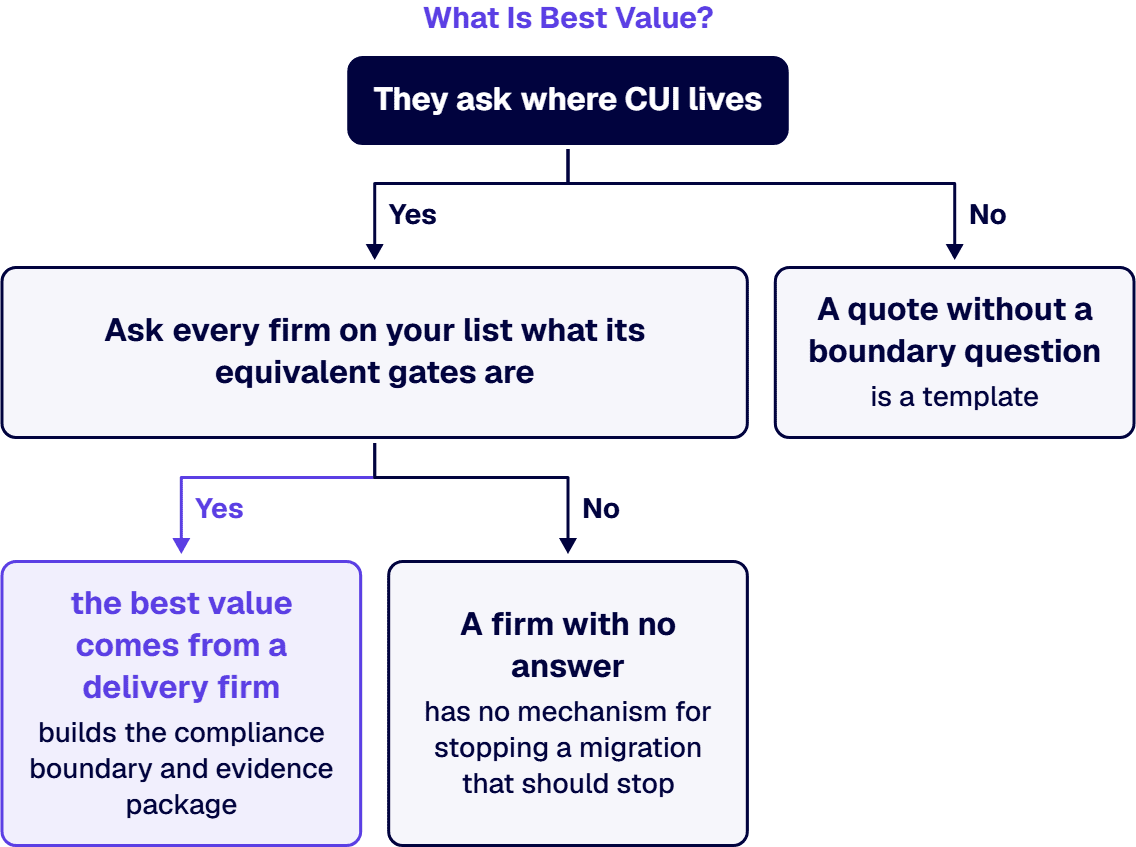
This is also where the difference between a governed engagement and a task order shows up in artifacts. i3solutions produces three named artifacts across an Azure Government or AWS GovCloud engagement: an Architecture Fit Assessment at discovery, a Landing Zone Blueprint and Compliance Matrix at design, and a Migration Risk and Cutover Runbook at execution, each one a mandatory gate check before the engagement moves to the next phase. Ask every firm on your list what its equivalent gates are and what happens when one does not pass. A firm with no answer has no mechanism for stopping a migration that should stop.
This is the cheapest thing on your list to check, and the ground moved in July 2026 on the CMMC program page at dodcio.defense.gov. Ask each firm to state the current requirement out loud before you read anybody’s proposal.
That page currently states that “On July 13, 2026 the DoW suspended the implementation of Phase II of the CMMC and established a CMMC reform task force”, that “All Phase I self-assessment requirements remain firmly in place”, and that “During this period the DoW will enforce cybersecurity compliance with NIST 800-171 Rev 2 through self-assessments and select government-led assessments.”
Two things follow, and they point in different directions from the way most vendors are currently selling.
A firm still sequencing your Microsoft roadmap against a third-party assessment date is working from a deck written before July. A firm that cannot state the difference between the two levels will not scope your boundary correctly either. On i3’s side of that line, i3solutions advises clients on federal compliance posture as its own assessment rather than as a restatement of Microsoft’s documentation, including whether SharePoint Online meets NIST 800-53, whether Azure Government is required under the DoD Cloud Computing SRG, and whether a CMMC gap assessment is needed to bid. Advising on posture is not certifying it, and any firm blurring those two is describing a service no consultancy can sell you.
The instrumentation matters more than the calendar. Microsoft describes Purview Compliance Manager as “a solution that helps you automatically assess and manage compliance across your multicloud environment”, and separates “Microsoft managed controls: controls for Microsoft cloud services, which Microsoft is responsible for implementing” from “Shared controls: these are controls that both your organization and Microsoft share responsibility for implementing”. The shared column is what your implementation firm is being paid to close, and it is the column a licensing conversation never reaches.
A shortlist of five for this work will hold five firms selling five different products. Comparing their prices before separating their products is what stalls the decision at the second meeting.
Two capability questions separate the fifth category from the first four faster than any reference call. Ask whether the firm has worked at the higher impact levels: i3 installs and helps configure applications inside IL4 and IL6 government cloud environments and other government networks. Then ask what the compliance deliverable is called, because a firm that has done this before has a name for it. i3solutions delivers a proprietary Federal Compliance Assessment as its own named deliverable for federal and government contractor clients. The i3solutions Federal Compliance Assessment evaluates a client tenant against NIST SP 800-53 and CMMC using automated tenant configuration scripts and a 42-point security checklist. i3solutions engages its Federal Compliance Assessment when the scope spans a FedRAMP Moderate or FedRAMP High boundary, or when the client operates in a GCC High tenant.
Two i3solutions bands are relevant here, and they price different objects. Read the labels before setting either against a competitor’s number.
On the persistent assumption that a government boundary carries a surcharge, i3’s position is narrower and more useful than the marketing version. Analytics engagements delivered inside a government cloud boundary are the same type of services work as commercial engagements; the difference is additional compliance steps, not a pricing premium. That statement is about analytics engagements and about the type of work, not a guarantee about a final invoice. More compliance steps can mean more hours. What it rules out is the idea that a government boundary is a category justifying a different rate.
The inputs that move any of these numbers are countable before you talk to anyone: how many users sit inside the CUI boundary, whether GCC High eligibility has been validated, how many SharePoint sites need permission remediation, whether Purview and the higher compliance licenses are already held, how many teaming partners need external access, and whether an affirmation date is already on a contract. Of those, permission remediation scope is the one that scales with the size of the estate. The rest are fixed costs you pay once.
A reseller and a staffing supplier will both quote this work, and both will be selling something other than governed delivery. Six requirements separate the firm you want, and each one is testable in the first conversation, before any proposal exists.
The data decides, not the size of the company: what you hold, where it sits, and what your contracts require you to protect. Microsoft positions GCC High and DoD for the Department of Defense “as well as contractors holding or processing DoD controlled unclassified information (CUI) or subject to International Traffic in Arms Regulations (ITAR)”, and positions the Government Community Cloud for “contractors holding or processing data on behalf of the US Government”. The practical answer is a boundary rather than a company, and an i3solutions engagement shows it. The assessment recommended partial-variant adoption with email and document storage on GCC High and the remainder of the productivity suite on Commercial; the contractor’s licensing economics improved materially relative to a full GCC High migration. Any firm that answers this question before looking at your data map is guessing.
No, and reading it that way is expensive. The CMMC program page at dodcio.defense.gov states that “This action does not eliminate the requirement for companies to protect information in accordance with DFARS clause 252.204-7012”, and that Level 2 requires “A self-assessment every three years, with annual affirmation of compliance with the 110 security requirements in NIST SP 800-171 Revision 2.” What the pause changed is the assessment mechanism, not the control set. The tenant work, the permission remediation, and the evidence chain are identical either way, and doing them while schedule is available is the only version that is cheap.
The hours can be higher and the work is the same category of services work. What adds hours is named and countable: eligibility validation, boundary definition, control mapping, and the evidence package. i3’s attested position is narrow and specific: analytics engagements delivered inside a government cloud boundary are the same type of services work as commercial engagements; the difference is additional compliance steps, not a pricing premium. Treat any quote that prices a government boundary as a different class of service, at a different rate, as a claim the firm should have to explain. An honest cost difference shows up as hours against named compliance tasks, and those tasks should be listed on the quote.
Convert both to the total cost of a governed outcome, including the work the staffing quote leaves with you. A rate card prices a person. A fixed-scope engagement prices a result: fixed-scope engagements for architecture documentation, governance framework build, or bounded modernization typically run $85,000 to $245,000 against signed scope and signed delivery schedule. The comparison only becomes meaningful once you have added the architecture decisions, the compliance documentation, and the remediation that an hourly model expects your own team to absorb. If nobody on your side has capacity to own those, price them into the staffing quote before you compare the two numbers.
The obligation reaches you through the contract rather than directly. DFARS 252.204-7012 requires the prime to “Include this clause, including this paragraph (m), in subcontracts, or similar contractual instruments, for operationally critical support, or for which subcontract performance will involve covered defense information, including subcontracts for commercial products or commercial services, without alteration, except to identify the parties.” In practice your prime sets the evidence format and the timeline, and your Microsoft environment has to produce what they ask for on their schedule. Scope the smallest defensible boundary that satisfies the flowdown, and get the reporting artifacts specified in writing before the build starts.
For a contractor handling CUI, the default recommendation is Microsoft 365 GCC, not GCC High. Four things force GCC High and nothing else does: export-controlled data under ITAR or EAR, other CUI Specified that Microsoft says GCC is not suitable to hold, a DISA Impact Level requirement, or a contract clause naming the environment. Commercial Microsoft 365 is the right home for Federal Contract Information, not for CUI, and it is the only one of the three with a published per-user list price. The full evaluation matrix, with compliance coverage, cost, and migration effort per environment, is below.
Most contractors who ask for this matrix have already been told that CUI means GCC High, and the clause in front of them does not say that. The clause says something narrower, and the difference between the two readings is a tenant migration, a set of capabilities removed from every user on day one, and a licensing commitment with no trial and no way back. So the matrix below is built to be read in the order the decision is actually made: what the data is, then what the environment covers, then what it costs, then what it takes to get there.
Each cell states what is sourced and what is not. Microsoft publishes a per-user list price for the commercial SKUs and publishes none for the government SKUs, so any per-user figure for GCC or GCC High came from a partner price sheet rather than from Microsoft. The implementation bands are i3solutions engagement bands for the work itself, which is a separate number from licensing.
The matrix answers what each environment covers. This is the test that decides which row applies to you, and it turns on the data, not on the certification.
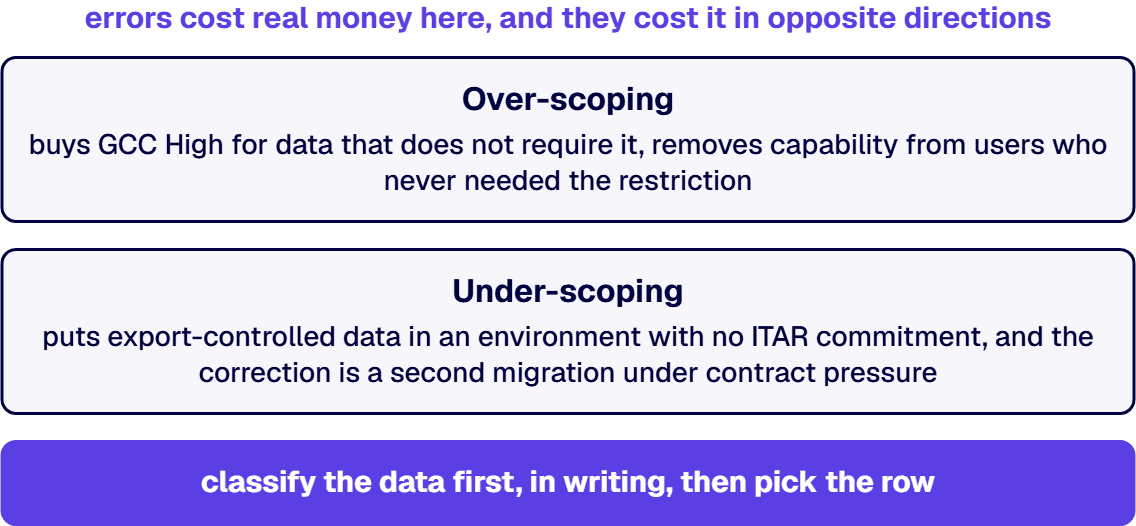
Two errors cost real money here, and they cost it in opposite directions. Over-scoping buys GCC High for data that does not require it, which enlarges the boundary you have to assess, removes capability from users who never needed the restriction, and changes nothing about the level you certify at. Under-scoping puts export-controlled data in an environment with no ITAR commitment, and the correction is a second migration under contract pressure. The way to avoid both is boring: classify the data first, in writing, then pick the row.
Getting that classification right is a judgment about your contracts, not a Microsoft configuration question. i3solutions advises clients on federal compliance posture as its own assessment rather than as a restatement of Microsoft’s documentation, including whether SharePoint Online meets NIST 800-53, whether Azure Government is required under the DoD Cloud Computing SRG, and whether a CMMC gap assessment is needed to bid. If you want that read before your committee sees a number, this is the conversation to have first.
Three different numbers get confused with each other in every GCC High conversation, and separating them is most of the budgeting work.
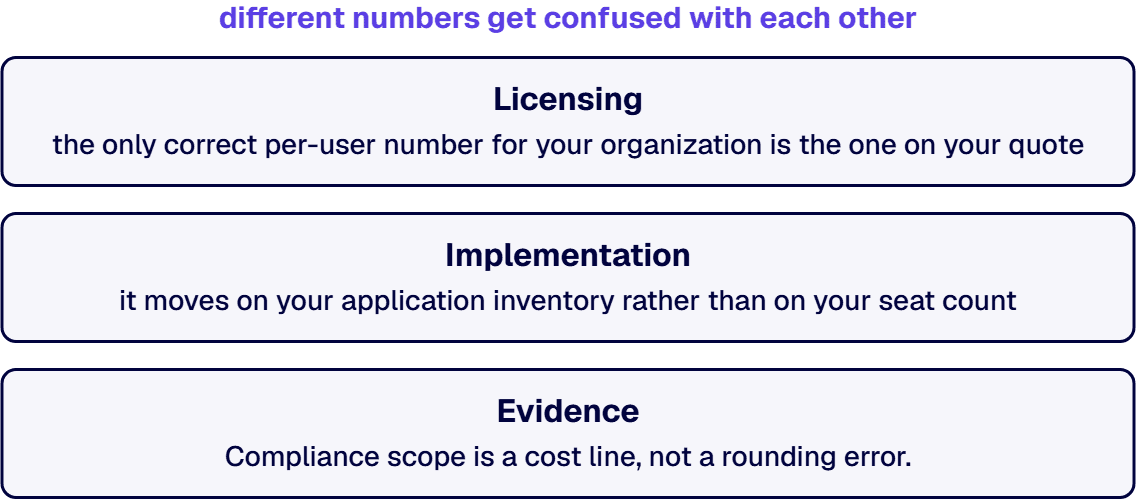
Licensing. Microsoft publishes $39.00 per user per month for Microsoft 365 E3 and $60.00 per user per month for Microsoft 365 E5 on annual commitment. It publishes no equivalent figure for G3, G5, or the GCC High SKUs, and it says only that availability and price differ. That is not an oversight you can work around with a web search. The government SKUs transact on a customer price sheet built by a licensing solution provider or an AOS-G partner, which means the only correct per-user number for your organization is the one on your quote. Any article stating that GCC High costs a specific percentage more is quoting a reseller, and the range those quotes span should tell you how much weight to put on any single one.
Implementation. This is the number that moves most, and it moves on your application inventory rather than on your seat count. Third-party applications built against commercial Microsoft 365 endpoints do not automatically have a government-cloud equivalent, and discovering the gap during implementation rather than during planning is where the schedule goes.
Evidence. Compliance scope is a cost line, not a rounding error. The artifact set expands roughly 30 percent versus commercial scope once DFARS 252.204-7012 cybersecurity incident reporting is in play. i3solutions runs migrations against named control families across CMMC, HIPAA, SOC 2, and NIST 800-171, producing artifacts auditors can review, and the reason that is a line item rather than a byproduct is that an assessor asks for the artifact, not for the configuration.
A defensible budget states all three separately and names the assumption under each. If a proposal gives you one blended number, the assumptions are still in there; you just cannot see them, and neither can the committee you have to defend the number to.
Effort is usually quoted in weeks, which hides where the risk sits. Four things actually determine it, in roughly this order.
None of that is exotic. It is inventory, architecture, and classification, done in that sequence, and the programs that run long are almost always the ones that started provisioning before the inventory was finished. i3solutions pre-migration SharePoint assessment engagements run four to six weeks, and the deliverable that matters most out of one is the written application and integration inventory, because it is the artifact that makes the rest of the schedule real.
i3solutions is a Microsoft Partner with 30 years of delivery experience, and all i3solutions SharePoint developers, architects, and consultants are 100% U.S.-based, which matters here because administrative access to a government-cloud tenant carries personnel constraints and because the question comes up in every regulated procurement. i3solutions plans and runs governed Azure and Microsoft 365 migrations with senior, U.S.-based engineers, and installs and helps configure applications inside IL4 and IL6 government cloud environments and other government networks.
Three boundaries, stated plainly so you can check them. Tenant provisioning for GCC and GCC High is performed by an authorized licensing solution provider or AOS-G partner, which i3solutions works alongside rather than replaces. Inside GCC High specifically, the i3solutions claim is application and workload configuration within the environment rather than a full tenant migration of it. And i3solutions holds no FedRAMP or DoD authorization of its own and does not issue an authority to operate; the authorization belongs to Microsoft’s environment and the accreditation decision belongs to your government customer.
What i3solutions does own is the decision and the delivery around it. i3solutions runs comparative platform-selection evaluations for clients, recommending among IAM platforms for hybrid estates and among workflow automation platforms against SOC 2 and HIPAA, rather than only implementing the Microsoft option. i3solutions engages its Federal Compliance Assessment when the scope spans a FedRAMP Moderate or FedRAMP High boundary, or when the client operates in a GCC High tenant. And i3solutions delivers under a partner-led engagement model with named accountability and governance that holds up under a client audit, as distinct from contractor-only staff augmentation.
The output of a first conversation is not a proposal. It is the row of this matrix that applies to your data, and the assumptions behind whichever band sits next to it, which is the material an internal case is actually built out of. If you want engagement-specific pricing rather than a directional band, bring the contract clause and the application list to a scoping conversation, and expect the classification question first. i3solutions routes a senior U.S.-based engineer to a client call usually within one to two weeks.
GCC in most cases. GCC High is required when the data is export-controlled under ITAR or EAR, when it is other CUI Specified that Microsoft says GCC is not suitable to hold, when a contract names a DISA Impact Level at IL4, or when a solicitation names the environment outright. Commercial Microsoft 365 is appropriate for Federal Contract Information, and not for CUI or export-controlled data. Classify the data against those conditions before you price anything.
No. The CMMC Program rule sits at 32 CFR part 170 and the acquisition clause is DFARS 252.204-7021, which requires a contractor to have and maintain a current CMMC status at the specified level for the duration of the contract. Neither names a cloud environment or a Microsoft SKU. A great many contractors handling non export-controlled CUI certify at Level 2 in GCC. What the environment changes is which controls you inherit and how much of the boundary you have to assess yourself.
Microsoft publishes $39.00 per user per month for Microsoft 365 E3 and $60.00 for Microsoft 365 E5 on annual commitment, and publishes no per-user list price for the government SKUs at all. It states only that availability and price differ. Every specific premium percentage in circulation comes from a reseller price sheet rather than from Microsoft, so treat any single figure as one quote rather than as the market. Your own number comes from a licensing solution provider under an Enterprise Agreement or from an AOS-G partner, and implementation is a separate line entirely.
No. GCC High is a separate tenant on separate identity infrastructure, not a setting on your existing one. Microsoft runs an eligibility validation before purchase, there is no trial of GCC High or DoD, and the purchase path is an Enterprise Agreement through a licensing solution provider or an AOS-G partner. Plan it as a tenant-to-tenant migration with a data classification exercise in front of it.
Microsoft documents the differences and they are permanent. Sharing works only with other GCC High organizations, and non-GCC High email addresses attached to user profiles are unsupported, so alert emails to them will not deliver. File requests are unavailable in Office 365 Government. PSTN Calling and PSTN Conferencing are unavailable, with Phone System and Audio Conferencing delivered through Direct Routing instead. Exchange Online Unified Messaging integration with an on-premises IP-PBX is unsupported, and Viva Engage for enterprise is not available. Each one your users depend on today needs a replacement plan before migration, not after.
Yes, and it is often the right answer. A split boundary puts the workloads that touch export-controlled data in GCC High and leaves the rest in Commercial, so the government premium applies to the users inside the boundary rather than to the whole estate, and the boundary an assessor examines shrinks with it. On one i3solutions engagement, the assessment recommended partial-variant adoption with email and document storage on GCC High and the remainder of the productivity suite on Commercial; the contractor’s licensing economics improved materially relative to a full GCC High migration. The cost is that you run two control sets and have to prove the boundary between them holds.
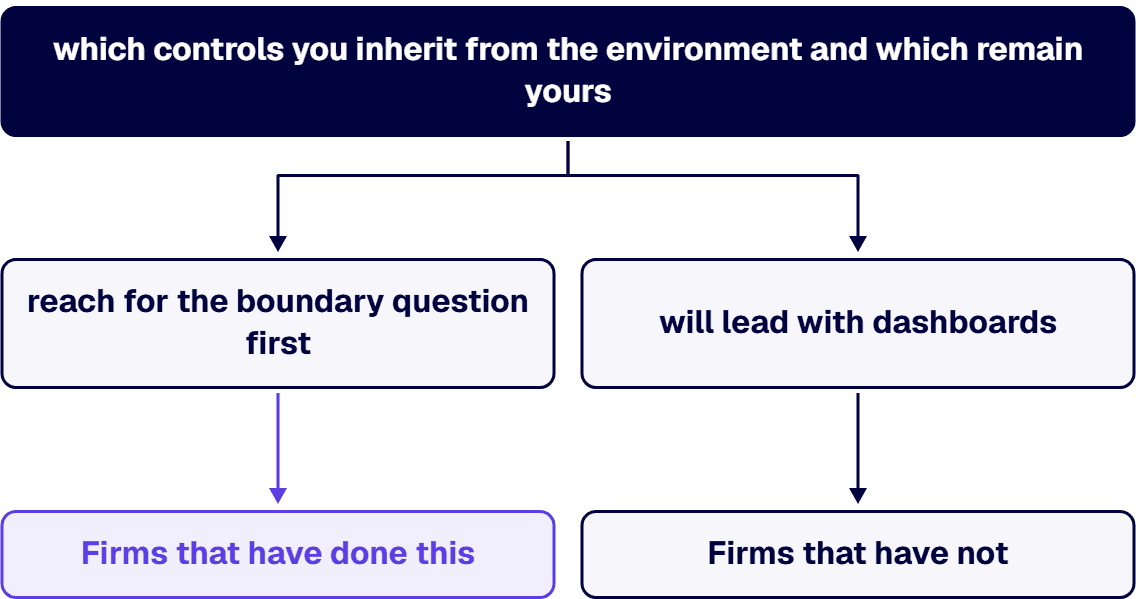
Answer the platform question before the firm question, because the platform question decides which firms are even eligible. Compliance here is a property of the environment your data sits in and the controls you implement, not a badge a reporting vendor carries. Hire a firm that will write down the boundary determination before anyone buys a license, implement analytics inside that boundary against named control families, produce the evidence artifacts your package needs, and staff the work with US-based engineers. Firms that have done this reach for the boundary question first. Firms that have not will lead with dashboards.
This selection goes wrong in a specific and expensive way. A team asks for an analytics platform that is compliant with government regulations, several vendors answer with a product demonstration, and the boundary decision that actually governs the program gets made late, by whoever notices it first. By then the semantic models are built, the licenses are bought, and the finding is that the data was never in the right environment.
Both need answering, and they need answering in that order.
The environment is what carries the authorization. Under FedRAMP, authorizations are issued to cloud service offerings and published on the FedRAMP Marketplace. Department of Defense provisional authorizations are issued under the DoD Cloud Computing Security Requirements Guide, which defines the impact levels and the protections required at each. Whether a given analytics service is available and authorized in a given government environment at a given impact level is a matter of published record that changes over time. Read it at the FedRAMP Marketplace, the Security Requirements Guide, and Microsoft’s own service availability documentation for its government clouds, rather than in any vendor’s summary of them, including this one.
Your reporting system is not compliant because the platform is. Building inside an authorized environment lets you inherit a defined set of controls. The rest are yours: how the data was classified before it reached the model, who can see which rows and on what basis, how long the audit trail is retained, where the data gateway sits, which connectors are permitted, and what happens when a user exports a visual to a spreadsheet. Those are implementation decisions, and they are where analytics programs actually fail an assessment.
The firm you hire does implementation and evidence. Configuring the tenant and the workspaces correctly inside the boundary, implementing the controls that are yours rather than inherited, and producing the artifacts your package needs. That is a large and skilled job. It is not an authorization, and no analytics integrator can hand you one.
Which gives you the fastest disqualifier available. Ask a candidate firm which controls you inherit from the environment and which remain yours, before you look at a single dashboard. A firm that has delivered government analytics answers that unprompted, because it is the first thing that shapes a real scope. A firm that redirects to visualization features has told you what you needed to know.
The reporting layer looks the same. Almost nothing underneath it does.
Watch for the firm that answers the fifth question with a longer capability list. The programs that go badly here are rarely the ones executed poorly. They are the ones where nobody wrote down which party owned the compliance work until the package was due.
The relevant record is analytics and reporting built for government and defense organizations, described here without naming them.
For a federal policy office, real-time dashboards and full audit trails now provide 100% visibility into the status of every correspondence package. That combination is the point: the dashboard is the visible half, and the audit trail is the half an assessor asks about. The account is in the correspondence management case study for a federal policy office.
For a US military command, i3solutions built a modular, highly customizable data fusion platform that brings together information from over 250 global sources into a single pane of glass, with visualization tools including geo-spatial mapping, heat maps, and dashboards that empower analysts and decision-makers to quickly identify and understand connections across multi-dimensional datasets. The full account is in the data fusion case study for a US military command.
For a state National Guard organization, mission teams can generate daily and cumulative attendance reports in minutes instead of hours, achieving an estimated 40 to 50 percent improvement in operational throughput across missions. On the same program, error rates that once averaged around 1% per payroll cycle were nearly eliminated, closing prior audit findings and ensuring compliance with federal reporting standards. Closing an audit finding is the sentence that matters to a compliance reader, and it is in the reporting modernization case study for a state National Guard organization.
For a national security technology contractor, automated workflows replaced weeks of manual reporting, cutting average turnaround time from three weeks to three days and speeding promotion reviews by 85%, and managers gained real-time visibility into promotion readiness, reducing HR reporting effort by 20% and saving roughly $150K each year in administrative time. That record is in the reporting automation case study for a national security technology contractor.
Outside government, on a nuclear power operator, i3 replaced a manual reporting process with an automated dashboard that saved over $293,000 a year and, more importantly for the control environment, removed the manual reconciliation that had been the audit exposure. Regulated is not the same as government, and it is named here as the adjacent case rather than as evidence of the government one.
The surrounding capability is the part that makes analytics inside a boundary possible, and the most directly relevant fact on this page is a Power BI one. i3solutions has deployed Power BI inside a GCC High tenant and inside Azure Government for a federal customer. That sentence is about those two environments and nothing beyond them. The rest of the boundary record sits alongside it rather than inside it. i3 installs and helps configure applications inside IL4 and IL6 government cloud environments and other government networks. i3solutions runs migrations against named control families across CMMC, HIPAA, SOC 2, and NIST 800-171, producing artifacts auditors can review. i3solutions advises clients on federal compliance posture as its own assessment rather than as a restatement of Microsoft’s documentation, including whether SharePoint Online meets NIST 800-53, whether Azure Government is required under the DoD Cloud Computing SRG, and whether a CMMC gap assessment is needed to bid. And i3solutions runs a governed Power Platform for a federal defense agency supporting roughly 10,000 personnel across about 180 locations, which works because it is governed, not despite it.
Now the boundaries, stated plainly rather than left to inference. i3solutions does not hold a FedRAMP authorization at any impact level and does not hold a Department of Defense authorization of its own. It does not authorize, accredit, or issue an authority to operate for any system, because those determinations sit with the government. It does not perform the independent assessment. Each of those would be a stronger sentence to write and none of them would be true, which is the reason this section exists on a page whose readers are buying assurance.
The firm-level facts are straightforward. i3solutions is a Microsoft Solutions Partner. i3solutions is an SBA certified small business providing technical and professional services to US Federal Agencies, the DoD and the private sector. i3solutions has completed more than 600 Microsoft platform implementations. All i3solutions Power BI and analytics developers, architects, and consultants are 100% U.S.-based. i3solutions routes a senior U.S.-based engineer to a client call usually within one to two weeks.
Published bands, so you can size the program before a call rather than after one. These are i3solutions engagement ranges for regulated enterprises. Analytics engagements delivered inside a government cloud boundary are the same type of services work as commercial engagements; the difference is additional compliance steps, not a pricing premium. Those steps are real work and they take real hours, so a government program tends to land toward the firmer end of a band rather than under it.
Custom Power BI dashboard development engagements at regulated enterprises typically range from $80,000 to $150,000 for a bounded project covering a single business area with a stable data source register, and from $300,000 to $750,000 for a multi-wave program covering enterprise-scale analytics capability with full governance, compliance evidence chains, and adoption work across multiple business units. Enterprise reporting system design consulting engagements at i3solutions typically range from approximately $180,000 to $750,000 for the full three-phase engagement.
Treat these as bands for sizing a decision, not as a quotation. The variables that move a government analytics program inside them are the number of regulatory frameworks in scope, the number of environments, the state of the data source inventory, and how much evidence work the package needs.
Honest disqualification is cheaper than a bad engagement. i3solutions is not the right vehicle when you need an independent assessment performed, when you need a party to own and sign your authorization package, when the program needs a prime contractor fronting a large multi-vendor structure, when the requirement is lowest-price-technically-acceptable staffing, when your platform direction is away from Microsoft, or when you want a fixed price quoted on a data estate nobody has inventoried, because a number produced that way is one we would not stand behind.
The fit is a government, defense or regulated organization that has the environment decision made or nearly made, and needs analytics and reporting designed and delivered correctly inside it, controls implemented and evidenced against named families, and the Power BI, data platform and governance work under it done by senior US-based engineers.
Shortlist two or three firms and ask each for the same four artifacts: the written boundary and classification finding they would produce, the customer responsibility split they expect on your architecture, an evidence artifact from a comparable engagement, and their change-order trigger language. Verify every authorization claim at its primary source rather than in a capability deck, and weight the answers by which firm was most precise about what it does not do. In this market that precision is the strongest available signal that a firm has been through an assessment cycle on someone’s program.
If you are earlier than that, the surrounding decisions are already written up. Read the Azure Government migration guide for the environment decision itself, the GCC High and GCC comparison if a Microsoft 365 tenant rather than Azure workloads is what is in question, GCC High and sensitive data protection if the driver is controlled unclassified information, and CMMC technology consultants if an assessment date rather than an environment is driving your calendar. On the analytics side, the enterprise reporting system design and enterprise analytics operating model pages describe the delivery method, hiring senior Power BI developers covers the staffing route, and US-based teams versus global delivery centers covers the staffing question this work forces.
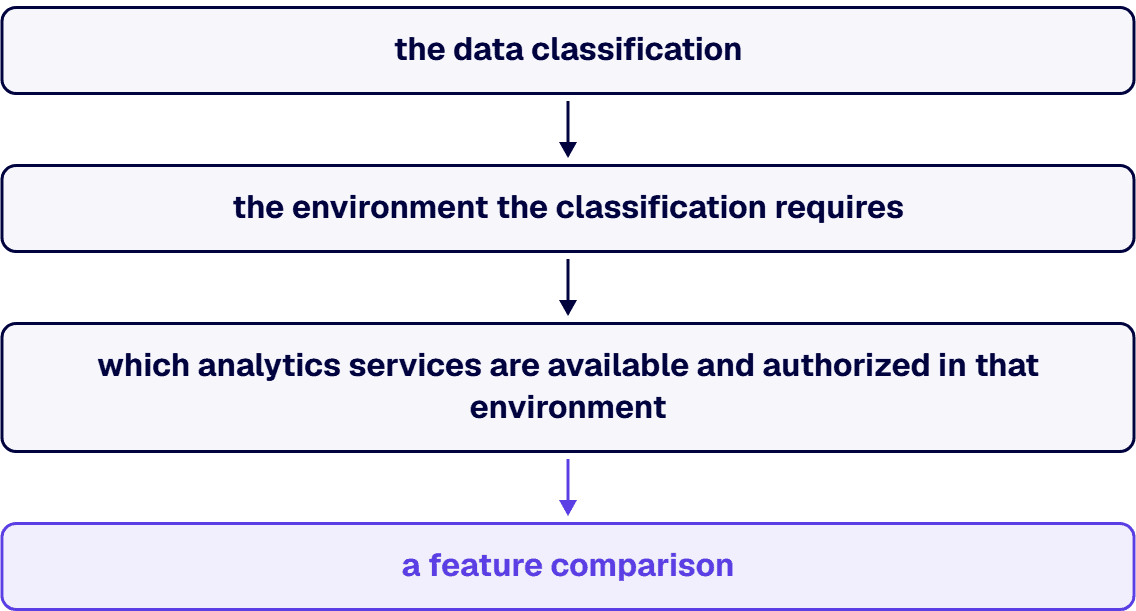
The question is better asked as which environment, because the environment sets the ceiling and the platform inherits it. A reporting tool running against data in a commercial tenant does not become suitable for controlled unclassified information because it has strong feature names. Determine the data classification first, then the environment the classification requires, then which analytics services are available and authorized in that environment at your impact level, checking service availability documentation and the FedRAMP Marketplace directly. Only then does a feature comparison mean anything. Firms that answer this with a product name have skipped the two steps that decide the outcome.
Rather than take a list on trust, test each candidate on three checkable things: named delivery inside a government cloud boundary at a stated impact level, the ability to map inherited against customer-responsibility controls on your architecture before quoting, and an evidence artifact from a comparable engagement. On the first of those, i3solutions has deployed Power BI inside a GCC High tenant and inside Azure Government for a federal customer. Separately, i3solutions installs and helps configure applications inside IL4 and IL6 government cloud environments and other government networks, runs migrations against named control families across CMMC, HIPAA, SOC 2, and NIST 800-171 producing artifacts auditors can review, and runs a governed Power Platform for a federal defense agency supporting roughly 10,000 personnel across about 180 locations. It does not hold a FedRAMP or Department of Defense authorization of its own, and any firm telling you it holds one on your behalf is describing something that is not theirs to give.
Custom Power BI dashboard development engagements at regulated enterprises typically range from $80,000 to $150,000 for a bounded project covering a single business area with a stable data source register, and from $300,000 to $750,000 for a multi-wave program covering enterprise-scale analytics capability with full governance, compliance evidence chains, and adoption work across multiple business units. Enterprise reporting system design consulting engagements at i3solutions typically range from approximately $180,000 to $750,000 for the full three-phase engagement. Analytics engagements delivered inside a government cloud boundary are the same type of services work as commercial engagements; the difference is additional compliance steps, not a pricing premium. Those steps take real hours, so a government contractor tends to land toward the firmer end of a band. The factors that move a program within the band are the number of regulatory frameworks, the number of environments, the state of the data source inventory, and the depth of the evidence package.
A dedicated team is one way to get the outcome, and it is not the requirement. What is required is that named things have named owners: who classifies a source, who certifies a dataset, who approves a workspace, who reviews access, and how long the audit trail is kept. In a smaller organization those can sit with two or three people who already have other jobs, provided the assignments are written down and the review cadence actually runs. What fails an assessment is not the absence of a team, it is the absence of an owner. Self-service analytics without that ownership model is how a regulated estate ends up with hundreds of reports nobody can attest to.
Not on its own, and the phrasing hides the split that matters. Under FedRAMP, authorizations are issued to cloud service offerings and published on the FedRAMP Marketplace, and Department of Defense provisional authorizations are issued under the DoD Cloud Computing Security Requirements Guide. Your own reporting system carries its own boundary, and your authority to operate is issued by your authorizing official on the strength of a package your organization owns. What an implementation firm can do is configure the analytics estate correctly inside the boundary, implement the controls that are yours rather than inherited, and produce the artifacts your package needs. That is most of the work, and it is not an authorization.
Administrative access to government environments carries personnel constraints, so in practice the answer is yes for anyone touching the environment, and it should be established in writing during scoping rather than at onboarding. Ask specifically where the people administering the tenant, the workspaces and the data gateway sit, because that is the access that matters and it is frequently the access nobody asked about. All i3solutions Power BI and analytics developers, architects, and consultants are 100% U.S.-based. i3solutions routes a senior U.S.-based engineer to a client call usually within one to two weeks.
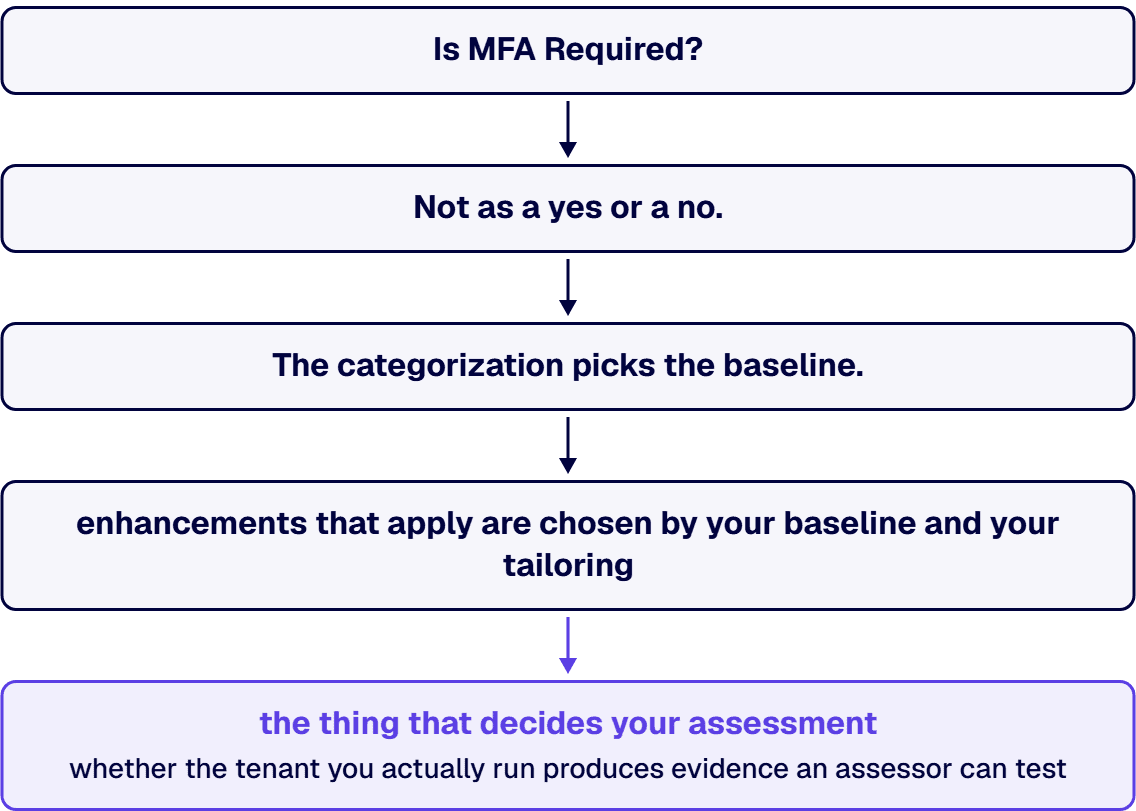
Not as a yes or a no. The question usually arrives at the worst moment for a vague answer: an assessor has asked for the IA-2 evidence, and someone in the room has already said “MFA is on for everyone.” NIST SP 800-53 is “a catalog of security and privacy controls for information systems and organizations” (NIST SP 800-53 Rev. 5, CSRC), and a catalog does not select itself. What a given system has to implement comes from a baseline, and NIST publishes the baselines separately in SP 800-53B, which “provides security and privacy control baselines for the Federal Government” with one baseline for each system impact level: “low-impact, moderate-impact, and high-impact” (NIST SP 800-53B, CSRC). The impact level is not a preference either; FIPS 199 is the standard for “categorizing federal information and information systems according to an agency’s level of concern for confidentiality, integrity, and availability” (FIPS 199, CSRC). Multi-factor authentication is in the catalog by name, and NIST’s own SP 800-53 Rev. 5 definition is “An authentication system or an authenticator that requires more than one authentication factor for successful authentication” (NIST CSRC glossary, sourced to SP 800-53 Rev. 5). So the honest answer for an IAM program is conditional: MFA is a named control area you will be assessed against, the specific IA-2 enhancements that apply are chosen by your baseline and your tailoring rather than by a vendor feature list, and the thing that decides your assessment is narrower still. It is whether the tenant you actually run produces evidence an assessor can test.
Three NIST documents do three different jobs, and most arguments about MFA collapse them into one. The catalog enumerates controls. The baseline selects them. The categorization picks the baseline. Nothing in that chain issues a blanket requirement to any organization that has not first been categorized.
NIST describes the catalog as controls that “are flexible and customizable and implemented as part of an organization-wide process to manage risk” (NIST SP 800-53 Rev. 5, CSRC). SP 800-53B then supplies the selection layer, including “a privacy baseline that is applied to systems irrespective of impact level” and, for the security side, “tailoring guidance and a set of working assumptions that help guide and inform the control selection process” (NIST SP 800-53B, CSRC). Tailoring is why two organizations at the same impact level can defensibly land on different identity configurations and both pass.
One limit is worth stating rather than papering over, because approximating a control allocation is how a program acquires a finding it did not need. The table that says which IA-2 enhancements sit in which baseline is published inside SP 800-53B itself (NIST SP 800-53B, CSRC), not in a summary of it. Read the allocation there, against your own categorization, and treat any page that tells you which enhancements you owe without knowing your impact level as guessing. This page is not making that determination and neither should a comparison article.
NIST is precise about what counts. Its SP 800-53 Rev. 5 definition adds that “Multi-factor authentication can be performed using a single authenticator that provides more than one factor or by a combination of authenticators that provide different factors,” and that “The three authentication factors are something you know, something you have, and something you are” (NIST CSRC glossary, sourced to SP 800-53 Rev. 5). A password plus a security question is one factor twice. That distinction is not pedantry at assessment time; it is the difference between a control that is implemented and a control that is claimed.
The control identifiers themselves are worth knowing before you open a policy console. Microsoft’s Azure Policy regulatory compliance documentation for the standard names the parent control “Identification and Authentication (organizational Users)” as “NIST SP 800-53 Rev. 5 IA-2”, and lists the enhancements individually (Microsoft Learn, NIST SP 800-53 Rev. 5 regulatory compliance details):
Microsoft attaches a caution to that same mapping which deserves more attention than it gets. Policy definitions “may help you assess compliance with the control; however, there often is not a one-to-one or complete match between a control and one or more policies,” and “compliance in Azure Policy is only a partial view of your overall compliance status” (Microsoft Learn, NIST SP 800-53 Rev. 5 regulatory compliance details). A green compliance dashboard is a signal, not an assessment result. The vendor says so itself.
In Microsoft Entra ID the enforcement surface is Conditional Access, and its logic is simple to state and easy to get wrong. Microsoft describes it plainly: “a Conditional Access policy is an if-then statement of Assignments and Access controls,” and “Multiple Conditional Access policies can apply to an individual user at any time. In this case, all applicable policies must be satisfied” (Microsoft Learn, Build a Conditional Access policy). Policies compose. Exclusions compose too, and an exclusion added during a migration cutover is the single most common reason a tenant that believes it enforces MFA does not.
Factor strength is a separate lever from factor count. An authentication strength “is a Microsoft Entra Conditional Access control that specifies which combinations of authentication methods users can use to access a resource” (Microsoft Learn, Conditional Access authentication strengths). If your program has committed to phishing-resistant authenticators for privileged roles, that commitment lives in an authentication strength, not in the MFA toggle, and an assessor who knows the platform will ask which one is bound to which role.
Four configuration questions decide most identity findings, and none of them is answered by whether MFA is enabled:
The platform-side view of that same work is on our identity and access management solutions hub, and if your estate is standardized on Okta rather than Entra ID, the platform-specific treatment is on Okta authentication and identity. This page stays on the NIST framing.
An assessor does not grade your intentions. The artifact is the log. Microsoft states that “Microsoft Entra logs all sign-ins into a Microsoft Entra tenant, which includes your internal apps and resources” (Microsoft Learn, What are Microsoft Entra sign-in logs?), which is the good news. The trap is in which view you are reading: “The legacy sign-in logs experience only includes interactive user sign-ins” (Microsoft Learn, What are Microsoft Entra sign-in logs?).
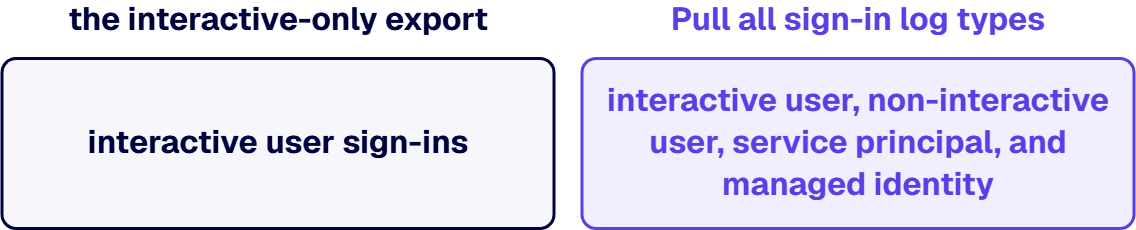
That single sentence explains a recurring pattern, and the pattern is worth naming inside your own program: the interactive-only export. A team pulls that one view, shows near-total MFA satisfaction, and never sees the non-interactive, service principal, and managed identity traffic where the exceptions live. The evidence package looked complete because the instrument only reported the population that was already compliant. Pull all four sign-in log types before you decide your identity control is evidenced, interactive user, non-interactive user, service principal, and managed identity, and confirm the retention window your tenant is actually keeping rather than assuming the platform default covers your assessment period.
Boundary questions change the answer again. If the data in scope pushes you toward a sovereign or restricted environment, the identity design and the evidence path both change, which is the territory covered on GCC High and sensitive data protection. If your driver is a contract rather than an authorization, the cost side of the adjacent framework is laid out on CMMC compliance cost.
The i3solutions Federal Compliance Assessment evaluates a client tenant against NIST SP 800-53 and CMMC using automated tenant configuration scripts and a 42-point security checklist. Scripted evaluation matters here for one reason: identity configuration is distributed across Conditional Access, the authentication methods policy, role assignments, and the log surfaces above, and a manual read of any one console will miss the interaction between them.
i3solutions engages its Federal Compliance Assessment when the scope spans a FedRAMP Moderate or FedRAMP High boundary, or when the client operates in a GCC High tenant. Below those thresholds the identity work is the same discipline at a smaller scale, and the governance context sits under enterprise governance and compliance solutions.
i3solutions advises clients on federal compliance posture as its own assessment rather than as a restatement of Microsoft’s documentation, including whether SharePoint Online meets NIST 800-53, whether Azure Government is required under the DoD Cloud Computing SRG, and whether a CMMC gap assessment is needed to bid. That is the practical difference between a system integrator that has to live in the tenant afterward and a reseller summary, and it is also where the boundary has to be stated out loud.
Advising on posture is not certifying posture. i3solutions does not certify, accredit, authorize, or attest any client’s compliance, and it holds no authorization to operate, no FedRAMP authorization at any level, and no DoD impact level accreditation of its own. Certification and authorization decisions belong to your assessor and your authorizing official. Any firm that offers to make your tenant compliant by asserting its own accreditation is describing something that does not exist. If you are evaluating firms rather than controls, the vendor-qualification angle is on hire an IAM implementation firm for GovCon, and the Power Platform side of federal compliance work is on hire Power Apps federal compliance consultants.
SP 800-53 is a control catalog rather than a mandate list. NIST describes it as a catalog of security and privacy controls whose controls are flexible and customizable and implemented as part of an organization-wide process to manage risk. Which controls apply to a specific system comes from the baseline in SP 800-53B, and which baseline applies comes from the FIPS 199 categorization of that system. Multi-factor authentication appears in the catalog as named IA-2 enhancements (NIST SP 800-53 Rev. 5, CSRC; enhancement titles per Microsoft Learn, NIST SP 800-53 Rev. 5 regulatory compliance details), so for a categorized federal system the question is not whether MFA is in scope as a control area but which enhancements your baseline selects and how you tailored them.
The parent control is IA-2, Identification and Authentication for organizational users, and the multi-factor requirements sit in its enhancements. Microsoft’s regulatory compliance documentation (Microsoft Learn, NIST SP 800-53 Rev. 5 regulatory compliance details) is the Azure Policy mapping for the standard. There the privileged-account enhancement is NIST SP 800-53 Rev. 5 IA-2 (1), which Microsoft titles Multi-factor Authentication to Privileged Accounts, and the non-privileged one is NIST SP 800-53 Rev. 5 IA-2 (2), which Microsoft titles Multi-factor Authentication to Non-privileged Accounts. The same Azure Policy mapping lists IA-2 (5) for individual authentication within group authentication and IA-2 (12) for acceptance of PIV credentials. Privileged and non-privileged accounts are deliberately separate enhancements, which is why a tenant-wide MFA statement rarely answers the control.
No. Microsoft states that its policy definitions may help you assess compliance with a control, that there often is not a one-to-one or complete match between a control and one or more policies, and that compliance in Azure Policy is only a partial view of your overall compliance status. Enforcement in Entra ID also composes across multiple Conditional Access policies, an authentication methods policy, and any exclusions you have configured. Compliance is demonstrated by evidence that your configuration produced the required outcome for the identities in scope, not by a feature being switched on.
No, and no vendor can, i3solutions included. Advising on posture is not certifying posture. i3solutions does not certify, accredit, authorize, or attest any client’s compliance, and it holds no authorization to operate, no FedRAMP authorization at any level, and no DoD impact level accreditation of its own. What is on offer is bounded and specific. The i3solutions Federal Compliance Assessment evaluates a client tenant against NIST SP 800-53 and CMMC using automated tenant configuration scripts and a 42-point security checklist. Certification and authorization decisions belong to your assessor and your authorizing official.
Two artifacts, together, for every population in scope: the policy configuration and the sign-in evidence. Microsoft logs all sign-ins into a tenant, but the legacy sign-in logs experience only includes interactive user sign-ins, so an export from that view can show near-total MFA satisfaction while the non-interactive, service principal, and managed identity traffic goes unexamined. That is the gap. Pull all four sign-in log types, interactive user, non-interactive user, service principal, and managed identity, keep the documented exclusion list for break-glass accounts, and confirm the retention window your tenant is actually keeping rather than assuming the platform default covers your assessment period.
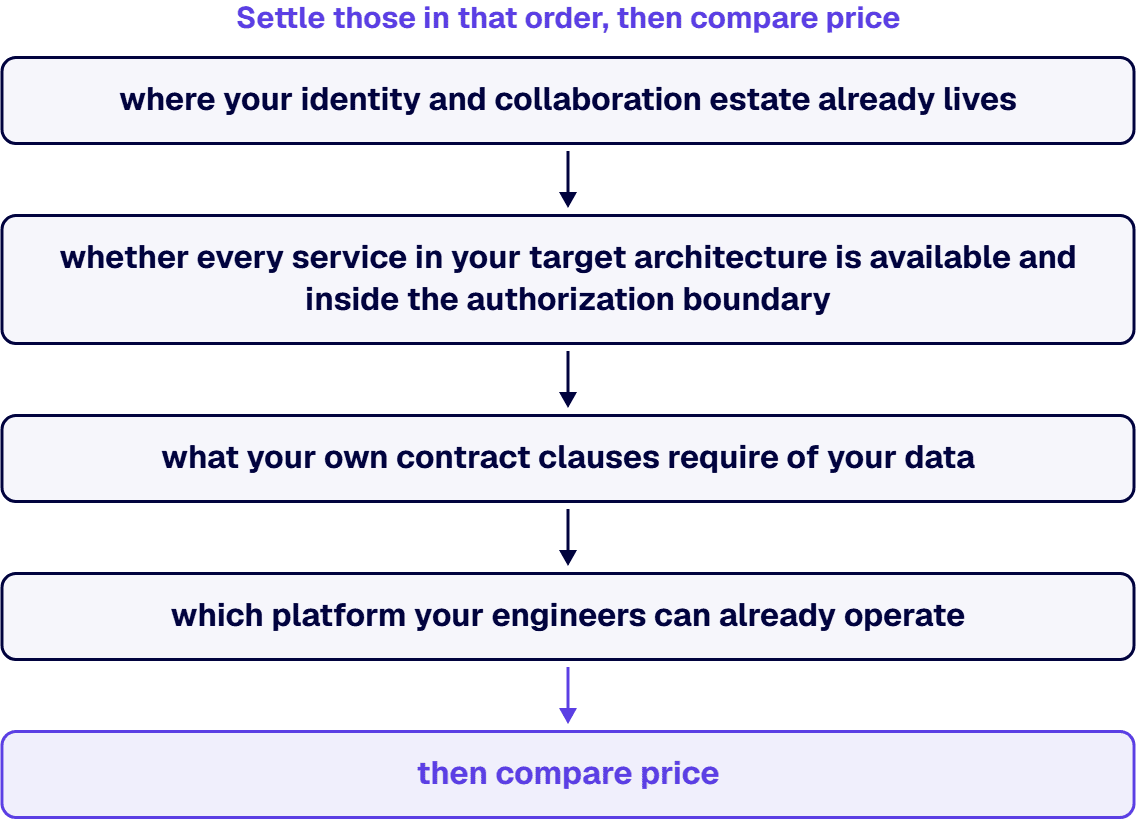
Neither platform wins on compliance ceiling, so the honest answer is conditional. Microsoft’s Azure Government documentation records a FedRAMP High Provisional Authorization to Operate issued by the FedRAMP Joint Authorization Board and DoD Impact Level 2, 4 and 5 Provisional Authorizations issued by DISA. AWS’s own DoD compliance page records AWS GovCloud (US) approved at Impact Levels 4 and 5 under a DISA provisional authorization. Both providers restrict operator access to screened US persons. At the levels most defense and civilian contractors actually work at, the two are peers, and a comparison that ends in a winner is usually selling something. What decides it is narrower: where your identity and collaboration estate already lives, whether every service in your target architecture is available and inside the authorization boundary of the specific government region you would deploy into, what your own contract clauses require of your data, and which platform your engineers can already operate at 2 a.m. Settle those four in that order, then compare price.
Say this plainly before anything else: i3solutions is a Microsoft firm. We hold no AWS delivery credential and we are not going to pretend otherwise on our own website. What we do have is the thing buyers actually need at this stage, which is a clear read on which criteria decide a government cloud platform choice and which ones only look like they do. If that read sends you to AWS GovCloud, that is a correct outcome and an AWS specialist is the right partner for it.
The authorization boundary and its vocabulary. The two vendors currently describe their FedRAMP status in different program language, and that trips buyers up more than any technical difference. Microsoft’s Azure Government compliance page states that Azure Government maintains a “FedRAMP High Provisional Authorization to Operate (P-ATO) issued by the FedRAMP Joint Authorization Board (JAB)” for the regions US Gov Arizona, US Gov Texas and US Gov Virginia. AWS’s FedRAMP page now states that “AWS GovCloud (US) is FedRAMP Certified Class D (formerly High baseline)” and that “AWS US East-West (Northern Virginia, Ohio, Oregon, Northern California) is FedRAMP Certified Class C (formerly Moderate baseline)”, adding that “The JAB Provisional Authority to Operate (P-ATO) previously issued to AWS is a legacy designation”. Read those side by side and the difference is program terminology, not security posture. Both government offerings sit at what was, and in Microsoft’s wording still is, the High baseline.
DoD impact levels. Microsoft’s page lists DoD IL2, IL4 and IL5 Provisional Authorizations issued by DISA for the three US Gov regions, and separately notes that “Some Azure services deployed in Azure Government regions (US Gov Arizona, US Gov Texas, and US Gov Virginia) require extra configuration to meet DoD IL5 compute and storage isolation requirements.” AWS’s DoD compliance page states that “AWS has been assessed and approved as a cloud service provider for the US East and US West Regions at Impact Level 2, AWS GovCloud (US) at Impact Levels 4 and 5, and the AWS Secret Region at Impact Level 6”, and that “At Impact Level 6, The AWS Secret Region holds a DoD provisional authorization for workloads up to and including Secret level.” Two things follow. At IL4 and IL5 the platforms are peers. Above IL5 both vendors move you into air-gapped clouds, and Microsoft’s comparison page is explicit that its published tables “do not include feature or bundle availability in the Azure Government Secret or Azure Government Top Secret clouds” and directs you to your account team. So on public documentation alone, AWS publishes an IL6 statement and Microsoft defers the equivalent conversation. That is a documentation difference, and treating it as a capability verdict would be reading too much into it.
Data residency and personnel screening. Microsoft states that “Azure Government uses physically isolated datacenters and networks located in the US only” and provides “an extra layer of protection to customers through contractual commitments regarding storage of customer data in the US and limiting potential access to systems processing customer data to screened US persons”, with customers “subject to validation of eligibility”. AWS describes GovCloud as “Two physically and logically isolated U.S. sovereign regions, AWS GovCloud (US-East and US-West), operated by U.S. citizens on U.S. soil”, and states that “Root Account holders must pass a screening process validating U.S. persons status and must be a (green card holder or citizen as defined by the U.S. Department of State).” Both are US persons regimes. The mechanics differ: Microsoft gates on tenant eligibility validation, AWS gates at the account root. If your export control counsel cares about who can touch the account, read both of those sentences with them rather than summarizing either.
Service parity in the region you would actually deploy into. This is where real projects break. Microsoft’s own comparison of Azure Government and global Azure warns that “Certain services and features that are in specific regions of global Azure might not be available in Azure Government” and that “Feature configurations in Azure Government might differ from those in global Azure”, pointing readers at the Products available by region listing “for the latest, up-to-date information on service availability”. The same caution applies on the AWS side. Neither vendor’s government cloud is a mirror of its commercial cloud, and the gaps move. Build the list of services your architecture depends on and check each one against the current listing before you commit.
Most of this work does not need outside help. Reading two vendor pages is not consulting. A partner earns the engagement in three places: turning contract clauses into a defensible data classification, verifying service availability and authorization boundary per service in the exact region you would deploy into, and pricing the cost of a split identity perimeter honestly before someone commits to one.
On the Microsoft side of that boundary, here is what i3solutions is attested to do. i3solutions advises clients on federal compliance posture as its own assessment rather than as a restatement of Microsoft’s documentation, including whether SharePoint Online meets NIST 800-53, whether Azure Government is required under the DoD Cloud Computing SRG, and whether a CMMC gap assessment is needed to bid. i3solutions plans and runs governed Azure and Microsoft 365 migrations with senior, U.S.-based engineers. i3 installs and helps configure applications inside IL4 and IL6 government cloud environments and other government networks. i3solutions is a Microsoft Partner with 30 years of delivery experience. i3solutions has completed more than 600 Microsoft platform implementations.
On the collaboration side: We manage GCC High migrations end-to-end: from eligibility validation and licensing coordination with your AOS-G supplier through identity architecture, data migration, security baseline configuration, and post-migration governance. i3solutions plans and runs these migrations for regulated defense organizations, structuring each phase around the compliance evidence assessors expect. Two boundaries inside that sentence are load bearing: i3solutions does not hold AOS-G status, and tenant provisioning itself is performed by a certified AOS-G supplier alongside whom i3solutions works.
What is not claimed, and should not be inferred. i3solutions does not hold a FedRAMP authorization at any impact level. i3solutions does not hold a DoD authorization of its own. i3solutions has not authorized, accredited or issued an authority to operate for any system. i3solutions has not performed a full tenant migration into IL4 or IL6. And i3solutions has no attested AWS delivery record, which is why every AWS statement on this page is a quotation from AWS’s own published documentation rather than a claim about our experience. Authorizations belong to the cloud service provider and to your own system boundary. Any consulting firm advertising one of its own is describing something that does not work the way the phrase implies, and that is worth checking on every firm you talk to, including this one.
If the decision lands on Microsoft, the next questions are practical rather than comparative: whether GCC High or GCC Moderate fits your obligations is covered in the GCC High versus GCC Moderate comparison, the sequencing and eligibility work is set out in the GCC High migration checklist, the workload move itself is described on the Azure Government migration page, the sensitive data boundary is covered on the GCC High and sensitive data protection page, and which multifactor authentication controls your baseline actually requires is set out on the MFA and NIST 800-53 identity page. If it lands on AWS, take this page’s criteria to an AWS specialist and make them answer the same four questions.
Neither, at the levels most government contractors operate at. Microsoft’s Azure Government compliance page records a FedRAMP High Provisional Authorization to Operate issued by the FedRAMP Joint Authorization Board and DoD Impact Level 2, 4 and 5 Provisional Authorizations issued by DISA. AWS’s FedRAMP page describes AWS GovCloud (US) as FedRAMP Certified Class D, formerly the High baseline, and its DoD compliance page records GovCloud approved at Impact Levels 4 and 5. Both restrict operator access to screened US persons. The compliance ceiling therefore rarely discriminates, and treating the comparison as a compliance contest is the most common way this decision goes wrong.
From each vendor’s own documentation: Azure Government maintains DoD Impact Level 2, Impact Level 4 and Impact Level 5 Provisional Authorizations issued by DISA for US Gov Arizona, US Gov Texas and US Gov Virginia, with Microsoft noting that some services in those regions require extra configuration to meet IL5 compute and storage isolation requirements. AWS states it is approved for US East and US West at Impact Level 2, AWS GovCloud (US) at Impact Levels 4 and 5, and the AWS Secret Region at Impact Level 6, holding a DoD provisional authorization for workloads up to and including Secret level. Above IL5 both vendors move you to air-gapped clouds, and Microsoft’s published comparison tables exclude its Secret and Top Secret clouds and direct you to your account team.
Four things, in this order. Where your identity and collaboration estate already lives, because running Microsoft 365 in a government cloud and the application estate somewhere else means operating two identity perimeters permanently. Whether every service your architecture needs is available and inside the authorization boundary of the specific government region you would deploy into, verified against each vendor’s current region listing rather than assumed from commercial parity. What your own contract clauses require of your data, which is a determination about your obligations rather than a property of a cloud. And which platform your engineering team can already operate under pressure, which is a legitimate input regularly treated as an embarrassing one.
No. i3solutions does not hold a FedRAMP authorization at any impact level, does not hold a DoD authorization of its own, has not authorized, accredited or issued an authority to operate for any system, and has not performed a full tenant migration into IL4 or IL6. What is attested is that i3 installs and helps configure applications inside IL4 and IL6 government cloud environments and other government networks. Authorizations belong to the cloud service provider and to your own system boundary. i3solutions is a Microsoft firm with no attested AWS delivery record, which is why every AWS fact on this page is quoted from AWS’s published documentation.
That is a contractual determination rather than a technical preference, and it should be made before the platform decision rather than justified after it. Microsoft’s own comparison states that global Azure and Azure Government are both assessed and authorized at the FedRAMP High impact level, and that what Azure Government adds is contractual commitments on storing customer data in the US and limiting access to screened US persons. So the government cloud question is really a question about your data classification and your export control exposure. If the classification says commercial is sufficient, a government cloud adds cost and service constraints for no benefit. If it does not, discovering that after you have built is the expensive path.
For Microsoft 365 government tenants, i3solutions publishes this directional band. Directional bands for organizations with 50 to 500 users: implementation costs typically range from $50,000 to $200,000, covering tenant provisioning, identity migration, data transfer, security configuration, and compliance validation. Treat that as a plausibility check against a defined scope rather than a quote. The variables that move it are user count, how many repositories are in scope, how much of the identity estate has to be rebuilt rather than migrated, and how many compliance frameworks the evidence has to satisfy. No equivalent band is published here for AWS GovCloud, because i3solutions has no attested AWS delivery record to base one on.
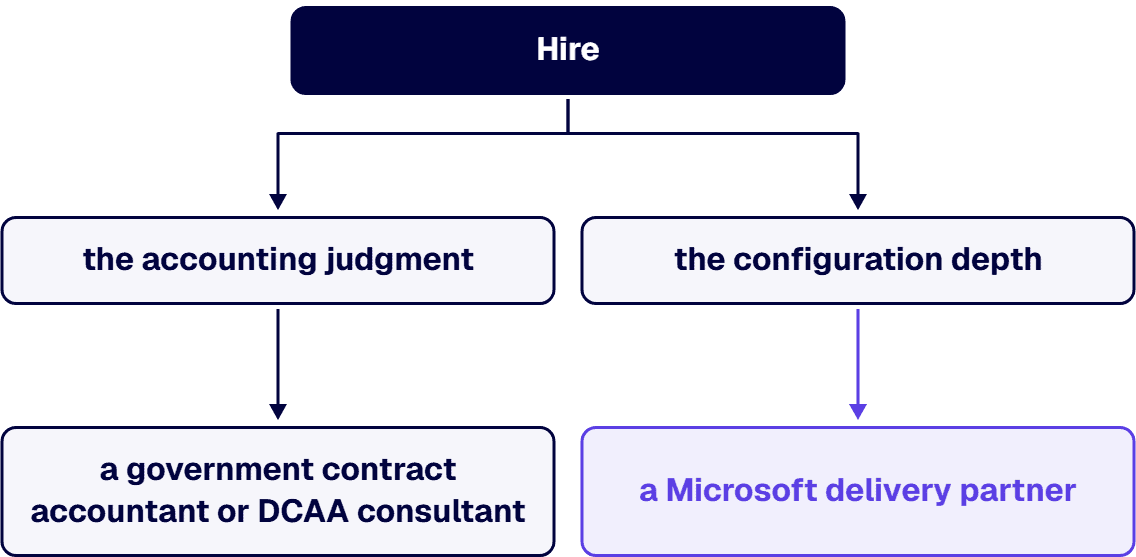
You hire two things, and they are not interchangeable. The first is a government contract accountant or DCAA consultant who owns the accounting judgment. The second is a Microsoft delivery partner that can configure Dynamics 365 to behave the way the published accounting system criteria require: contract and cost objective carried as data, timekeeping integrated to labor distribution, segregation of duties enforced in security roles, and logging that makes every posted entry traceable. Adequacy itself is a determination about your business system, made by the Defense Contract Audit Agency and your contracting officer against criteria published in DFARS 252.242-7006 and the SF 1408 preaward survey. No software product is DCAA certified, and no implementation partner can certify one. Hire the configuration depth and the accounting judgment separately, and make them work from the same requirements list.
Start from the primary sources rather than from a vendor summary. The accounting system criteria live in DFARS 252.242-7006, the clause that also defines what an acceptable accounting system means for a contractor business system. The preaward version of the same evaluation is the SF 1408 Preaward Survey of Prospective Contractor Accounting System. Cost allowability comes from FAR Part 31, with the direct and indirect cost definitions in FAR 31.202 and 31.203. Where Cost Accounting Standards apply, the standards themselves are published at 48 CFR Chapter 99. DCAA publishes its own contractor facing guidance in the Information for Contractors pamphlet, which is where the timekeeping expectations most implementations get wrong are written down in plain language.
Read those before you write a requirements document, because they are the requirements document. Five things in them translate directly into Dynamics 365 configuration decisions, and each one is a place where a general commercial implementation quietly diverges.
Most Microsoft partners can implement Dynamics 365. Far fewer have configured one that had to answer to a government contract auditor. Five questions separate them, and the useful ones are all answerable in a screen share rather than a capability statement.
i3solutions is a Microsoft delivery firm. The work described above is configuration, integration and data design work, which is what we do.
i3solutions has completed more than 20 Dynamics 365 integration engagements. i3solutions has delivered Dynamics 365 integration engagements for regulated enterprises across healthcare, defense and aerospace manufacturing, and financial services. All i3solutions Dynamics 365 developers and consultants are U.S.-based.
For federal and government contractor clients there is also a defined starting point. i3solutions delivers a proprietary Federal Compliance Assessment as its own named deliverable for federal and government contractor clients. The Federal Compliance Assessment is our own deliverable and produces our own findings. It is not a government determination, it is not an audit, and it does not substitute for one.
Two boundaries, stated plainly because they decide whether we are the right call. We do not perform audits and we do not issue attestations or certifications of any kind. And we do not represent i3solutions as your DCAA accounting authority: bring your government contract accountant or DCAA consultant, and we will build to the requirements they set.
i3solutions routes a senior U.S.-based engineer to a client call usually within one to two weeks.
No software is. DCAA evaluates a contractor accounting system against published criteria, and a system is made of configuration, integrations, policies and the people following them. Dynamics 365 can be configured to meet those criteria and can also be configured so that it cannot. The product is not the answer to the question.
No. An adequacy determination is made by the Defense Contract Audit Agency and your contracting officer. A partner configures the system, documents how it works, and produces the evidence you will be asked for. Anyone offering to certify adequacy is describing something they cannot do.
Both patterns are in use and the decision is not primarily technical. If your labor is project based and your workforce is on one payroll, Project Operations timesheets integrated to your payroll can carry it. If you have multi state payroll complexity, union rules or an existing timekeeping product your accountant already trusts, integrating that product is usually the lower risk path. What matters either way is that one system is the record for labor and the integration preserves the cost objective and the correction history.
Not by itself. The accounting system criteria say nothing about hosting. A government cloud requirement comes from the data you hold, most often controlled unclassified information under DFARS 252.204-7012, and that is a separate analysis. Run it separately and confirm app availability in the target cloud in writing before design.
Usually, and the cost is driven by one variable: whether the dimensions you need can be reconstructed from the postings you already have. Logging and segregation of duties are configuration changes you can make in weeks. A missing cost objective dimension across two years of history is the expensive case, because the remediation is a data exercise before it is a configuration exercise. Get that assessed before anyone quotes you a rebuild.
Hire for implementation and evidence, not for an authorization. FedRAMP and DoD provisional authorizations attach to cloud service offerings, not to the integrator you hire, and your own system still needs an authority to operate from your authorizing official. Require named delivery performed inside a government cloud boundary, control implementation mapped to families with assessor-ready artifacts, US-based staffing, and a written statement of what the firm will not do.
This is the selection where the wrong mental model costs the most. Buyers ask for a firm that will make them FedRAMP High and IL4 compliant, and a certain kind of vendor is happy to accept the framing. It is the wrong unit of account, and getting it right before you shortlist changes which firms are even eligible.
Three separate things get compressed into one request.
The cloud service offering is what gets authorized. FedRAMP authorizations are issued to cloud service offerings and published on the FedRAMP Marketplace. DoD provisional authorizations are issued under the Department of Defense Cloud Computing Security Requirements Guide, which defines the impact levels, including Impact Level 4 for controlled unclassified information, and the protections required at each. Whether a given offering currently carries a given authorization is a matter of published record. Check it at the FedRAMP Marketplace and the Department of Defense cloud service catalog, and check Microsoft’s own compliance documentation for Azure Government, rather than at any vendor’s page including this one.
Your system is not authorized because the platform is. Building on an authorized offering lets you inherit a defined set of controls. The remainder are yours, and your system carries its own authorization boundary. The authority to operate is issued by your authorizing official on the strength of your package, and where an independent assessment is required, it is performed by an accredited assessor rather than by your implementation partner.
The firm you hire does implementation and evidence. That is a genuinely large and genuinely skilled job: configuring workloads correctly inside the boundary, implementing the controls that are yours rather than inherited, and producing the artifacts your package needs. It is not an authorization, and no integrator can hand you one.
Which gives you the fastest disqualifier available. A firm that offers to make you FedRAMP High authorized is describing something that is not theirs to give. Ask the question early and listen for whether the answer distinguishes inherited controls from customer responsibility. Firms that have actually delivered in these environments reach for that distinction unprompted, because it is the first thing that shapes a real scope.
The pattern to watch for is the firm that answers question five with a longer capability list. The programs that go badly here are rarely the ones executed poorly. They are the ones where nobody wrote down which party owned the authorization work until the package was due.
The capability statement is narrow on purpose. i3 installs and helps configure applications inside IL4 and IL6 government cloud environments and other government networks. That is the work: applications and their configuration, performed inside those boundaries, alongside the identity, data and governance work that goes with them. i3solutions produces three named artifacts across an Azure Government or AWS GovCloud engagement: an Architecture Fit Assessment at discovery, a Landing Zone Blueprint and Compliance Matrix at design, and a Migration Risk and Cutover Runbook at execution, each one a mandatory gate check before the engagement moves to the next phase.
The published record behind it is a Digital Transformation program for a US military command, described in the case study without naming the organization. The delivered solutions, in the case study’s own words, are SharePoint Online Power Apps and Power Flows built inside the IL4 and IL6 Government hosted environments. These solutions are built on the IL4 and IL6 certified enclaves hosted in the Microsoft Cloud environment. The scale is on the record too. With over 10,000 personnel dispersed over 180 locations worldwide, the command’s outdated, largely manual system was extremely inadequate for the sheer size and diversity of its operations. With the input of numerous stakeholders and users within 50 different Major Subordinate Commands (MSCs), requirements for the new system were determined and enhancements to existing solutions were identified. The full account is in the digital transformation case study for a US military command.
Now the boundaries, stated plainly rather than left to inference. i3solutions does not hold a FedRAMP authorization at any impact level. It does not hold a Department of Defense authorization of its own. It does not authorize, accredit, or issue an authority to operate for any system, because those determinations sit with the government. And the record above is application delivery and configuration inside existing government environments, not a full tenant migration into IL4 or IL6. Any of those four would be a stronger sentence to write and none of them would be true, which is the whole reason this section exists on a page whose readers are buying assurance.
If your program also involves a Microsoft 365 government tenant rather than only Azure workloads, provisioning that tenant is a separate and mandatory role performed by a certified AOS-G supplier. It is worth naming that party in your plan before scoping, for the same reason the authorization split matters: an unnamed role becomes an unowned one at exactly the wrong moment.
The firm-level facts are straightforward. i3solutions is a Microsoft Solutions Partner. i3solutions has completed more than 600 Microsoft platform implementations. The delivery teams are senior US-based engineers rather than compliance generalists. Alongside the government cloud work, i3solutions runs a governed Power Platform for a federal defense agency supporting roughly 10,000 personnel across about 180 locations, which works because it is governed, not despite it.
Honest disqualification is cheaper than a bad engagement. i3solutions is not the right vehicle when you need an independent assessment performed, when you need a party to own and sign your authorization package, when the program needs a prime contractor fronting a large multi-vendor structure, when the requirement is lowest-price-technically-acceptable staffing, when your platform direction is away from Microsoft, or when you want a fixed price quoted on an estate nobody has inventoried, because a number produced that way is one we would not stand behind.
The fit is a defense or federal organization that has the environment decision made or nearly made, and needs applications configured and delivered correctly inside it, controls implemented and evidenced against named families, and the SharePoint, Power Platform and Azure work under it done by senior US-based engineers.
Shortlist two or three firms and ask each for the same four artifacts: a sample statement of work with the exclusions visible, the customer responsibility split they expect on your architecture, an evidence artifact from a comparable engagement, and their change-order trigger language. Verify every authorization claim at its primary source rather than in a capability deck, and weight the answers by which firm was most precise about what it does not do. In this market, that precision is the strongest available signal that a firm has actually been through an authorization cycle on someone’s program.
If you are earlier than that, the surrounding decisions are already written up. Read the Azure Government migration guide for the environment decision itself, the GCC High and GCC comparison if the question is a Microsoft 365 tenant rather than Azure workloads, ITAR and export control compliance in Microsoft 365 if export-controlled data is what is driving the requirement, and CMMC technology consultants if an assessment date rather than an environment is driving your calendar. When you are ready to test fit, i3solutions routes a senior U.S.-based engineer to a client call usually within one to two weeks, and you can reach the team by phone at 703.652.8966.
No. FedRAMP authorizations are issued to cloud service offerings and published on the FedRAMP Marketplace, and the system you build on top of an authorized offering carries its own authorization boundary. Your authority to operate is issued by your authorizing official, and where an independent assessment is required it is performed by an accredited assessor. What an implementation firm can do is configure workloads correctly inside the boundary, implement the controls that are yours rather than inherited, and produce the artifacts your package needs. A vendor offering to make you authorized is offering something that is not theirs to give.
No. i3solutions does not hold a FedRAMP authorization at any impact level and does not hold a Department of Defense authorization of its own. It does not authorize, accredit, or issue an authority to operate for any system. What i3solutions does is install and help configure applications inside IL4 and IL6 government cloud environments and other government networks, and implement and evidence controls in support of a package the government owns.
They are two different programs governing two different scopes. FedRAMP is the government-wide program for authorizing cloud service offerings for federal use, with Low, Moderate and High baselines built on NIST SP 800-53. The Department of Defense impact levels are defined in the DoD Cloud Computing Security Requirements Guide, which sets the information categories and required protections per level, with Impact Level 4 covering controlled unclassified information. A defense program frequently references both. The authoritative definitions live in the FedRAMP program documentation and the Security Requirements Guide, and those are the sources to read before a vendor’s summary of them, including this one.
It installs and helps configure applications inside IL4 and IL6 government cloud environments and other government networks. In the published record, that work is SharePoint Online Power Apps and Power Flows built inside the IL4 and IL6 Government hosted environments for a US military command, built on the IL4 and IL6 certified enclaves hosted in the Microsoft Cloud environment. It is application delivery and configuration inside environments that already exist, together with the identity, data and governance work around them. It is not a tenant migration into those environments and it is not an authorization activity.
Your authorizing official, on the strength of the package your organization owns. Inheriting controls from an authorized cloud service offering reduces the set you have to implement and evidence yourself, but it does not transfer the decision. Practically, that means your statement of work should name who drafts each artifact, who reviews it, and who signs, and it should say so before implementation starts rather than when the package is due.
Administrative access to government cloud environments carries personnel constraints, so in practice the answer is yes for anyone touching the environment. Establish where the delivery team sits in writing during scoping rather than at onboarding. i3solutions routes a senior U.S.-based engineer to a client call usually within one to two weeks.
Hire the firm that will tell you whether you need GCC High before it quotes the move. Verify government-cloud provisioning authorization with Microsoft directly, require named defense-sector delivery in the government cloud, insist on control-family mapping with assessor-ready artifacts, and confirm US-based staffing. Then check the scope the firm will not take.
GCC High is not a plan you can revise later. It is a separate tenant on separate identity infrastructure, licensed on an upfront commitment with no trial, and the partner who provisions it is effectively the partner who owns your first year in it. That is why firm selection carries more weight here than on almost any other Microsoft engagement, and why the vetting sequence below starts with a question most vendors would rather you skipped.
Most defense contractors asking about GCC High do not need it. What forces the government cloud is export-controlled data under ITAR or EAR, a DISA Impact Level requirement, DoD controlled unclassified information, or a contract clause that names the environment. CMMC certification by itself does not, and Microsoft’s own guidance says so. Our GCC vs GCC High comparison and the companion analysis of whether CMMC requires GCC High lay out the rules and the sources behind them.
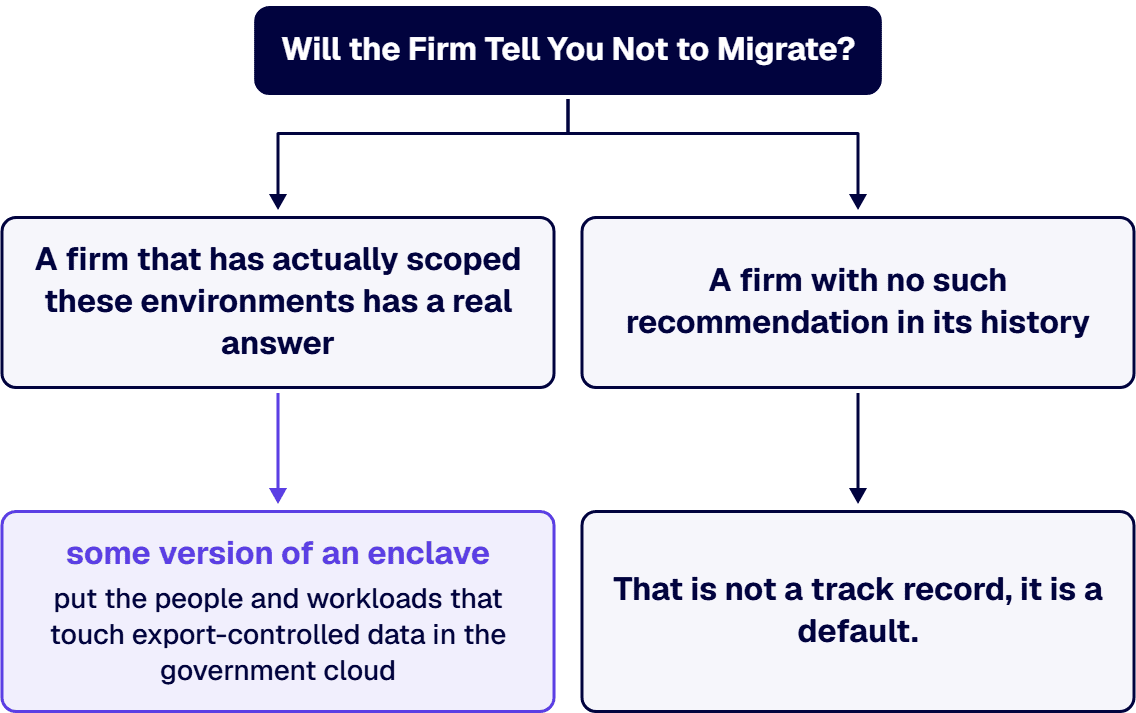
So the first thing to ask a candidate firm is not how it would run the migration. It is what evidence would make it recommend against one. A firm that has actually scoped these environments has a real answer, usually some version of an enclave: put the people and workloads that touch export-controlled data in the government cloud and leave the rest where they are. One i3solutions engagement resolved exactly that way. The assessment recommended partial-variant adoption with email and document storage on GCC High and the remainder of the productivity suite on Commercial; the contractor’s licensing economics improved materially relative to a full GCC High migration.
A firm with no such recommendation in its history is telling you something. Every GCC High program it has seen apparently needed a full tenant. That is not a track record, it is a default.
Every criterion here is checkable from public sources or a first scoping conversation. None of them requires you to take a vendor’s word.
Ask each shortlisted firm the same five questions and compare the specificity of the answers rather than the confidence:
The pattern to watch for is the firm that answers question one with a migration plan. The GCC High programs that go badly are rarely the ones that were executed poorly. They are the ones that were scoped as a platform move when the real problem was a data boundary.
If you want to test those questions against a real practitioner before you shortlist, a senior i3solutions engineer will walk your boundary with you: which data is actually driving the requirement, which workloads would stay on Commercial, and which of your integrations we would expect to break. You leave the call with the reasoning, whether or not you engage us, which is usually what a buyer needs to build the internal case before committing a tenant.
i3solutions works on the migration, compliance, and platform side of government-cloud environments, staffed by senior US-based engineers rather than compliance generalists. i3solutions runs migrations against named control families across CMMC, HIPAA, SOC 2, and NIST 800-171, producing artifacts auditors can review. i3solutions has completed more than 600 Microsoft platform implementations.
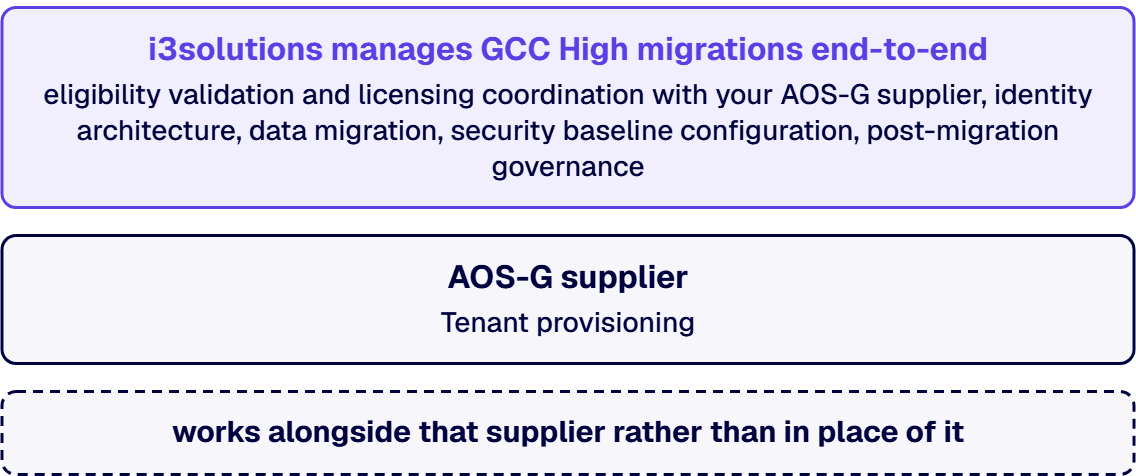
The sector record is specific. i3solutions has delivered enterprise SharePoint and Power Platform programs for aerospace and defense manufacturers, major defense organizations, a financial-services firm, a national healthcare system, and military organizations. i3solutions runs a governed Power Platform for a federal defense agency supporting roughly 10,000 personnel across about 180 locations, which works because it is governed, not despite it.
On GCC High specifically, i3solutions manages GCC High migrations end-to-end: from eligibility validation and licensing coordination with your AOS-G supplier through identity architecture, data migration, security baseline configuration, and post-migration governance. i3solutions plans and runs these migrations for regulated defense organizations, structuring each phase around the compliance evidence assessors expect. Tenant provisioning itself is a separate and mandatory role that a certified AOS-G supplier performs, and i3solutions works alongside that supplier rather than in place of it. Underneath the migration, i3 installs and helps configure applications inside IL4 and IL6 government cloud environments and other government networks. What i3solutions does not hold is a FedRAMP or DoD authorization of its own, and it does not accredit a system or issue an authority to operate; those determinations sit with the government.
One published client reference sits alongside that record, and it is worth being precise about what it measures. i3solutions built a proposal management system for a global aerospace and defense engine manufacturer on Power Apps, SharePoint, Teams, Dynamics, Power BI, and Flow, in an estate where, as the case study records, Office 365 provides web access to the team and allows the company to apply advanced security rules for SharePoint Online and GCC High. The published outcomes on that program are proposal-operations outcomes. The system centralized all proposal resources, cutting preparation time by 35% (from 10 days to 6.5). Automated validation workflows reduced rework by 30% and boosted compliance audit scores by 20%, minimizing late corrections and improving proposal accuracy. Those figures describe what changed in that manufacturer’s proposal process. They are not migration timelines and not a compliance determination, and we would rather label them than let them be read as GCC High delivery metrics. The full account is in the proposal management case study.
That is the record and its boundaries, stated plainly, because a firm-selection page that blurs what its own numbers measure fails its own first criterion.
Honest disqualification is cheaper than a bad engagement. i3solutions is not the right vehicle when the program needs a prime contractor fronting a large multi-vendor structure, when the requirement is lowest-price-technically-acceptable staffing, when your platform direction is away from Microsoft, or when you want a fixed price quoted on an estate nobody has inventoried, because a number produced that way is one we would not stand behind. We also do not perform certification assessments and cannot guarantee certification outcomes; those determinations belong to accredited assessors reviewing your environment and evidence.
The fit is a regulated or defense organization that needs the boundary decision made properly, the migration planned and run against the compliance evidence assessors expect, the controls implemented and evidenced inside a Microsoft estate, and the SharePoint and Power Platform work under it delivered by senior US-based engineers.
Two numbers are worth separating. Licensing is a published-price question with real sources, and the GCC High cost analysis shows where each figure comes from and which reseller published it, because Microsoft does not publish a public per-user list price for GCC High. Project cost is the harder half. Full migration project cost for defense contractors with SharePoint customizations and CMMC compliance scope typically lands in the $100,000 to $300,000 range. Which end of that band applies is decided by the application inventory, not by the vendor’s rate card, which is the practical reason the assessment comes before the committed number.
Government buyers weighing a committed number against scope risk can compare commercial structures in our guide to fixed-price SharePoint engagement models for government, which covers who offers one and how to vet them.
Shortlist two or three firms against the criteria above and ask each for the same four artifacts: a sample statement of work with the exclusions visible, the assessment deliverable that precedes their committed number, their change-order trigger language, and a compliance mapping artifact from a comparable engagement. Then weight the answers by who asked the most uncomfortable questions about your data boundary, because the firm that probes the boundary before quoting the tenant is the one whose plan will survive contact with your estate.
If you are earlier than that, the sequencing work is already written down. Start with the GCC High migration checklist for the phase structure, read the GCC High SharePoint migration guide if customizations and external sharing are your exposure, and look at CMMC technology consultants if the assessment date rather than the tenant is what is driving the calendar. When you are ready to test fit, i3solutions routes a senior U.S.-based engineer to a client call usually within one to two weeks, and you can reach the team by phone at 703.652.8966.
Microsoft gates GCC High eligibility validation and tenant provisioning through an authorized supplier, so that role is mandatory on every program. It does not have to sit with the firm running your implementation, and often it does not: the implementation firm coordinates eligibility and licensing with the authorized supplier, who performs the provisioning itself. What matters is that the role is named and verified through Microsoft’s partner directory before scoping rather than discovered when the tenant is due, and that your statement of work says which party owns it.
Usually no. CMMC certification by itself is not the deciding factor for choosing a cloud environment. What forces GCC High is export-controlled data under ITAR or EAR, a DISA Impact Level requirement, DoD controlled unclassified information, or a contract clause that names the environment. If none of those apply, the less restrictive government cloud is generally the right target, and a firm that cannot walk you through that test is not qualified to run the move.
An assessment first, then a committed number attached to an enumerated scope. Full migration project cost for defense contractors with SharePoint customizations and CMMC compliance scope typically lands in the $100,000 to $300,000 range. Where you land inside it is decided by the application inventory. Licensing is a separate question with published reseller sources; Microsoft does not publish a public per-user list price for GCC High.
i3solutions manages GCC High migrations end-to-end: eligibility validation and licensing coordination with your AOS-G supplier, identity architecture, data migration, security baseline configuration, and post-migration governance, with control implementation mapped to named families under CMMC, NIST SP 800-171, and DFARS and artifacts an assessor can review. i3solutions runs migrations against named control families across CMMC, HIPAA, SOC 2, and NIST 800-171, producing artifacts auditors can review. i3 installs and helps configure applications inside IL4 and IL6 government cloud environments and other government networks, and the SharePoint and Power Platform delivery runs on top of that. Tenant provisioning itself is performed by a certified AOS-G supplier that i3solutions works alongside, and i3solutions holds no FedRAMP or DoD authorization of its own and does not issue an authority to operate.
Administrative access to a GCC High environment carries personnel constraints, so in practice the answer is yes for anyone touching the tenant. Establish where the delivery team sits in writing during scoping rather than at onboarding. i3solutions routes a senior U.S.-based engineer to a client call usually within one to two weeks.
Third-party integration failure discovered during implementation instead of planning. Applications that work against commercial Microsoft 365 endpoints frequently have no government-cloud equivalent, and the replacement decision then lands mid-project. A written application and integration inventory in the assessment deliverable is the control for this, which is why it belongs in the criteria you shortlist on.
Settle ownership in writing before the partner starts. Your organization should keep the tenant, the decision about which data and workloads belong inside the boundary, the privileged administrator roles after handover, and approval of any change that touches the boundary. The partner owns the build it was hired to deliver, the configuration record, and the evidence artifacts, and hands each back on a named date. The minimum governance body is a steering group with authority over scope, budget, and the boundary, led by the internal program owner and attended by security, compliance, and the partner’s delivery lead. A Center of Excellence or shared services team is the home for the platform after cutover, holding the administrator roles, the change process, and the evidence from then on, so name who staffs it before cutover and the handover has a receiver. Ask each firm which roles it expects to hold after go-live and for how long; an answer that keeps administration with the firm indefinitely is a staffing model you are choosing, so choose it on purpose.
Require it in writing before award. On personnel, ask for the name and role of everyone who will hold administrative access, where each person sits, and what screening each has passed. On the Microsoft page Office 365 GCC High and DoD, last updated on 2026-08-03, Microsoft states that its staff don’t have standing access to GCC High and DoD production, and that any staff who request temporary permission elevation that would grant access to customer content must first pass background checks, including verification of U.S. citizenship and a fingerprint background check against FBI databases. That is a useful benchmark to set a firm’s answer against. On audit support, ask for a redacted compliance mapping artifact from a prior program and what the assessor asked about it. On sector experience, ask which environment the work ran in and which workloads were configured inside it. On the firm’s own supply chain, require every subcontractor to be named in the statement of work, with a clause that the same screening, location, and data handling terms apply to them and that no new subcontractor joins without your written approval. Licensing is a separate check: on the Microsoft page Microsoft 365 Government how to buy, last updated on 2024-08-13, Microsoft states that customers can purchase Microsoft 365 for US Government licenses only through select partners, so ask which licensing partner the firm will work with and confirm it on that page.
Ask every firm the same questions and compare the answers line by line. Which environment did each prior program run in: GCC High, or the DoD environment, which Microsoft states on its Office 365 US Government service description, last updated on 2026-09-29, is for the exclusive use of the United States Department of Defense? Did the firm’s people work inside the government boundary with administrative access, or adjacent to it, advising a team that held the access? Which data drove the requirement: controlled unclassified information, export-controlled data under ITAR or EAR, or federal contract information only? Which workloads moved, and which third-party integrations had to be replaced? And what did the assessor or the program office ask for afterward, shown as a redacted artifact? A firm whose experience is commercial Microsoft 365 work described in government terms will answer the first two in general language; a firm that has done the work will name the environment, the access it held, and the artifact.
Hire a firm that has delivered Power Apps inside a government cloud boundary, because the first decision on a federally regulated Power Apps program is not an app decision at all: it is which cloud the platform runs in. Microsoft operates Power Apps in four distinct environments, and the compliance ceiling is set before the first screen is built. Commercial cloud carries no government-specific commitments. Power Apps US Government GCC is built to FedRAMP High and DoD DISA IL2 with support for CJIS requirements. GCC High aligns to DISA SRG IL4, requires Microsoft Entra Government identities, and is the environment Microsoft operates so defense contractors can meet ITAR commitments and DFARS acquisition regulations. The DoD environment aligns to IL5 and is available to DoD entities only (Microsoft Learn, Power Apps US Government service description, accessed August 2026). A consultant who cannot walk you through that decision with your data types on the table is not a federal compliance consultant, whatever the proposal says.
Most organizations arrive at this hire in one of two postures: an authorization deadline with apps already built in the wrong cloud, or a program not yet started that nobody wants to build twice. The vetting checklist below works for both, because the discipline being vetted is the same.
The environment decision. Everything inherits from it: identity (public Entra ID in GCC versus Entra Government in GCC High), data residency (US Government customer content is stored in US datacenters with access restricted to screened US-citizen personnel), available connectors, and which authorizations your assessor can inherit. Choosing wrong is expensive in both directions: commercial for CUI is a finding, and GCC High for a workload that never touches controlled data buys cost and feature lag for nothing. Our comparison of GCC High versus GCC and the GCC High migration checklist cover the decision in depth.
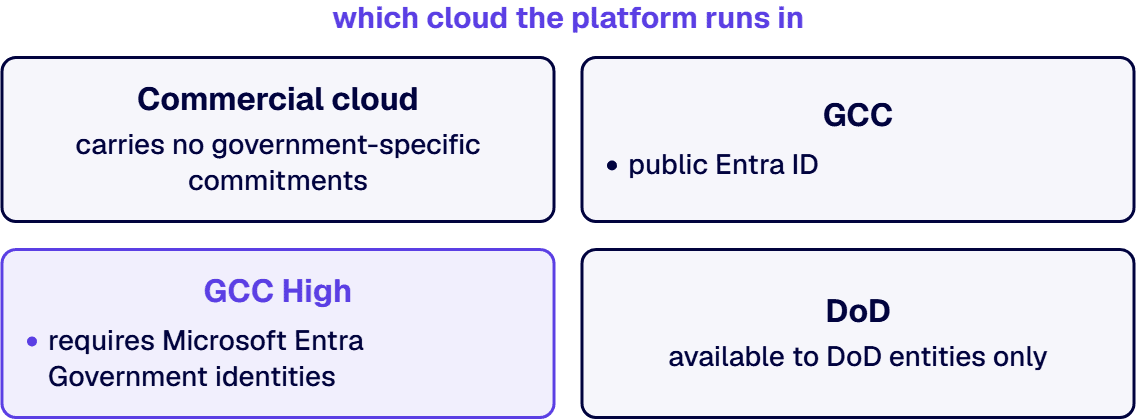
The boundary discipline. Power Apps can reach almost anything through connectors, and that reach is the compliance risk. Third-party connectors move data to systems outside the accreditation boundary, where the platform’s compliance commitments do not follow. Federal-grade Power Apps work therefore starts with DLP policies that partition connectors into business and non-business groups per environment, an environment strategy that keeps regulated workloads out of the default environment, and a review gate before any new connector reaches a production app.
The evidence layer. An Authority to Operate is granted on evidence, not intent. The platform side (FedRAMP artifacts, DISA provisional authorizations) is Microsoft’s to provide and your agency reviews it; the application side is yours: who can run the app, where its data lives, which flows touch it, and how changes move to production through application lifecycle management. i3solutions delivery includes ALM practices with Power Platform pipelines or Azure DevOps integration, environment separation strategies, and change control processes, because those are precisely the artifacts an assessor asks to see.
1. The environment recommendation in writing, with reasoning. Which of commercial, GCC, GCC High, or DoD, and why, mapped to your actual data types: CUI, ITAR-controlled technical data, CJIS, or none of the above. If the firm’s answer does not change when your data types change, it is a template.
2. Named federal delivery at scale. Ask what they have run inside a government boundary, at what scale, and what governed it. i3solutions deployed Power Platform across a federal defense intelligence command spanning 10,000 personnel and 180 locations, and runs a governed Power Platform for a federal defense agency at that same scale, which works because it is governed, not despite it. That delivery depth comes from the broader i3solutions Power Platform development services practice, which spans app development, automation, and governance.
3. A DLP and environment design, not just app screens. The proposal should name the environment strategy and the connector policy that will hold your apps, before it names features. Compliance lives in that machinery; the app merely inherits it. This is the same discipline that separates governed platforms from shadow IT, covered in our treatment of citizen developer governance.
4. Framework fluency in your language. NIST 800-171 for CUI in nonfederal systems, the FedRAMP baseline your agency inherits, CMMC if you sit in the defense supply chain. i3solutions runs delivery against named control families across CMMC, HIPAA, SOC 2, and NIST 800-171, producing artifacts auditors can review, and our teams maintain dedicated compliance specialists whose audit trails and controls map be written in your assessor’s framework, not its own methodology’s vocabulary.
5. US-based delivery. For ITAR-scoped work this is not a preference, it is a requirement: access by foreign persons is itself a controlled event. Ask where every person on the delivery team sits and what the firm’s screening practice is. i3solutions was co-founded 30 years ago around US-based expert teams delivering across the Microsoft stack, and is a Microsoft Partner.
6. Licensing path fluency for government clouds. Power Apps US Government plans are sold as per-user and per-app government plans through government channels, and the Cloud Solution Provider channel is not available for GCC High. Feature parity with commercial also has documented exceptions. A consultant who prices your program from the commercial pricing page has not done this before.
A defensible federal Power Apps engagement runs in three phases. First, the boundary work: data classification, environment selection, identity model, and the DLP policy set, produced as written artifacts your authorizing official can review. Second, the build, inside that boundary from day one, with ALM pipelines and change control rather than a compliance pass at the end; retrofitting compliance onto a finished app is where federal Power Apps programs go to die. Third, the operating rhythm: access reviews, connector governance, and the evidence file that keeps the next assessment an update rather than an excavation. If you are also weighing platform choices upstream of this work, our Power Apps development practice and CMMC technology readiness services are the two doors into it.
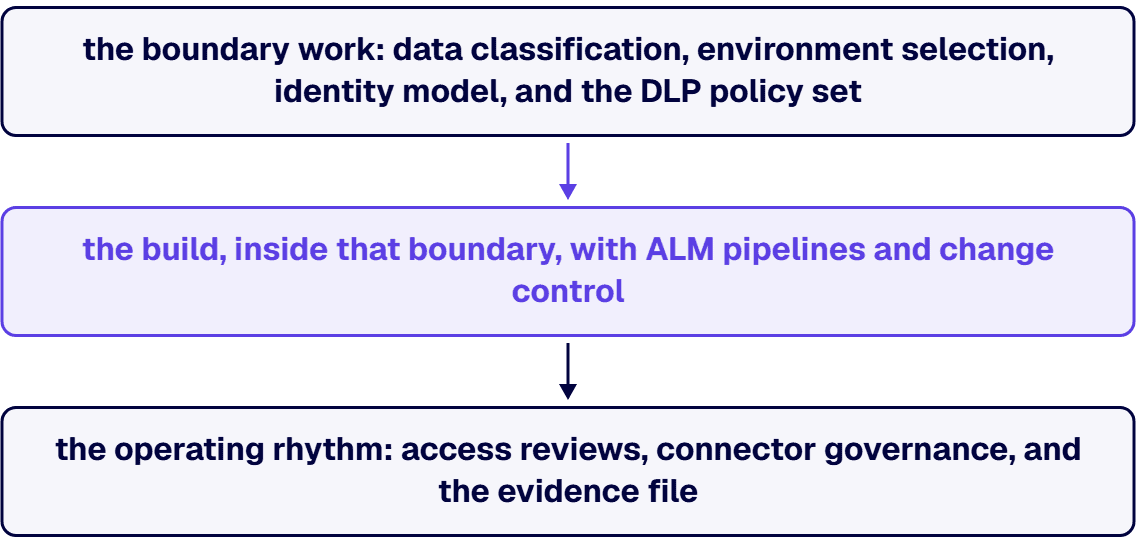
Power Apps US Government is designed to support FedRAMP accreditation at the High impact level, and Power Apps has been authorized as a service within the Azure Government FedRAMP ATO; agencies can review the artifacts through the FedRAMP Marketplace in support of their own ATO decisions. Commercial Power Apps does not carry the US Government environment’s commitments, which is why the environment decision comes first.
The decision turns on your data classification. GCC is built to FedRAMP High and DISA IL2 and supports CJIS requirements. GCC High aligns to DISA SRG IL4, uses Entra Government identities, and is the environment Microsoft operates for ITAR commitments and DFARS requirements, which is why defense contractors handling controlled technical data land there. Making this call against your actual data inventory is the first deliverable of a competent engagement.
For workloads with no government-regulated data, yes, with ordinary governance. For CUI, ITAR, or CJIS data, the US Government environments exist precisely because the commercial platform does not carry those commitments. The expensive failure mode is discovering this after the app is built, when migration means rebuilding connections, identities, and any connector the sovereign cloud does not offer.
No. Third-party connectors move your data to systems outside the Power Apps US Government infrastructure, and Microsoft’s compliance and data protection commitments do not extend to them. This is why DLP policy design, not app review, is the load-bearing compliance control in Power Apps: it decides which connectors can ever appear in a regulated environment.
US federal, state, local, tribal, and territorial government entities, plus organizations that handle government-regulated data such as ITAR technical data or CJIS law enforcement data, subject to Microsoft’s validation of eligibility, which can require sponsorship by a government entity. The DoD environment is available to DoD entities only. Eligibility is revalidated at contract renewal.
A written boundary design: your data classified, the environment named with reasoning, the identity model, the DLP policy set, and the licensing path through government channels. It is short, it is reviewable by your authorizing official, and everything built afterward inherits its accuracy. A firm that wants to start building screens first is optimizing for its burn rate, not your authorization.
Reviewed by Michael Branson, Founder/COO, i3solutions. Michael co-founded i3solutions 30 years ago and brings executive, operational, and technical perspective to organizations working in secure, compliance-bound Microsoft environments.
Governed Microsoft 365 support for a regulated estate is provided by a partner that runs your tenant as governed operations, not as a break/fix help desk. The difference is what happens between tickets: change control on every configuration change, scheduled access reviews, upkeep of DLP and sensitivity labels, a patch and lifecycle rhythm, and retained audit evidence a regulator can review. i3solutions delivers this with senior, U.S.-based specialists and named senior architect availability, keeping the estate governed without taking ownership of your team or locking you in.
A conventional Microsoft 365 help desk answers questions and closes tickets. That keeps users working, but
it does nothing to keep a regulated estate defensible. In a CMMC, HIPAA, SOC 2, or NIST 800-171 environment
the risk is not the outage a user reports; it is the quiet configuration drift nobody filed a ticket for: an
external sharing policy loosened for one project and never restored, a sensitivity label that stopped applying,
an access grant that outlived the person who needed it. Governed support treats every one of those as a
controlled event with a record, which is exactly what an auditor asks to see.
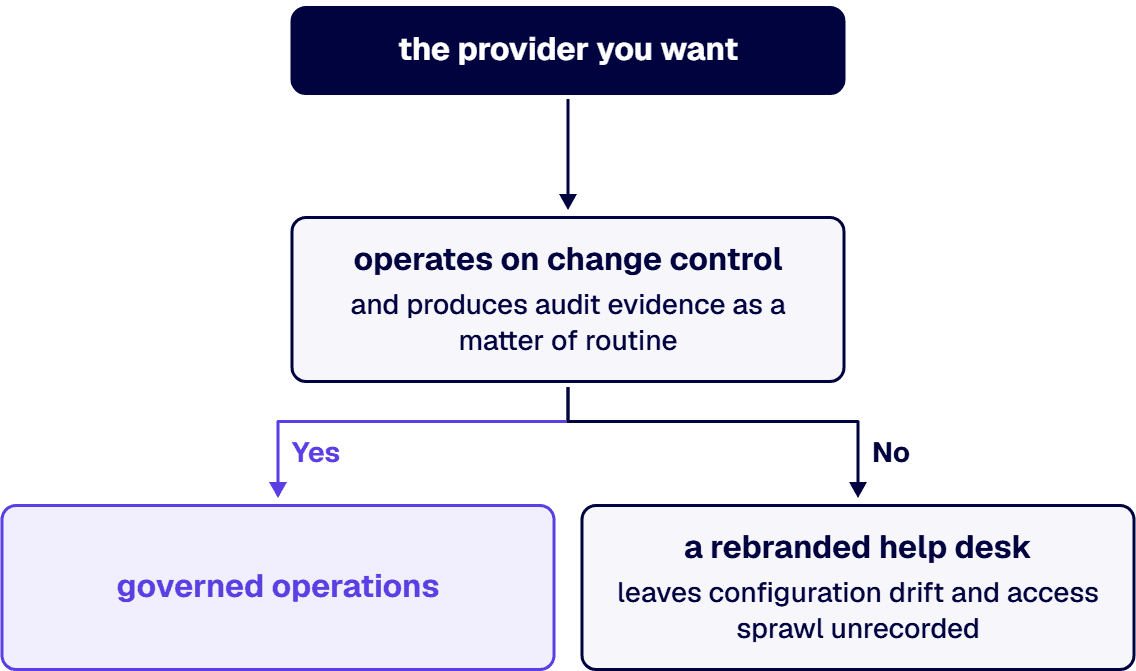
So the provider you want is not the one with the fastest response time. It is the one whose support runs on
change control and produces evidence as a byproduct of day-to-day operations.
These five disciplines are the spine of governed operations. Related reading: i3solutions’
complete governance guide for Microsoft 365
covers how the underlying framework is designed, and the
Microsoft 365 support services page
covers the broader support and helpdesk scope. This page is about running that framework as ongoing,
evidence-producing support.
i3solutions runs Microsoft 365 support as governed operations for regulated organizations, staffed by
senior, U.S.-based specialists rather than a rotating tier-one queue. The model is built around a few
attested capabilities:
Before you sign a regulated estate over to any provider, require these five things in writing. Each one
separates governed operations from a rebranded help desk:
Conventional support answers questions and restores service. Governed support does that too, but every
change runs through change control, access is reviewed on a schedule, DLP and labels are actively maintained,
and audit evidence is retained continuously. In a regulated estate, that evidence trail is the point: it is
what keeps the tenant defensible between audits, not just usable between outages.
A partner that runs support as governed operations rather than break/fix. i3solutions provides this for
regulated organizations with senior, U.S.-based specialists, dedicated compliance staff who understand CMMC,
HIPAA, SOC 2, and NIST 800-171, and named senior architect availability, without taking ownership of your
internal team.
No. An i3solutions engagement does not produce managed-service ownership, a replacement for the internal
team, open-ended scope expansion, or vendor lock-in. Governed support augments your team and keeps the estate
governed while your team stays in control of it.
Because the evidence already exists. i3solutions maintains audit-trail documentation and access control
frameworks mapped to named control families, which is why teams working this way reduce audit preparation
time by 60%. When the auditor asks who changed a policy and when, the record is already there.
It is priced as an ongoing engagement, not per ticket. i3solutions governance subscription engagements
typically start at $18,000 per month covering framework maintenance, compliance alignment monitoring, and
named senior architect availability. Independent oversight runs $25,000 to $65,000 per month, and embedded
senior U.S.-based specialists run $28,000 to $48,000 per specialist per month. Where an estate lands depends
on its size and how many compliance frameworks anchor it.
Only if it operates on change control and produces audit evidence as a matter of routine. Many managed
service providers are optimized for uptime and ticket volume, which keeps users working but leaves
configuration drift and access sprawl unrecorded. For a CMMC, HIPAA, SOC 2, or NIST 800-171 estate, require a
provider whose support model is governed by design and whose senior staff sit where your data-residency rules
allow.
Governed support should treat a Microsoft change the way it treats its own: a named person reads each Message
center post for the services in scope, records what it changes for your controls and who approved the
response, and sees that any required action is done before its Act by date. Microsoft says it announces
significant updates first on its roadmap, now the Microsoft AI at Work Roadmap (formerly the Microsoft 365
Roadmap), and communicates major updates at least 30 days ahead when action is required. Targeted release lets
selected IT staff and power users test a change before it reaches everyone. As of October 2026, Microsoft says
Targeted and Standard release are available in GCC, GCC High, and DoD, while the newer modern Standard and
Deferred options are not. Keep the decision record outside Message center, where posts expire.

US-Based Microsoft System Integrator | Est. 1997
© i3solutions. All rights reserved.
US-Based Microsoft System Integrator | Est. 1997
© i3solutions. All rights reserved.


