
Delivery questions become urgent once a roadmap gets approved and the team meant to execute it is already stretched. These answers address what a capacity review assesses, what a discovery engagement has to produce, and when more Microsoft expertise gets added in-house, brought in through a partner, or deferred.
When a Microsoft implementation is going wrong, the decision in front of you is not who to hire next. It is whether the team delivering it can be stabilized or has to be replaced, and those are different problems with different costs. Stabilize when the delivery problem is a structure problem: the scope was never bounded, the acceptance criteria were never written down, the environments were never separated, or nobody owns the decisions. A capable team inside a broken structure produces exactly what you are seeing, and changing the team changes nothing. Replace when the delivery problem is a capability problem: the work that exists cannot be made to meet the standard the environment requires, or the people who understood the design are no longer on the engagement. Structure repairs do not create competence that was never there. Four tests separate the two, and they are run against artifacts and not against opinions: the decision record, the environment separation, the build reproducibility, and the acceptance definition. Where two tests disagree, the estate is telling you the problem is mixed, and a mixed answer means stabilize the structure first and re-run the capability tests against the repaired structure before deciding anything about the team. Whichever way the decision goes, the sequence that follows is the same: take custody of the environments and the code, capture what only the current team knows before it leaves, and re-baseline against what is actually built and not against the plan.
The decision here is about your program, not about anyone’s reputation. This page works from criteria and from situations, and it names no firms.
The question arrives as “should we fire them.” It is almost never the useful version of the question.
Two situations produce identical symptoms from where you sit. A schedule that keeps moving, demos that show the same thing twice, defects that reappear after they were closed, and a team that cannot answer what was decided or when. Those symptoms are consistent with a team that cannot do the work, and they are equally consistent with a competent team operating inside a program that never gave them a bounded scope, a decision owner, or a definition of done.
Replacing a team fixes the first situation. It makes the second situation worse, because the replacement inherits the same unbounded scope with less context than the people who just left. That is the failure mode worth naming plainly: a change of team is a reset of context, and context is the thing a struggling program has least of.
So the sequence is: test the structure, test the capability, then decide about the team. In that order, because the structure tests are cheap and they are run against artifacts your own tenant already produces.
Each test names the surface that produces its evidence. If the surface is empty, that is itself the finding, and an empty surface is a structure finding and not a capability finding.
How to read the four together. Two or more tests failing on the STRUCTURE side, meaning no decision record and no acceptance definition, is a program that has not been set up to succeed, and the delivery team is not the variable to change first. Two or more failing on the CAPABILITY side, meaning environments that were never separated and a build nobody can reproduce, is work product that will not meet a regulated standard regardless of who continues it.
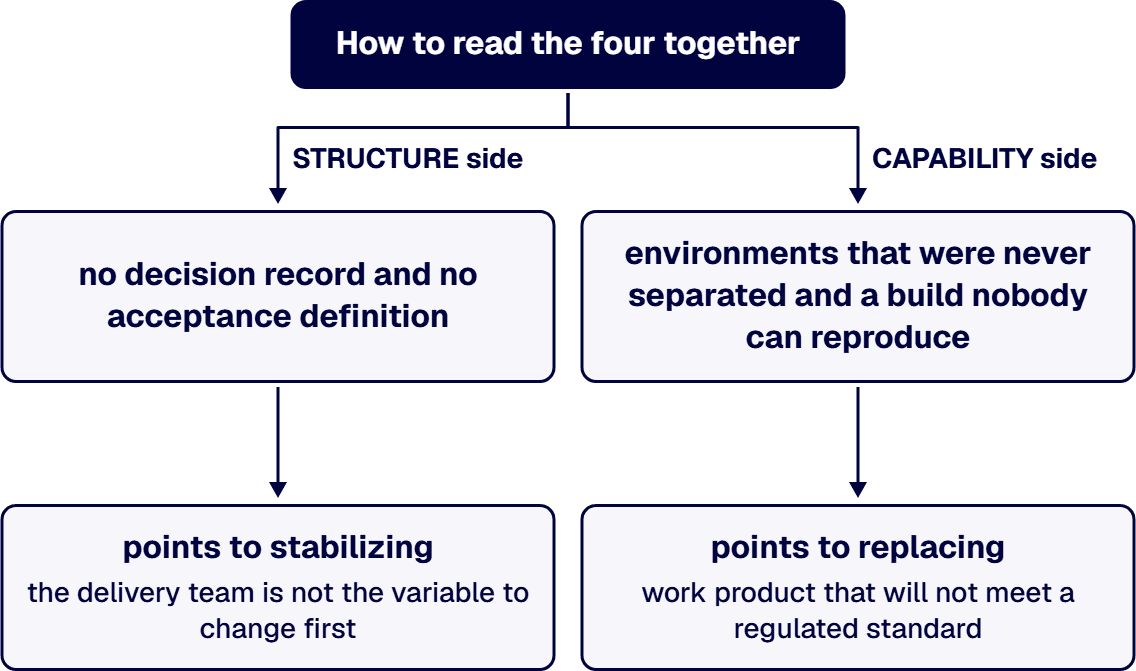
When two tests disagree, the answer is not to average them. A program with a clean decision record and an unreproducible build has a competent process and an under-skilled implementation, and that is a replace-the-implementation situation, not a replace-the-team situation: the same structure will support new hands. A program with separated environments and no acceptance definition has capable engineers and an absent owner, and that is yours to fix, not theirs.
Stabilizing is not patience. It is a set of specific changes to how the program is run, made in a fixed order because each one depends on the one before it.
Bound the scope to what is already built. Not to the original plan. Take the inventory of what exists in the environments listed above, and declare that the current release contains those things and nothing else. Everything else moves to a named later release. A program that cannot draw this line has not stabilized; it has paused.
Name one decision owner with the authority to say no. Steering committees do not make delivery decisions at the pace delivery needs them. One person, named, whose decisions the delivery team can act on without a further meeting.
Write the acceptance criteria before the next unit of work starts. In the tracker, on the work item, dated. This is the artifact that ends the loop where a demo is followed by a new requirement.
Separate the environments if they are not separated. This is usually the largest single piece of work in a stabilization, and it is the one most often deferred because it produces nothing a stakeholder can see. It is also the change that makes every subsequent change safe.
Re-baseline the schedule against the bounded scope, and let the new date be whatever the inventory says it is. A stabilization that keeps the original date has changed nothing that matters.
If those five changes are made and delivery does not respond, the structure hypothesis has been tested and failed, and the decision moves to replacement with evidence behind it instead of frustration.
Stabilization is a hypothesis, and a hypothesis nobody can disprove is not being tested. The conditions that close it are written down before the five changes start, not discovered afterwards, because a program that has never agreed what failure looks like finds out by attrition instead.
Four conditions close the stabilize option. Each is stated against an artifact rather than against an impression, so that someone who was not in the room can check it.
The scope line will not hold. The release was bounded to what exists in the environments, and items outside that line keep arriving back inside the current release. Evidence: the work item history in the tracker, queried for items added to the current iteration after the date the scope was declared, with the account that moved each one. Read the account column before drawing any conclusion from the count. Where your own stakeholders are the ones adding the items, stabilization has still failed, and replacing the delivery team will not hold the line either, because the line was never theirs to hold.
Acceptance criteria now exist, and work still comes back. Criteria are written on the work item and dated before the work started, and items are still reopened after they were accepted. Evidence: the state-change history on those items, exported from the tracker, showing the accepted-then-reopened transitions. This is the least ambiguous capability signal on the page, because the structural defence has been removed: the team was told in writing what done meant, before starting, and returned something else.
The environments were separated and the build still cannot be reproduced. A promotion path exists between development, test and production, and a managed solution exported from the Power Platform admin center still fails to import into an empty environment, or a fresh clone still fails to build from the pipeline definition in Azure DevOps Pipelines. Evidence: the solution import log and the pipeline run history, both of which persist and both of which export. Structure was the stated blocker, structure was removed, and the artifact still does not reproduce.
A decision owner is deciding and nothing downstream moves. One person holds the authority to say no, decisions are being issued and dated, and the delivery position does not change against them. Evidence: the decision record created during stabilization, read next to the work item state changes over the same span. Decisions that produce no state change downstream mean the constraint was never the absence of decisions.
When two of these conditions disagree, the artifact outranks the account of it, and the environment outranks both. A tracker showing a held scope line while the environments contain work nobody scoped is not a disagreement to be averaged. It means the tracker has stopped describing the system, which is a finding about the structure and not about the team, and it is repaired before anything is concluded about anyone.
None of these conditions is a deadline and none is a count of weeks. They are states, and a program arrives at them when it arrives. What they buy is the difference between replacing a team because the evidence closed the alternative, and replacing it because everyone is tired.
A transition is a custody problem before it is a staffing problem. The order below is set by dependency: each step needs the one before it, and the calendar it runs on is set by the condition of the estate and not by any schedule an incoming team would offer you.
Take custody first, then announce. Custody means the things that stop being available the moment a relationship ends: administrative access, source control, the pipeline definitions, the environment ownership, the deployment credentials, and the documentation wherever it actually lives and not wherever it was supposed to live. Confirm each one by using it, not by being told it has been handed over. An administrator account you have not signed into is not custody.
Verify the inventory against the environments, not against the report. Every solution, site, app, flow, pipeline, integration and scheduled job that exists in the tenant. The Power Platform admin center lists environments and their solutions; the Azure portal lists resources by resource group; the Microsoft 365 admin center and the SharePoint admin center list the collaboration surfaces. What is running is the truth. The status report is a claim about the truth.
Capture what only people know before those people leave. This is the step that is skipped, and it is the one that cannot be recovered afterward. It is treated separately below because it deserves its own answer.
Freeze changes across the boundary. No new functional work while custody is transferring. Defect repairs and security work continue; anything that changes behaviour waits until one team is accountable for the result.
Re-baseline against what is built. The incoming team’s first commitment is made against the verified inventory, never against the outgoing plan. A team that commits to the old date before it has seen the environments is telling you something about how it will handle the rest of the engagement.
Two things this page will not tell you, because the honest answer is that they depend on your contract and your estate: how long the transition takes, and what it costs. Both are set by the size of the inventory and the terms already signed, and any number offered before the inventory exists is a guess wearing a number’s clothes.
Custody, above, is about taking control of the systems. This is the narrower question of what has to physically exist before the work can change hands at all, and every item is settled by inspection rather than by assurance. Each one is either present or it is not, and the surface that answers the question is named beside it.
Ask for all of it while the relationship still holds goodwill. Every item here is cheaper to obtain before an exit is announced than after.
The environment and tenant map, as an export and not as a description. Every environment, what it is for, who owns it, and what connects to it. Produced from the Power Platform admin center environment list, the Azure portal resource group and subscription layout, and the site inventory in the SharePoint admin center. A diagram drawn in a slide is not this artifact. An export from the admin surface is.
Pipeline and release definitions that live in the repository and not only in a portal. A build configured through a user interface and never committed leaves with the person who configured it. Check the repository for the pipeline definition files themselves, then check Azure DevOps Pipelines for definitions that have no file behind them, and treat the difference as the list of things about to disappear.
The service connection and credential inventory, with expiry dates on it. Which app registrations and service principals exist, what each authenticates to, and when its secret or certificate expires. The Microsoft Entra admin center enumerates the app registrations and their credential expiry; the Power Platform admin center lists connection references and the accounts behind them. This is the item whose absence produces an outage long after everyone involved has moved on.
Anything running under a named individual’s account rather than a service identity. Flows, scheduled jobs, scripts and connections owned by a person stop when that person’s account is disabled, and the account is usually disabled on the exit date. Enumerate them from the flow and connection ownership views in the Power Platform admin center and from the job definitions in whatever scheduler holds them, and reassign each one before the account closes. This is the most common way a transferred program breaks, and it breaks quietly.
Work that exists and has not been merged. Unmerged branches, work in progress, and code that was only ever run from a workstation. Compare the repository’s branch list against the default branch, and ask directly whether anything is run by hand from a local machine. A repository whose default branch does not build what is running in production has not been handed over, whatever the paperwork says.
The open position, stated rather than summarized. Open defects, items closed with a workaround still in force, and behaviour that is known to be broken and was accepted rather than fixed. Evidence: an exported work item query, and a direct question about workarounds, because a workaround in force is rarely written on the item it belongs to.
The decision record with the reasons still attached to it. This one has its own section below, because the reasons are the part no system can reproduce once the people are gone.
When the handover pack and the environments disagree, the environments are right. The pack is a claim about the estate. Reconcile every item on it against the admin surface that produces that item, and carry each difference as an open item with a name against it rather than as a discrepancy to be settled later.
Choosing what shape of team replaces the one that is leaving, and whether that is a dedicated team or a set of contracted individuals, is a separate decision with its own risk profile, and it is handed off below rather than answered here.
Knowledge transfer during a live delivery, where an incoming team is being taught while the work continues, is a different engagement shape and it is covered on its own page: knowledge transfer during delivery. This section is about the narrower and more urgent case, which is capture at an exit, when the window is closing.
What is worth capturing is what is not written anywhere and cannot be recovered from the system. Three categories:
Decisions and their reasons. Not the decision, which the tracker may hold, but why the alternative was rejected. This is what stops a new team from re-litigating a settled question or, worse, undoing a deliberate constraint because it looked like an oversight.
Operational knowledge that lives in habit. The order things have to be deployed in. The integration that fails silently if a job runs before another finishes. The configuration that is set by hand after every environment refresh because it was never automated. None of this appears in a repository, and all of it appears in an outage.
Environment and credential reality. Which service accounts do what, which permissions were granted as exceptions and why, and which external systems hold a connection to yours. The Entra admin center enumerates the identities and their assignments; what it cannot tell you is which of them matters and which is a leftover.
Capture these as written artifacts in your own systems, in working sessions recorded and transcribed, and by having the incoming team perform each operational task once with the outgoing team present instead of being described to. A demonstration that has been watched is not knowledge transfer. A task that has been performed is.
Do this before notice is given where the contract allows it. The quality of what you capture is a function of the goodwill in the room, and goodwill is a depleting resource after an exit is announced.
This page owns the decision about a team already engaged. Once the decision is made, the recovery work itself is specific to the platform, and each of those has its own page:
And if you are earlier than this page assumes, and the question is how to choose a partner instead of what to do about the one you have, that decision lives on the Microsoft consulting services pillar.
A change of delivery party is an intervention with a cost of its own, and there are three situations in which making one makes the program worse instead of better. All three are settled by inspection before the decision is announced, and all three are cheap to check now and expensive to discover afterwards.
The program is salvageable with the incumbent. The test is whether the five stabilization changes above were actually made, and what happened after they were. Evidence: the declared scope line with the date it was declared, the acceptance criteria written on the work items and dated before the work started, and the decisions the named owner has issued since. Those are read from the tracker’s work item history and from the decision record. Where the changes were never made, the structure hypothesis has not been tested yet, and there is nothing to conclude about the team from a test that was not run. Where they were made and delivery moved against them, meaning items closing against criteria that predate the work and fewer items reopened after acceptance in the state-change history, the constraint was structural and it has already been removed. Read the incumbent’s own written record beside that. A team that has been asking in writing for a bounded scope or a named decision owner was operating inside the constraint you have just repaired, and the requests and their dates sit in the status reports and the escalation trail. Changing the party at that point discards the context the repair had just made useful.
The failure is scope or sponsorship, not delivery. Evidence: the work item history for the current iteration, read with the account column, which shows the accounts that added items after the scope line was declared. The change log read against the signed scope document, which shows changes accepted with no corresponding change to date or budget. And the decision record read for decisions that were requested and never issued, carrying the requested date and the issued date on each. Where the accounts adding scope are your own, and the unissued decisions are yours to issue, a change of delivery party changes the name on the invoice and leaves the cause in place. The incoming party inherits the same unbounded scope, with less context than the people who left. The single check that settles this one: name the person who can say no, then find a decision they issued that held against pressure. Where no such decision exists in the record, the constraint is sponsorship, and sponsorship does not transfer to anyone you hire.
The timeline cannot absorb a handover. Write down each date that cannot move and, beside it, the artifact that fixes it: a contract clause, a regulator’s notice, a vendor’s end-of-support notice, the retirement date of a system yours depends on. A date with no artifact beside it is a preference and it will move under pressure; a date with one will not. Then size the transition against that date from your own verified inventory rather than from anyone’s estimate. The inventory step above produced it: the environments and solutions, the integrations and scheduled jobs, the credentials and their expiry dates, and the branches that have not been merged. Add the change freeze to that size, because custody cannot transfer while functional work continues across the boundary. Where the fixed date depends on functional change continuing through the window the freeze would occupy, a handover begun before that date causes the miss it was meant to prevent.
When two of these three disagree, neither overrides the other, and what changes is the sequence. Take the case where the diagnosis says replace and the calendar says a handover does not fit. Bound the current release to what the fixed date actually requires, deliver that bounded scope with the incumbent under the five changes above, and run the transition on the far side of the date. A handover begun inside a window it cannot finish in produces both failures at once, a missed date and an incomplete transfer, and the incomplete transfer is the half that persists.
None of this settles whether the incumbent is capable. It settles whether changing the party is the lever that moves this program, and in these three situations it is not.
Choosing what shape of team replaces the one that is leaving, and whether that is a dedicated team or a set of contracted individuals, is a separate decision with its own risk profile, and it is answered on dedicated Microsoft teams versus traditional IT staffing.
Talk to a senior architect
If the four tests point one way and the calendar points the other, that is the conversation to have: Talk to a senior architect.
Run four tests against artifacts and not against opinions: the decision record, the environment separation, the build reproducibility, and the acceptance definition. Two or more failing on the structure side, meaning no decision record and no written acceptance definition, points to stabilizing, because a capable team inside a broken structure produces the symptoms you are seeing and changing the team changes nothing. Two or more failing on the capability side, meaning environments that were never separated and a build nobody can reproduce, points to replacing, because structure repairs do not create competence that was never there. Where the tests disagree, the problem is mixed: repair the structure first and re-run the capability tests against the repaired structure before deciding anything about the team.
Treat it as a custody problem before a staffing problem, in dependency order. Take custody first and confirm it by use and not by assurance: administrative access signed into, repositories cloned, pipelines run, environment ownership transferred. Verify the inventory against the environments themselves through the Power Platform admin center, the Azure portal, and the SharePoint and Microsoft 365 admin centers, rather than against the status report. Capture what only people know before those people leave. Freeze functional change across the boundary while defect and security work continues. Then re-baseline the incoming team’s first commitment against the verified inventory and not against the outgoing plan.
Seven things, each settled by inspection against a named admin surface rather than by assurance. An environment and tenant map exported from the Power Platform admin center, the Azure portal and the SharePoint admin center, not drawn in a slide. Pipeline and release definitions committed to the repository rather than configured only in a portal, since a build that exists only in a user interface leaves with the person who configured it. A service connection and credential inventory carrying expiry dates, from the app registrations and their credential expiry in the Microsoft Entra admin center and the connection references in the Power Platform admin center. An enumeration of everything running under a named individual’s account rather than a service identity, reassigned before that account is disabled, because those stop quietly on the exit date. Any work that exists and has not been merged, found by comparing the branch list against the default branch. The open position, meaning open defects and the workarounds still in force, from an exported work item query plus a direct question, because a workaround is rarely written on the item it belongs to. And the decision record with the reasons still attached. Where the handover pack and the environments disagree, the environments are right.
Capture the three things that are not recoverable from the system: the decisions together with why the alternatives were rejected, the operational knowledge that lives in habit rather than in documentation, and the environment and credential reality behind the identity assignments. Capture them as written artifacts in your own systems, in recorded and transcribed working sessions, and by having the incoming team perform each operational task once with the outgoing team present rather than watching it described. Do this before notice is given where the contract allows it, because the quality of what you capture depends on goodwill in the room and goodwill depletes once an exit is announced.
By Justin Bowen, Sr. Vice President, Delivery Services, i3solutions
No. A third-party firm can run Power Apps end to end, because Power Platform administration is a scoped tenant role that cannot touch user accounts, licenses, or Exchange and SharePoint settings. What must stay in-house is smaller than most teams assume: decision rights, license purchasing, and one named approver.
The question usually arrives after the apps do. Somebody in finance built a canvas app that four departments now depend on, a second one is quietly writing to a production system, and the person who built both has moved to another team. IT is now accountable for a platform it did not choose, on a schedule it did not set. The budget conversation that follows is almost always framed as a hiring question: do we need a Power Apps person, or two, or a team. That is the wrong first question. The right one is which parts of running Power Apps can be held by someone outside your organization, and which parts cannot.
The rest of this page sets out what the recurring work actually is, where the security boundary sits, the three jobs that do not delegate, and what each operating model costs.
The staffing argument goes badly when nobody has written down the work. Managing Power Apps is not app development. It is a standing administrative load that continues whether or not anyone is building anything, and most of it lives in the Power Platform admin center rather than in the maker experience.
Microsoft groups the governance capabilities under managed environments, described as “a suite of premium capabilities that allow admins to manage Power Platform at scale with more control, less effort, and more insights.” The named features tell you what the recurring job is: environment groups, sharing limits, weekly usage insights, data policies, pipelines, solution checker, IP firewall, customer managed key, lockbox, extended backup, data policies for desktop flows, export to Azure Application Insights, default environment routing, and controls over which apps are allowed in an environment.
Read that as a duty roster rather than a feature list. Somebody has to set the data loss prevention policies and then re-evaluate them every time a connector is added. Somebody has to decide which environments exist, who can create them, and where a new maker’s first app lands. Somebody has to move solutions from development to test to production without hand-editing anything. Somebody has to look at usage insights and retire the apps whose owner left. Every line of that recurs on a schedule, which is why it is an operating cadence and not a project.
One licensing fact settles a question that comes up in every one of these conversations. Microsoft states that “managed environments are included as an entitlement with standalone Power Apps, Power Automate, Microsoft Copilot Studio, Power Pages, and Dynamics 365 licenses.” If your makers already hold standalone licenses, the governance layer is not a separate purchase. It is an entitlement you are probably already paying for and not using.
The reason most IT leaders assume they need in-house staff is a security assumption rather than a technical one: that letting an outside firm administer the platform means letting them into the tenant. That is not how the role is built.
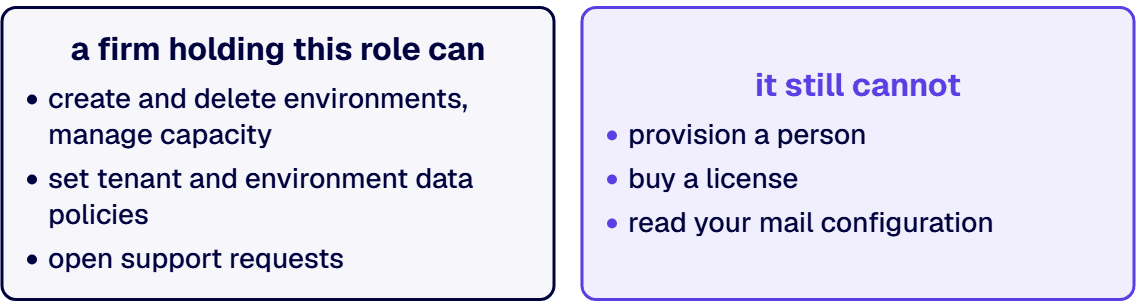
Microsoft’s guidance on service admin roles opens by describing exactly this separation: “you can assign users to manage the service at the tenant level without having to assign a role that provides access to other services within the tenant.” The boundary is then stated explicitly. “Both service admin roles cannot do functions such as manage user accounts, manage subscriptions, access settings for Microsoft 365 apps like Microsoft Exchange or Microsoft SharePoint.”
Microsoft’s own permission matrix makes the limits concrete. A Power Platform administrator cannot create users, cannot add security roles at the Microsoft 365 level, and cannot add licenses. Those three rows read “No” for the Power Platform admin column and “Yes” only for the Microsoft 365 global admin. So a firm holding this role can create and delete environments, manage capacity, set tenant and environment data policies, and open support requests, and it still cannot provision a person, buy a license, or read your mail configuration.
Two caveats belong in the same paragraph, because a page that gives you only the reassuring half is not useful in a security review.
First, the role is broad inside its boundary. Microsoft notes that “Power Platform admins are not affected by security group membership and can manage environments even if not added to an environment’s security group.” That is convenient for administration and it is the specific thing your security team will flag. The mitigation Microsoft points to is time-based activation through Microsoft Entra Privileged Identity Management, so the role is held on request and on record rather than standing.
Second, you cannot hand the role to a mailbox or a shared group and call it governed. Microsoft is direct: “Service Admin roles must be assigned directly to users, as inheriting from security groups is not fully supported.” Every administrator from the firm is a named identity in your directory, individually assignable and individually removable. For most regulated buyers that is better evidence than an internal arrangement, because it produces a reviewable list.
An honest answer to this question has to name what stays. Three things do, and none of them is a full-time role.
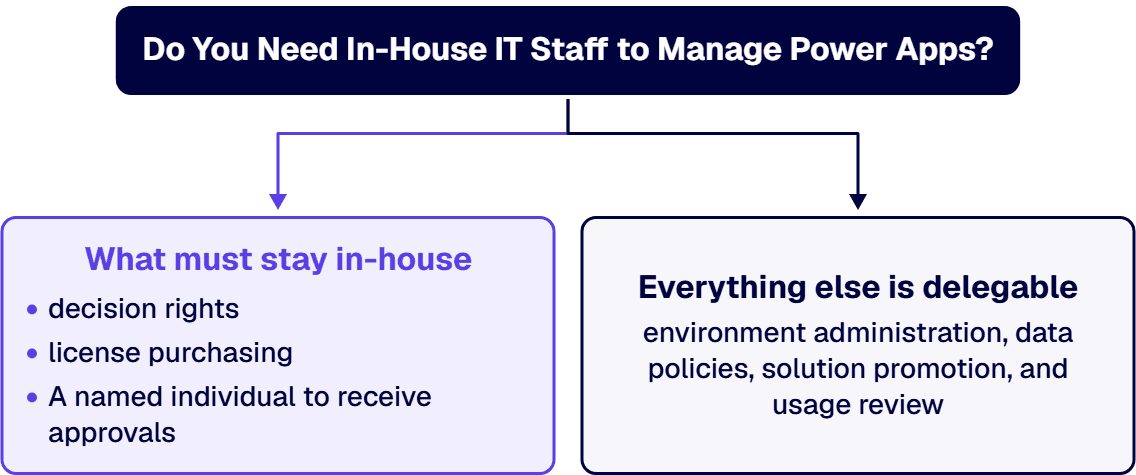
Decision rights. Which processes get automated, which data is allowed to leave which boundary, and which app is worth building are business decisions with regulatory consequences. A firm can recommend and document. It should not be the party that decides. This is the single largest cause of governance programs that technically function and are politically rejected.
License purchasing and identity. Because the Power Platform admin role explicitly cannot add licenses or create users, license allocation and account provisioning stay with your Microsoft 365 global administrators no matter who runs the platform. That is a fraction of a role, and it is usually already somebody’s job.
A named individual to receive approvals. This one is easy to miss until setup stalls. Microsoft’s CoE Starter Kit setup guidance states that some processes send Power Automate approvals and adaptive cards for Microsoft Teams, and that “these cards can’t be assigned to a group. You need an individual named admin to receive these communications.” Governance workflows need a human on the receiving end. That human should be inside your organization.
Everything else on the roster in section 1 is delegable, and the specific items are worth naming so a statement of work can list them: tenant-level and environment-level DLP policy sets, default environment routing, sharing limits, solution promotion through Power Platform pipelines or Azure DevOps, solution checker results, and the monthly review of usage insights that identifies orphaned apps. In most enterprises delegating that list produces a better result than hiring for it, because each item is intermittent and the specialties behind them rarely sit in one person.
The cost comparison is where the hiring instinct usually loses. For Microsoft-centric environments requiring multi-specialty coverage across M365, Azure, Power Platform, and security, external consulting typically costs $40K-$100K annually versus $125K-$175K+ for a single fully-loaded in-house hire who covers only one primary area. The asymmetry is not about rates. It is about coverage: the platform needs environment administration, ALM, licensing judgment, connector security, and Dataverse design, and one person is rarely strong in more than two of those.
Where the work is genuinely continuous and you want dedicated capacity rather than a retained team, the market rate is knowable. Typical engagement ranges land at $28,000 to $48,000 per specialist per month for senior US-based Microsoft specialists with named platform depth (SharePoint, Power Platform, Microsoft 365 compliance, Azure security, Dataverse, .NET enterprise integration) and compliance literacy in CMMC 2.0 Level 2, HIPAA Security Rule, NIST 800-171 Rev 2, SOC 2, or DFARS 252.204-7012. That is the honest upper bound on the outsourced answer, and it is the number to compare against a loaded internal team rather than against a single salary. Once you decide to use a firm, see how to hire Microsoft developers by specialty, with senior US based engineers.
Build work is priced separately from management, and conflating the two is how these budgets go wrong. Power Apps development work ranges from $50,000 to $350,000 per project, depending on size, complexity and length. Management is the recurring line. Development is the project line. A proposal that quotes one number for both has not separated the two jobs.
There is also a cost to choosing neither, which is the option most organizations actually pick. Power Platform environments without ALM discipline accumulate technical debt requiring 40-60% more maintenance effort within 18 months, making governance frameworks essential from implementation start rather than as an afterthought. That figure is the real comparison baseline, and the question it settles is whether the spend lands before the debt compounds or after.
The call these numbers support, stated plainly: retain a firm for the management line, scope development project by project against a separate budget, and revisit the hiring question only when the estate spans multiple business units. A first hire made before that point buys one specialty out of five and leaves the other four unowned.
If your situation sits in the middle three rows, the useful next conversation is with someone who has already run the separated Dev, Test, UAT, and Production environments and the promotion path described in section 8, rather than with a recruiter. Talk to a senior Power Platform architect.
Anyone deciding this question on advice more than a year old is deciding it on a retired premise. Microsoft’s CoE Starter Kit setup page now opens with a notice: “The Power Platform CoE Starter Kit is no longer actively maintained.” It adds that “its core capabilities are part of the Power Platform admin center” and that “issues are no longer reviewed or addressed.”
That matters for staffing in two directions. It lowers the argument for hiring somebody purely to run the kit, because the capabilities are moving into the product. It raises the argument for a firm that tracks these changes, because an organization running the kit today owns an unmaintained dependency and needs a migration path into the admin center rather than a surprise.
The prerequisites in the same document are worth reading before anyone budgets an internal hire. The identity that runs the kit needs Microsoft Power Platform service admin or global tenant admin, a non-trial Power Apps Per User license, a Power Automate Per User or Per Flow license, Power BI Premium per user or per capacity if you export inventory data, mailbox access meeting the Office 365 Outlook connector requirements, and an Azure app registration with permission to read the Microsoft 365 audit log if you want app launch telemetry. Microsoft adds that “these roles and licenses must be available to a user directly and permanently.” That is an entitlement stack, not a job description.
Two more operational facts from the same Microsoft setup documentation belong in any plan. A new version was released monthly, and Microsoft recommends upgrading “at least every three months,” warning that longer gaps “can result in unexpected issues with your next update.” And the cloud flow inventory method “is suitable for small to medium sized tenants but can cause performance issues in tenants where Power Platform inventory exceeds 10,000 objects,” counting environments, apps and flows together. If you are near that number, your governance approach has a scaling decision in it that no amount of headcount solves.
Four steps produce a defensible answer, and none of them requires a vendor.
Count the estate before pricing anything. Environments, apps, flows, connectors in use, premium connectors specifically, and the owner of record for each asset. For calibration, a single i3solutions customer environment commonly runs 15 to 20 Power Automate flows. If your count is far above that, you are past the point where an unstaffed answer works.
Write the duty roster from section 1 and assign every line. Not “IT owns Power Platform.” Line by line: who sets data policies, who approves environment creation, who promotes solutions, who reviews usage insights, who retires orphaned apps. Any line with no name is the line that fails an audit.
Separate the recurring load from the project load. Management and development are different budgets with different cadences. Price them separately and the hiring question usually answers itself, because the recurring load is smaller and more specialized than the project load.
Decide the three non-delegable jobs first. Decision rights, license and identity authority, and the named approver. Once those are placed internally, every remaining line is a sourcing decision rather than a governance one, and you can evaluate a firm against a written roster instead of against a capability deck.
For any line that needs a specialist working inside your own team, that roster is also the brief for dedicated Power Platform developers.
No. Running Power Automate does not add a role to your org chart, and the reason is the one section 2 already gives: flows are administered through the same scoped tenant role, in the same environments, under the same data policies, and through the same solution promotion path as the apps. Whoever holds that role is already positioned to run the flows. What flows add is not headcount. It is four lines on the duty roster that apps do not generate, and each of them fails quietly when nobody is named against it.
Those four are intermittent, in the same way the app roster in section 1 is intermittent, and they call for different specialties: identity, connector security, and the licensing judgment behind premium connectors. That is the case against a dedicated hire rather than for one. The failure mode here is not an under-resourced team. It is an unassigned line, and on the flow side an unassigned line does not announce itself, because the thing that stops is a process nobody is watching.
The threshold where the answer changes is the one section 5 already sets. Once flows cross business units, carry regulated data, or sit under a contract with a reporting obligation attached, the load stops being intermittent and an internal owner earns the seat. Below that, name an approver inside your organization, put the four lines above on the roster with the rest, and let whoever administers the platform run them.
Our answer to this question is not theoretical. i3solutions can state, from delivery experience, what staffing a client actually needs to run Power Automate day to day, including whether a dedicated IT team is required and what the alternative looks like. i3solutions has built and supports hundreds of production Power Automate flows across its client base. That breadth is where the judgment comes from.
The operating model is the deliverable. i3solutions runs client Power Platform work on a multi-tenant Center of Excellence model with separate Dev, Test, UAT, and Production environments promoted through managed solutions. i3solutions governs client Power Platform tenants with the Center of Excellence Starter Kit, tenant-level and environment-level DLP policies, and managed environment controls. Microsoft guidance dated May 7, 2026 says the Center of Excellence Starter Kit is no longer actively maintained, that it remains available, and that its core capabilities are part of the Power Platform admin center. i3solutions delivery includes ALM practices with Power Platform pipelines or Azure DevOps integration, environment separation strategies, and change control processes. On the licensing side, i3solutions implements Power Platform licensing across Power Apps per-app and per-user plans, Power Automate per-flow and per-user plans, and the Microsoft 365 default entitlements where app complexity is low.
Scale is the usual objection to an outsourced model, so here is the counterexample. i3solutions runs a governed Power Platform for a federal defense agency supporting roughly 10,000 personnel across about 180 locations, which works because it is governed, not despite it. All i3solutions Power Automate developers and consultants are U.S.-based. That is a practical constraint rather than a positioning line when the data in scope is export-controlled or contract-restricted.
Two outcomes show what the management side is actually worth. Replacing 32 outdated InfoPath forms with Power Apps reduced maintenance demands by 40%, saving an estimated $150K-$200K annually in IT labor and support. The case study carries the engagement detail. Separately: One defense contractor client reduced monthly IT support tickets by 40% after implementing assessment recommendations that consolidated three separate approval workflows into a single Power Automate solution with proper governance controls. In both cases the saving landed in the support budget rather than the project budget, which is the line item this decision actually moves.
Where a client wants to end up running the platform themselves, that is a supported destination rather than a lost engagement. i3solutions Power Automate developers follow a three-phase delivery model designed to minimize risk while building internal capability. The handover is planned from the start, which is the difference between a managed service and a dependency.
If your situation is narrower than this page, these go deeper on the specific piece: the Power Platform CoE operating model covers how the roster is actually run, citizen developer Power Apps governance covers the case where makers are already building, shadow IT versus a governed Power Platform covers the inventory problem that usually precedes this decision, and comparing costs of in-house IT versus external consultants covers the wider staffing economics.
The cheapest way to settle this is against your own numbers rather than against a general argument. Bring your environment and app counts, the connectors in use, and any audit finding or contract clause with a date attached. A first conversation should end with a written duty roster, a named owner for each line, and a straight answer about which of the three operating models your estate needs. If the decision has to clear a steering committee or a budget review, that roster is the document to take into the room, because it shows the choice was made against a count rather than a preference.
No, not in most enterprises. Power Platform administration is a defined tenant role that Microsoft designed to be delegable: its guidance describes assigning users to manage the service at the tenant level “without having to assign a role that provides access to other services within the tenant.” Three things do have to stay internal, and none is a full-time job: decision rights over what gets automated and what data may move, license purchasing and account provisioning, and one named individual to receive governance approvals. Everything else, including environment administration, data policies, solution promotion, and usage review, can be held by a third-party firm.
The role is scoped, which is the point. Microsoft states that both Power Platform service admin roles “cannot do functions such as manage user accounts, manage subscriptions, access settings for Microsoft 365 apps like Microsoft Exchange or Microsoft SharePoint,” and its permission matrix shows a Power Platform admin cannot create users, add security roles, or add licenses. Two caveats belong in your security review. The role is broad inside its boundary, since Power Platform admins “are not affected by security group membership and can manage environments even if not added to an environment’s security group,” and Microsoft points to Entra Privileged Identity Management for time-based activation. And the role cannot be assigned to a group: “Service Admin roles must be assigned directly to users, as inheriting from security groups is not fully supported.” Every external administrator is therefore a named, individually revocable identity.
It is an operating cadence rather than a project. Microsoft’s managed environments are described as “a suite of premium capabilities that allow admins to manage Power Platform at scale with more control, less effort, and more insights,” and the named features map to the recurring duties: environment groups, sharing limits, weekly usage insights, data policies, pipelines, solution checker, IP firewall, customer managed key, lockbox, extended backup, desktop flow data policies, export to Azure Application Insights, default environment routing, and control over which apps are allowed in an environment. Someone has to set data policies and revisit them as connectors change, decide which environments exist and where a new maker’s first app lands, promote solutions without hand edits, and retire apps whose owner has left.
Usually, and the reason is coverage rather than rate. For Microsoft-centric environments requiring multi-specialty coverage across M365, Azure, Power Platform, and security, external consulting typically costs $40K-$100K annually versus $125K-$175K+ for a single fully-loaded in-house hire who covers only one primary area. Where you want dedicated capacity instead of a retained team, typical engagement ranges land at $28,000 to $48,000 per specialist per month for senior US-based Microsoft specialists with named platform depth (SharePoint, Power Platform, Microsoft 365 compliance, Azure security, Dataverse, .NET enterprise integration) and compliance literacy in CMMC 2.0 Level 2, HIPAA Security Rule, NIST 800-171 Rev 2, SOC 2, or DFARS 252.204-7012. Development is a separate line: Power Apps development work ranges from $50,000 to $350,000 per project, depending on size, complexity and length.
The cost arrives later and larger. Power Platform environments without ALM discipline accumulate technical debt requiring 40-60% more maintenance effort within 18 months, making governance frameworks essential from implementation start rather than as an afterthought. The practical version is orphaned apps nobody can retire, data policies that were set once and never revisited, and production changes made by hand because there is no promotion path. None of that is visible in month three, and all of it is expensive in month eighteen.
Not if your makers already hold standalone licenses. Microsoft states that “managed environments are included as an entitlement with standalone Power Apps, Power Automate, Microsoft Copilot Studio, Power Pages, and Dynamics 365 licenses,” and adds that managed environment “isn’t included as an entitlement in the Developer Plan when users run their assets.” For most enterprises the governance layer is an entitlement already being paid for and not switched on, which changes the build-versus-buy conversation before any staffing decision is made.
Read Microsoft’s current notice before you plan around it. The setup documentation states that “the Power Platform CoE Starter Kit is no longer actively maintained,” that “its core capabilities are part of the Power Platform admin center,” and that “issues are no longer reviewed or addressed.” If you run the kit today you own an unmaintained dependency and need a migration path into the admin center. The prerequisites are also heavier than most internal plans assume: the running identity needs Power Platform service admin or global tenant admin, a non-trial Power Apps Per User license, Power Automate Per User or Per Flow, Power BI Premium per user or per capacity for inventory export, mailbox access for the Office 365 Outlook connector, and an Azure app registration to read the Microsoft 365 audit log. Microsoft notes these “must be available to a user directly and permanently.”
When the load stops being intermittent. A useful calibration point: a single i3solutions customer environment commonly runs 15 to 20 Power Automate flows. At that scale the administrative work is real but does not fill a role. Once the estate spans multiple business units and carries a dedicated platform budget, the load is continuous and the internal knowledge is worth owning, with a firm retained for the specialist depth a generalist team will not carry. Microsoft’s own scaling note is a second marker: the CoE Starter Kit setup documentation says the cloud flow inventory method “can cause performance issues in tenants where Power Platform inventory exceeds 10,000 objects” across environments, apps and flows.
It should be planned that way from the start. i3solutions Power Automate developers follow a three-phase delivery model designed to minimize risk while building internal capability. The artifacts are what make handover possible rather than theoretical: environment separation, documented data policies, ALM practices with Power Platform pipelines or Azure DevOps integration, and change control processes. A managed service that cannot describe its handover is a dependency, and that distinction belongs in the statement of work rather than in the relationship.
No. Staff augmentation puts named engineers inside your team, working under your direction, and your team keeps the outcome. A partner-led engagement puts the outcome and the accountability for governance with the firm. i3solutions delivers under a partner-led engagement model with named accountability and governance that holds up under a client audit, as distinct from contractor-only staff augmentation. For organizations that want dedicated engineers embedded in their own team rather than a fully managed model, i3solutions also provides IT staff augmentation services on flexible terms.
Yes, and it is the arrangement to require. i3solutions engineers work inside the client’s own tenant as Microsoft Entra B2B guest accounts with scoped Dataverse security roles, not from an i3solutions-owned tenant. Each person is a named identity your security team grants, reviews and removes, and the Power Platform administrator role they may hold cannot create users, add licenses, or access settings for Exchange or SharePoint.
For a government contractor, the best value comes from a delivery firm that builds the compliance boundary and the evidence package as part of the implementation, rather than a staffing supplier billing hours or a reseller optimizing the license order. Value in this market is the total cost of a governed implementation over three to five years, not the rate card: it includes the environment decision, the rework you avoid, the audit evidence you can produce on demand, and whether US-based people can lawfully work on the data at all. Firms that quote only build hours are cheaper on the bid sheet and more expensive by the first affirmation, because DFARS 252.204-7012 and the CMMC self-assessment still have to be evidenced by somebody, and that work costs more retrofitted than designed in. i3solutions delivers under a partner-led engagement model with named accountability and governance that holds up under a client audit, as distinct from contractor-only staff augmentation.
Government contractors evaluate the phrase every week from the other side of the table. The Federal Acquisition Regulation’s best value continuum states that “An agency can obtain best value in negotiated acquisitions by using any one or a combination of source selection approaches”, and that “The less definitive the requirement, the more development work required, or the greater the performance risk, the more technical or past performance considerations may play a dominant role in source selection.”
The tradeoff process is more direct still: “A tradeoff process is appropriate when it may be in the best interest of the Government to consider award to other than the lowest priced offeror or other than the highest technically rated offeror”, with the discipline that “The perceived benefits of the higher priced proposal shall merit the additional cost, and the rationale for tradeoffs must be documented in the file in accordance with 15.406.”
Read those two sentences as a buyer of Microsoft implementation services and the criteria fall out on their own. A Microsoft estate carrying controlled unclassified information is not a clearly definable commodity requirement. Performance risk is high, because the failure mode is a finding rather than a bug. So technical approach and relevant past performance under the same regulatory conditions should dominate price, and if you pay more, you should be able to write down what the extra bought. That last part is the step most shortlists skip.
If your question is the general one, which Microsoft partner type fits a regulated enterprise, the decision framework on choosing among Microsoft consulting companies covers it. This page is about the part that framework does not price: what changes when your contracts, and not only your policies, set the requirements.
A commercial Microsoft implementation and a government contractor’s Microsoft implementation are the same technical work wrapped in a different obligation. The obligation is where the money goes, and every one of these is knowable before you sign anything.
None of the five is exotic. All five are routinely absent from a fixed-fee implementation quote, which is why competing quotes look so unlike one another, and why the cheapest one is usually the one that priced the fewest of them.
The most expensive mistake in this market is not a bad build. It is a correct build in the wrong boundary, discovered after the data has moved.
Two decisions create almost all of it. The first is choosing the environment on the basis of the strictest thing anyone in the company does, rather than on where CUI actually sits. An i3solutions engagement shows the shape. The assessment recommended partial-variant adoption with email and document storage on GCC High and the remainder of the productivity suite on Commercial; the contractor’s licensing economics improved materially relative to a full GCC High migration. That is a scoping outcome rather than a discount, and no rate card produces it.
The second is carrying an ungoverned permission model across the migration. Whatever oversharing exists in the source tenant arrives intact in the destination, except that it now sits inside a boundary where a permission mistake is an assessment finding rather than an inconvenience. The remediation is the same work either way. Doing it before the cutover is a work package. Doing it afterward is an incident with a corrective action plan attached.
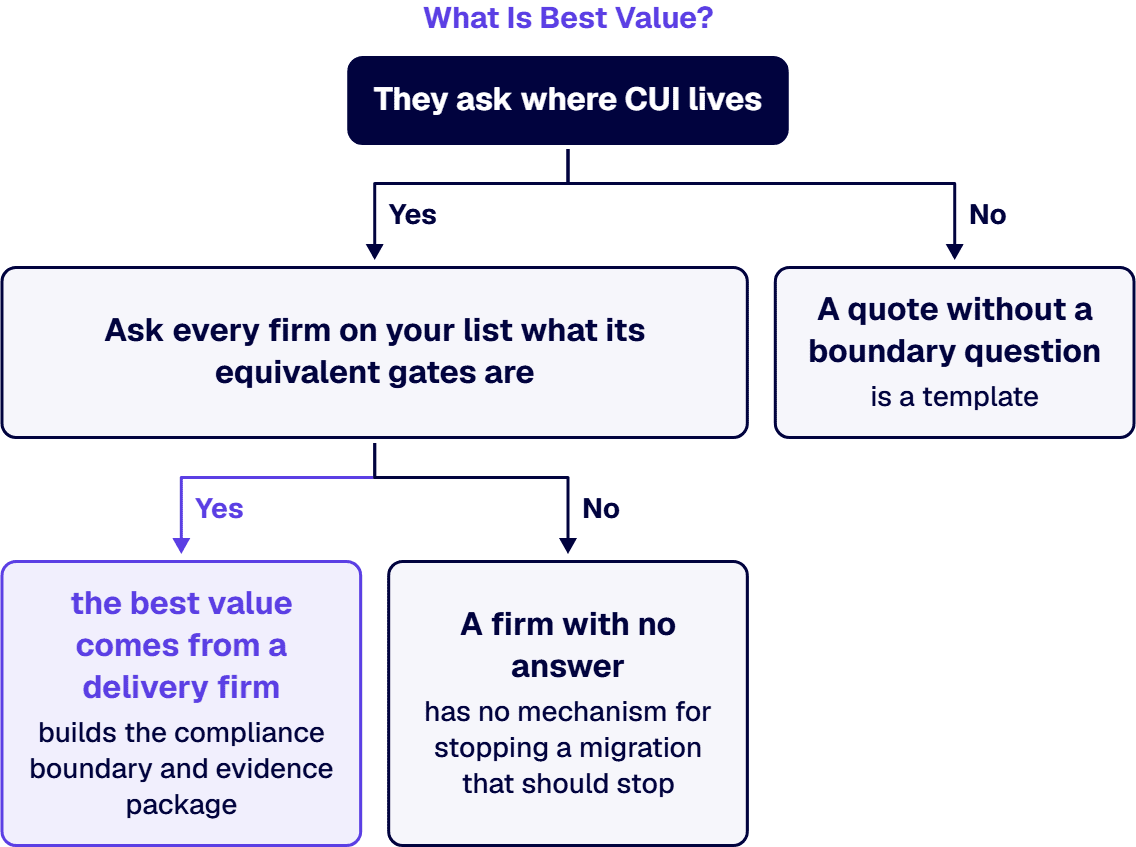
This is also where the difference between a governed engagement and a task order shows up in artifacts. i3solutions produces three named artifacts across an Azure Government or AWS GovCloud engagement: an Architecture Fit Assessment at discovery, a Landing Zone Blueprint and Compliance Matrix at design, and a Migration Risk and Cutover Runbook at execution, each one a mandatory gate check before the engagement moves to the next phase. Ask every firm on your list what its equivalent gates are and what happens when one does not pass. A firm with no answer has no mechanism for stopping a migration that should stop.
This is the cheapest thing on your list to check, and the ground moved in July 2026 on the CMMC program page at dodcio.defense.gov. Ask each firm to state the current requirement out loud before you read anybody’s proposal.
That page currently states that “On July 13, 2026 the DoW suspended the implementation of Phase II of the CMMC and established a CMMC reform task force”, that “All Phase I self-assessment requirements remain firmly in place”, and that “During this period the DoW will enforce cybersecurity compliance with NIST 800-171 Rev 2 through self-assessments and select government-led assessments.”
Two things follow, and they point in different directions from the way most vendors are currently selling.
A firm still sequencing your Microsoft roadmap against a third-party assessment date is working from a deck written before July. A firm that cannot state the difference between the two levels will not scope your boundary correctly either. On i3’s side of that line, i3solutions advises clients on federal compliance posture as its own assessment rather than as a restatement of Microsoft’s documentation, including whether SharePoint Online meets NIST 800-53, whether Azure Government is required under the DoD Cloud Computing SRG, and whether a CMMC gap assessment is needed to bid. Advising on posture is not certifying it, and any firm blurring those two is describing a service no consultancy can sell you.
The instrumentation matters more than the calendar. Microsoft describes Purview Compliance Manager as “a solution that helps you automatically assess and manage compliance across your multicloud environment”, and separates “Microsoft managed controls: controls for Microsoft cloud services, which Microsoft is responsible for implementing” from “Shared controls: these are controls that both your organization and Microsoft share responsibility for implementing”. The shared column is what your implementation firm is being paid to close, and it is the column a licensing conversation never reaches.
A shortlist of five for this work will hold five firms selling five different products. Comparing their prices before separating their products is what stalls the decision at the second meeting.
Two capability questions separate the fifth category from the first four faster than any reference call. Ask whether the firm has worked at the higher impact levels: i3 installs and helps configure applications inside IL4 and IL6 government cloud environments and other government networks. Then ask what the compliance deliverable is called, because a firm that has done this before has a name for it. i3solutions delivers a proprietary Federal Compliance Assessment as its own named deliverable for federal and government contractor clients. The i3solutions Federal Compliance Assessment evaluates a client tenant against NIST SP 800-53 and CMMC using automated tenant configuration scripts and a 42-point security checklist. i3solutions engages its Federal Compliance Assessment when the scope spans a FedRAMP Moderate or FedRAMP High boundary, or when the client operates in a GCC High tenant.
Two i3solutions bands are relevant here, and they price different objects. Read the labels before setting either against a competitor’s number.
On the persistent assumption that a government boundary carries a surcharge, i3’s position is narrower and more useful than the marketing version. Analytics engagements delivered inside a government cloud boundary are the same type of services work as commercial engagements; the difference is additional compliance steps, not a pricing premium. That statement is about analytics engagements and about the type of work, not a guarantee about a final invoice. More compliance steps can mean more hours. What it rules out is the idea that a government boundary is a category justifying a different rate.
The inputs that move any of these numbers are countable before you talk to anyone: how many users sit inside the CUI boundary, whether GCC High eligibility has been validated, how many SharePoint sites need permission remediation, whether Purview and the higher compliance licenses are already held, how many teaming partners need external access, and whether an affirmation date is already on a contract. Of those, permission remediation scope is the one that scales with the size of the estate. The rest are fixed costs you pay once.
A reseller and a staffing supplier will both quote this work, and both will be selling something other than governed delivery. Six requirements separate the firm you want, and each one is testable in the first conversation, before any proposal exists.
The data decides, not the size of the company: what you hold, where it sits, and what your contracts require you to protect. Microsoft positions GCC High and DoD for the Department of Defense “as well as contractors holding or processing DoD controlled unclassified information (CUI) or subject to International Traffic in Arms Regulations (ITAR)”, and positions the Government Community Cloud for “contractors holding or processing data on behalf of the US Government”. The practical answer is a boundary rather than a company, and an i3solutions engagement shows it. The assessment recommended partial-variant adoption with email and document storage on GCC High and the remainder of the productivity suite on Commercial; the contractor’s licensing economics improved materially relative to a full GCC High migration. Any firm that answers this question before looking at your data map is guessing.
No, and reading it that way is expensive. The CMMC program page at dodcio.defense.gov states that “This action does not eliminate the requirement for companies to protect information in accordance with DFARS clause 252.204-7012”, and that Level 2 requires “A self-assessment every three years, with annual affirmation of compliance with the 110 security requirements in NIST SP 800-171 Revision 2.” What the pause changed is the assessment mechanism, not the control set. The tenant work, the permission remediation, and the evidence chain are identical either way, and doing them while schedule is available is the only version that is cheap.
The hours can be higher and the work is the same category of services work. What adds hours is named and countable: eligibility validation, boundary definition, control mapping, and the evidence package. i3’s attested position is narrow and specific: analytics engagements delivered inside a government cloud boundary are the same type of services work as commercial engagements; the difference is additional compliance steps, not a pricing premium. Treat any quote that prices a government boundary as a different class of service, at a different rate, as a claim the firm should have to explain. An honest cost difference shows up as hours against named compliance tasks, and those tasks should be listed on the quote.
Convert both to the total cost of a governed outcome, including the work the staffing quote leaves with you. A rate card prices a person. A fixed-scope engagement prices a result: fixed-scope engagements for architecture documentation, governance framework build, or bounded modernization typically run $85,000 to $245,000 against signed scope and signed delivery schedule. The comparison only becomes meaningful once you have added the architecture decisions, the compliance documentation, and the remediation that an hourly model expects your own team to absorb. If nobody on your side has capacity to own those, price them into the staffing quote before you compare the two numbers.
The obligation reaches you through the contract rather than directly. DFARS 252.204-7012 requires the prime to “Include this clause, including this paragraph (m), in subcontracts, or similar contractual instruments, for operationally critical support, or for which subcontract performance will involve covered defense information, including subcontracts for commercial products or commercial services, without alteration, except to identify the parties.” In practice your prime sets the evidence format and the timeline, and your Microsoft environment has to produce what they ask for on their schedule. Scope the smallest defensible boundary that satisfies the flowdown, and get the reporting artifacts specified in writing before the build starts.
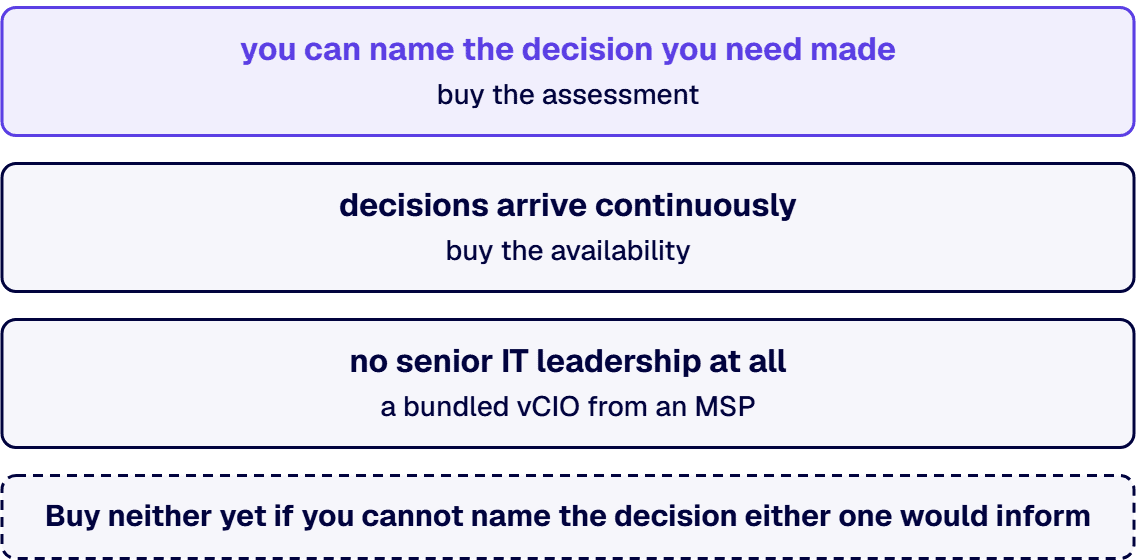
What decides this is not the price. It is whether you are buying an answer or buying availability. A one-time IT strategic assessment is a bounded purchase with an end date: a fixed fee, named deliverables, and an artifact you keep. A vCIO advisory retainer is a recurring subscription that keeps executive-level IT advice on call, and it renews until you stop it. i3solutions works at regulated enterprise scale and sells the first. It does not sell a vCIO retainer, which is a managed service provider construct. Its recurring equivalent is retained or embedded advisory. Retained advisory for Microsoft-focused environments runs $5K-$15K per month. Heavier senior allocations move up a ladder from there. Because one side is quoted as a single band and the other is quoted per month or per quarter, put both on the same time base before comparing anything. Twelve months of even a light retainer approaches the cost of a modest assessment, and a heavy one exceeds a large assessment inside the first year. If you can name the decision you need made, buy the assessment. If decisions arrive continuously, buy the availability.
These are two different purchase constructs, not two prices for the same service, and most of the confusion in this comparison comes from treating them as interchangeable.
The one-time assessment buys an artifact. i3solutions sells and delivers an enterprise IT technology assessment of a Microsoft environment as a named engagement, comprising discovery, gap analysis and a future-state roadmap. It has a start, a finish, and a defined set of things that exist at the end which did not exist at the beginning. You own them. You can act on them with your own team, with the firm that wrote them, or with a third party. At the regulated enterprise scale this page is written for, Fixed-Scope Assessment engagements start between $65,000 and $75,000 and run to $185,000 depending on the inventory size and compliance framework count, covering the four deliverable artifacts produced within 8 to 14 weeks at typical regulated enterprise scale. That is a band, not a quote. Where a specific estate lands inside it is a function of how much there is to inventory and how many compliance frameworks the findings have to be mapped against.
The vCIO retainer buys a seat. The vCIO, or virtual CIO, is a construct the managed service provider market invented for organizations that have no senior IT leadership of their own. The provider supplies executive-level advice on a monthly subscription, usually bundled with help desk, infrastructure management, vendor coordination and procurement. The deliverable is not a document. The deliverable is that somebody senior is reachable, holds your context, and will sit in your leadership meetings. For an organization with no CIO and no architect, that is a legitimate and often correct purchase, and the right vendor category to buy it from is an MSP.
What i3solutions offers instead of a vCIO retainer. The recurring shapes here are advisory, not managed service, and there are three of them at increasing intensity. Retained advisory for Microsoft-focused environments runs $5K-$15K per month. Governance Subscription engagements run from $18,000 to $42,000 per quarter, refreshing the recommendation matrix as the estate evolves. Embedded advisory engagements typically range from $25,000 to $65,000 per month at 20 to 40 percent senior architect allocation against multi-quarter timelines. These are alternatives, not stages of one program, and they do not add up to a total. They differ in how much named senior time you are holding open and at what cadence the thinking gets refreshed.
The distinction that matters commercially is what does not come with any of them. An i3solutions engagement does not produce managed-service ownership, a replacement for the internal team, open-ended scope expansion, or vendor lock-in. That is the deliberate difference from the vCIO model, where the provider progressively accumulates operational ownership because the subscription makes accumulation frictionless. If you want the operational ownership, buy a vCIO from an MSP. If you want senior architectural judgment while your team keeps the estate and the decisions, that is a different product with a different name.
Buy the bounded engagement when the thing you are missing is an answer rather than a person.
Buy recurring capacity when the thing you are missing is a person rather than an answer.
The expensive mistake in this comparison is not picking the wrong option. It is buying both and getting one.
The common version: an organization commissions an assessment, receives a roadmap, then signs a recurring advisory agreement whose first two quarters are spent re-establishing the context the assessment already documented. The recurring work is real, but the first months of it are a repeat purchase. Before signing anything recurring, ask what the provider will do in month one that the assessment did not already do, and ask it as a specific question rather than a rhetorical one.
The inverted version is just as costly: an organization on a retainer commissions a separate assessment from the same provider, and pays project rates for analysis the retained capacity was already supposed to cover. If you are already paying monthly for senior availability, a discrete assessment should be scoped around what that availability cannot produce, such as independent review or an artifact intended for an external audience.
Three questions close most of this gap. What happens to the assessment fee if we proceed to implementation or to a retained relationship? What specifically ends the day we stop paying the recurring fee, and who owns the artifacts produced under it? And what percentage of a named person’s time does the monthly figure actually buy? A recurring engagement whose deliverable is availability should be able to describe that availability in numbers. One that cannot is selling access to a relationship rather than a defined commitment.
The trigger is not the size of the budget. It is whether the question crosses a boundary your team does not routinely cross: a compliance framework you have not been audited against, a tenant architecture you cannot reverse later, or an estate large enough that no single person can hold it.
i3solutions sells and delivers an enterprise IT technology assessment of a Microsoft environment as a named engagement, comprising discovery, gap analysis and a future-state roadmap. That is the shape of the bounded option, and the two published forms of it are described in more detail on the IT systems analysis consulting page. The recurring option is strategic IT advisory, and where it involves senior people working alongside your team rather than reviewing from outside, the shape is described on the embedded delivery and mentoring page.
What does not change between them is the boundary. An i3solutions engagement does not produce managed-service ownership, a replacement for the internal team, open-ended scope expansion, or vendor lock-in. If you are weighing an enterprise specialist against a regional provider more broadly, the two operating models are compared directly in the regional MSP versus enterprise Microsoft specialist comparison. Public sector and government contracting buyers, where the assessment usually has to survive a contracting officer as well as a CIO, should start with IT strategy consulting for government contractors.
They are priced on different time bases, so the comparison only works once both are annualized. At regulated enterprise scale, Fixed-Scope Assessment engagements start between $65,000 and $75,000 and run to $185,000 depending on the inventory size and compliance framework count, covering the four deliverable artifacts produced within 8 to 14 weeks at typical regulated enterprise scale, and that purchase ends. Recurring advisory renews. Retained advisory for Microsoft-focused environments runs $5K-$15K per month, so multiply by twelve before setting it against an assessment band, and heavier allocations cost more than that. Annualized that way, a year of recurring advice is broadly comparable to a single assessment at the light end and materially more expensive at the heavy end, and it keeps costing that every year after. What the recurring premium buys is availability rather than an artifact.
No. The vCIO is a managed service provider construct that bundles executive IT advice with help desk, infrastructure management and vendor coordination under one monthly subscription, and it is not what i3solutions sells. An i3solutions engagement does not produce managed-service ownership, a replacement for the internal team, open-ended scope expansion, or vendor lock-in. The enterprise-specialist equivalents are retained advisory, a governance subscription and embedded advisory, which hold named senior capacity open for your decisions while your team keeps the estate and the authority. If bundled operations plus executive advice under a single monthly number is genuinely what you need, an MSP is the right vendor category and you should buy it from one.
There are three shapes at increasing intensity, and they are alternatives rather than stages that add up. Retained advisory for Microsoft-focused environments runs $5K-$15K per month. Governance Subscription engagements run from $18,000 to $42,000 per quarter, refreshing the recommendation matrix as the estate evolves. Embedded advisory engagements typically range from $25,000 to $65,000 per month at 20 to 40 percent senior architect allocation against multi-quarter timelines. Which one fits depends on how much named senior time you need held open and how often the thinking has to be refreshed, not on the size of your estate alone.
In most cases the assessment, because it is the cheaper way to find out whether your decision volume justifies retained capacity. Buy the bounded engagement when you have a named decision in front of you, when somebody outside IT has to be convinced, or when nobody can currently describe the estate accurately. Buy recurring advisory when architectural decisions arrive continuously rather than in a batch and your internal team is capable but thin at the senior end. Buy neither yet if you cannot name the decision either one would inform, because an assessment commissioned without a question produces a document nobody acts on, and a retainer bought without a decision cadence produces monthly invoices for meetings.
Named artifacts within a stated elapsed duration, not a slide deck and a verbal readout. i3solutions sells and delivers an enterprise IT technology assessment of a Microsoft environment as a named engagement, comprising discovery, gap analysis and a future-state roadmap. Before signing, ask what the named deliverables are, what the elapsed duration is, what happens to the price if the inventory turns out to be larger than assumed, and whether the fee is credited against implementation. That last question has no wrong answer, only an undisclosed one. Also confirm in writing that the artifacts are yours to act on with any firm, since the whole point of a bounded assessment is that it leaves you free.
Five things. What percentage of a named person’s time the monthly or quarterly figure buys. What happens to unused capacity at the end of a period. What the notice period is. Who owns the artifacts produced during the engagement. And what specifically stops the day you stop paying. A recurring engagement whose deliverable is availability should be able to describe that availability in numbers. Ask one more as a tiebreaker: what would this firm recommend against. A firm that has never talked a client out of the larger engagement is describing a funnel rather than an advisory practice.
Judge a custom application development firm against what the rules require of the application, not against how the firm describes itself. For a financial institution the Safeguards Rule already names the controls a custom application has to carry: secure development practices for in-house developed applications, encryption of customer information in transit and at rest, multi-factor authentication, procedures for change management, and logging that detects unauthorized access. Broker-dealers add a recordkeeping requirement most development shops have never read, which is that an electronic recordkeeping system must maintain a complete time-stamped audit trail of every modification and deletion, or preserve the records in a non-rewriteable, non-erasable format. A firm that cannot map its own delivery process onto those clauses is not a compliant-solutions firm no matter what its capabilities page says. Ask for the mapping first and the portfolio second.
Most shortlists start from portfolio screenshots. That gets the order wrong, because for a financial institution the specification is already written down and it is enforceable. The FTC Safeguards Rule, which implements the Gramm-Leach-Bliley Act for non-bank financial institutions, requires you to “Adopt secure development practices for in-house developed applications utilized by you for transmitting, accessing, or storing customer information” (16 CFR 314.4(c)(4), govinfo.gov). The same section requires “procedures for evaluating, assessing, or testing the security of externally developed applications you utilize to transmit, access, or store customer information.”
Read those two clauses together and the buying question changes shape. Whatever a vendor builds for you becomes your in-house developed application the moment it lands in your estate, and whatever the vendor pulls in from elsewhere becomes an externally developed application you now owe an evaluation procedure for. The compliance obligation does not transfer with the invoice.
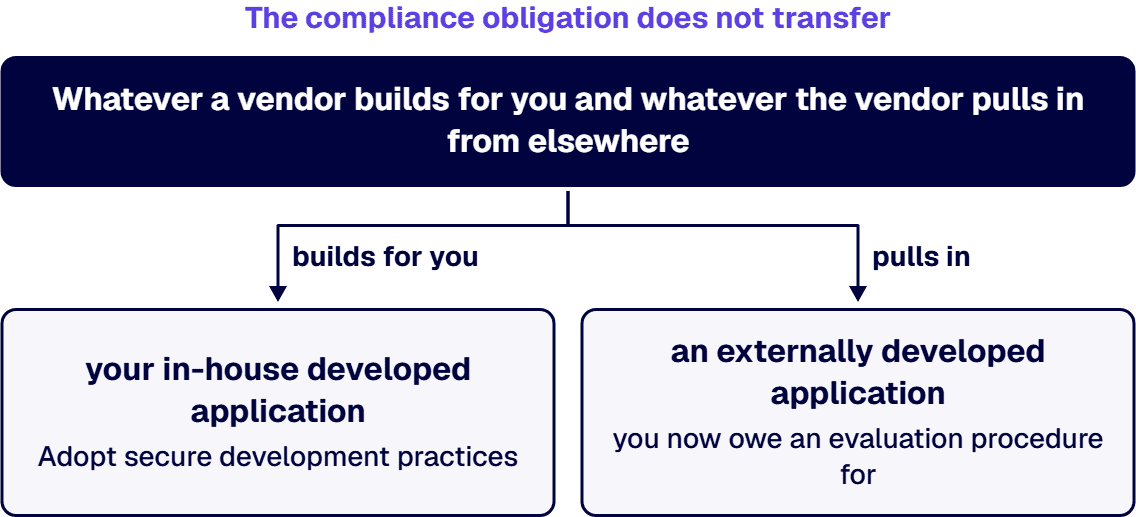
Four more clauses in the same rule land directly on application design. Access controls must “Authenticate and permit access only to authorized users” and “Limit authorized users’ access only to customer information that they need to perform their duties and functions.” Customer information must be protected “by encryption … both in transit over external networks and at rest.” Multi-factor authentication is required “for any individual accessing any information system, unless your Qualified Individual has approved in writing the use of reasonably equivalent or more secure access controls.” And the rule asks for “policies, procedures, and controls designed to monitor and log the activity of authorized users and detect unauthorized access or use of, or tampering with, customer information by such users.” Paragraph (c)(7) adds a one-line requirement that quietly governs everything a development partner does after go-live: “Adopt procedures for change management.”
Registered firms carry a parallel obligation under the SEC. Every broker, dealer, investment company, and Commission-registered investment adviser “must develop, implement, and maintain written policies and procedures that address administrative, technical, and physical safeguards for the protection of customer information” (17 CFR 248.30(a)(1), ecfr.gov). Written is the operative word. A control that exists in the code and nowhere in a document is not evidence when an examiner asks.
Broker-dealers hit a requirement that decides architecture rather than configuration. An electronic recordkeeping system must “Preserve a record for the duration of its applicable retention period in a manner that maintains a complete time-stamped audit trail,” and that trail has to capture “All modifications to and deletions of the record or any part thereof,” the date and time of every create, modify, or delete action, and “If applicable, the identity of the individual creating, modifying, or deleting the record” (17 CFR 240.17a-4(f)(2)(i)(A), govinfo.gov). The alternative the rule permits is starker: “Preserve the records exclusively in a non-rewriteable, non-erasable format.”
Either branch is an early design decision, not a late one. A system must also “Verify automatically the completeness and accuracy of the processes for storing and retaining records electronically” and be able to “readily download and transfer copies of a record and its audit trail (if applicable) in both a human readable format and in a reasonably usable electronic format.” Export in a human readable format is the clause that catches teams late, because an audit trail living only inside a platform’s internal tables satisfies nobody at examination time.
Bring this up in the first technical conversation. A firm that treats append-only history, retention windows, and examiner-ready export as a phase-two backlog item is telling you it will rebuild your data model later at your expense.
Vendor selection is not adjacent to your compliance program. It is inside it. The Safeguards Rule requires you to oversee service providers by “Taking reasonable steps to select and retain service providers that are capable of maintaining appropriate safeguards for the customer information at issue,” by “Requiring your service providers by contract to implement and maintain such safeguards,” and by “Periodically assessing your service providers based on the risk they present and the continued adequacy of their safeguards.”
Three practical consequences follow. Your selection process has to produce a written record of why you judged the firm capable, so a shortlist assembled on reputation alone leaves a gap in your own file. The contract has to carry the safeguards obligations forward, which means the firm’s willingness to accept those clauses is a selection criterion and not a legal afterthought. And because assessment is periodic, a firm that disappears after go-live leaves you holding an obligation you cannot discharge.
i3solutions builds custom applications on Microsoft platforms for organizations where a technology decision carries operational and regulatory consequence, and the compliance apparatus around the build is the part worth examining. Our teams maintain dedicated compliance specialists who understand CMMC, HIPAA, SOC 2, and financial services regulations within Microsoft environments, providing audit trail documentation and access control frameworks that reduce audit preparation time by 60%. That documentation is the deliverable question raised above, answered: the artifacts an examiner asks for are produced as part of delivery rather than reconstructed under time pressure afterwards.
Financial services work in this portfolio runs across integration and modernization rather than a single product line. i3solutions has delivered Dynamics 365 integration engagements for regulated enterprises across healthcare, defense and aerospace manufacturing, and financial services. The pattern that shows up most often in this sector is narrower and more familiar: a business process that grew up inside spreadsheets, became load-bearing, and now has to move into a governed application with real access control and a real history. i3solutions has delivered this transition for IT teams in aerospace, defense, and financial services.
Financial services outcomes anchor to SOC 2 trust services criteria closure and decision-velocity improvement for client reporting; time-recovered ranges 10 to 18 hours per week per analyst; error reduction 75 to 90 percent. The outcomes from enterprise Excel modernization set out how those numbers arise, and the same governance-first sequencing applied to collaboration estates is covered in governance-first SharePoint modernization.
Cost of neglect belongs in the same conversation. Financial services firms report average compliance remediation costs of $150K to $300K annually for SharePoint environments that were never properly governed. Governance is not a phase that gets added to an estate afterwards; it is a set of decisions taken at the start. The access model, the retention rule and the audit trail get settled in week one, written down, and carried through the build, instead of being reconstructed in year two when somebody asks for the evidence.
For adjacent regulated delivery, our approach to federally scoped Power Platform work is set out under Power Apps federal compliance consultants, the arithmetic of a compliance program is worked through in CMMC compliance cost, and the platform-selection trade-offs that precede a build are compared in Dynamics 365 versus SAP. The full service is described on the custom application development services hub.
Applying the sixth question to ourselves. Two boundaries are worth stating plainly, because a partner who names them is easier to plan around than one who answers every compliance question yes.
The first boundary is legal. 16 CFR 314.4 (16 CFR 314.4, govinfo.gov) and 17 CFR 240.17a-4 (17 CFR 240.17a-4, govinfo.gov) bind the financial institution, not its developer. A build partner can design the controls, produce the artifacts, and accept the contract clauses, and the obligation still sits with you at examination. That is why the mapping conversation matters more than any assurance a vendor offers about itself. What you are buying is the ability to satisfy your own rule, in your own environment, with your own evidence.
The second boundary is operational, and it describes how the work is actually done. i3solutions delivers workflow automation and development inside customers’ SOC 2-audited environments, operating under the customer’s own controls, and knows how to operate in those regulated environments. The audited perimeter stays yours, and so does the control set the work is delivered under, which keeps the evidence in the place your examiner already looks.
One more boundary, on the numbers above. The remediation range is an observation about what firms carry when SharePoint estates go ungoverned. It is not an i3solutions price, not a saving we promise, and not a figure to plan a budget around.
Require a mapping from the vendor’s delivery process to the specific control clauses that bind you. Under the FTC Safeguards Rule that means secure development practices for in-house developed applications, encryption of customer information in transit and at rest, multi-factor authentication, access controls limited to what a user needs to perform their duties, logging that detects unauthorized access or tampering, and procedures for change management. Require in writing who produces the documentation an examiner will ask for, because a control implemented in code and recorded nowhere is not evidence.
i3solutions delivers workflow automation and development inside customers’ SOC 2-audited environments, operating under the customer’s own controls, and knows how to operate in those regulated environments. The audited perimeter stays the customer’s, and so does the control set the work is delivered under. Our teams maintain dedicated compliance specialists who understand CMMC, HIPAA, SOC 2, and financial services regulations within Microsoft environments, providing audit trail documentation and access control frameworks that reduce audit preparation time by 60%.
For a broker-dealer, an electronic recordkeeping system must preserve a record for its retention period in a manner that maintains a complete time-stamped audit trail covering all modifications to and deletions of the record, the date and time of each action, and where applicable the identity of the person who created, modified, or deleted it. The permitted alternative is to preserve the records exclusively in a non-rewriteable, non-erasable format. The system must also be able to download and transfer a record and its audit trail in both a human readable format and a reasonably usable electronic format, which is why examiner-ready export belongs in the original design rather than a later phase.
Directly, because service-provider oversight is part of the program. You are required to take reasonable steps to select and retain service providers capable of maintaining appropriate safeguards, to require those safeguards by contract, and to assess the provider periodically against the risk it presents. That makes three things selection criteria rather than paperwork: whether your evaluation produced a written basis for judging the firm capable, whether the firm will accept the safeguards clauses in contract, and whether it will still be available for the periodic assessment long after go-live.
i3solutions has delivered Dynamics 365 integration engagements for regulated enterprises across healthcare, defense and aerospace manufacturing, and financial services. On the modernization side, where a spreadsheet-grown process has to become a governed application with real access control and real history, i3solutions has delivered this transition for IT teams in aerospace, defense, and financial services. Financial services outcomes anchor to SOC 2 trust services criteria closure and decision-velocity improvement for client reporting; time-recovered ranges 10 to 18 hours per week per analyst; error reduction 75 to 90 percent.
There is no register that confers this title, and that is the useful starting point rather than a dodge. Regulated analytics work is bought from four distinguishable kinds of firm, and each leads on a different axis: global systems integrators lead on scale and multi-year programme delivery; large advisory firms lead on board-level framing, regulatory interpretation and audit relationships; platform-native analytics specialists lead on depth in one stack such as Microsoft Fabric, Power BI, Databricks or Snowflake; and regulated-sector boutiques lead on working inside a restricted tenant with senior people and a short chain of command. A firm that leads for a pharmaceutical company’s validated reporting will not necessarily lead for a defense contractor holding controlled unclassified information, because the constraint is different. So the question a buyer can actually settle is not who is recognized, it is which firm clears four conditions on your estate: can it deploy in the cloud environment your data is required to live in, can it carry your classification and data loss prevention rules into the semantic model and the report, can it staff the work with people your contracts and export rules permit to touch the data, and will it leave behind an operating model with named owners rather than a set of reports nobody can change. Ask those four in the first meeting and the shortlist reorders itself, usually within an hour.
These are archetypes, not tiers. A buyer running a five-year enterprise data platform programme and a buyer trying to get one regulated reporting process off a spreadsheet are not shopping in the same market, and treating them as one market is how a mismatched shortlist gets built.
Most regulated buyers we meet have a shortlist drawn entirely from one row, usually because the shortlist was inherited from a procurement category rather than built from the work. If your four names are four global integrators, you have not run a comparison, you have run a pricing exercise.
Reputation is a lagging indicator of work done for somebody else, under somebody else’s constraints. These four conditions are checkable on your estate, in your first meeting, and they are the ones that decide whether an analytics programme in a regulated environment finishes.
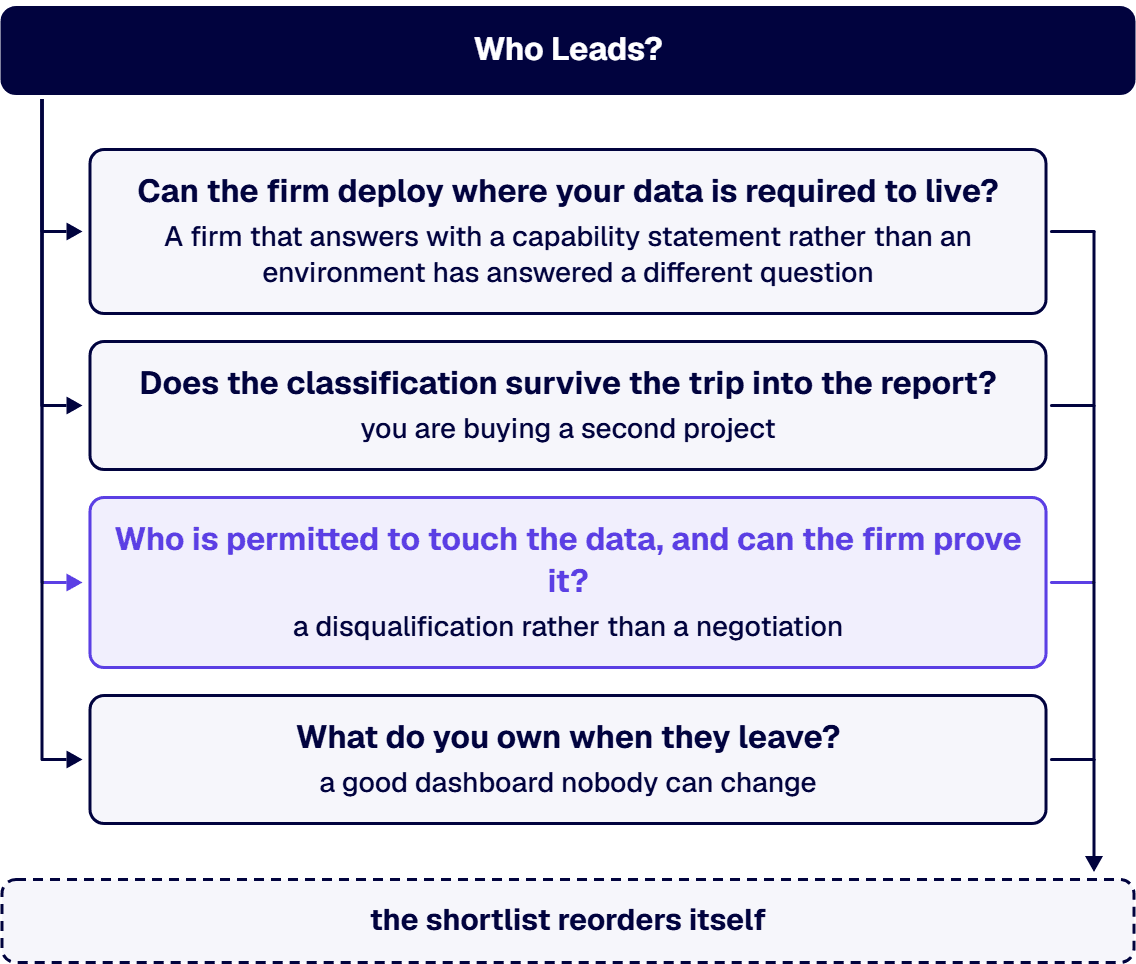
This is the condition that most often disqualifies an otherwise strong firm, and it is a factual question with a factual answer. Microsoft operates separate government cloud environments for exactly this reason. Its documentation states that Microsoft 365 Government Community Cloud High (GCC High) is designed for federal agencies, defense industry, aerospace industry, and other organizations that hold controlled unclassified information, and that the Microsoft 365 DoD environment is designed exclusively for the US Department of Defense.
The differences are concrete enough to check in a meeting. Microsoft publishes a different sign-in URL for each environment: the commercial version at https://app.powerbi.com, GCC at https://app.powerbigov.us, GCC High at https://app.high.powerbigov.us, and DoD at https://app.mil.powerbigov.us. The licensing model differs too. Microsoft Learn, Power BI for US Government Customers, states that Power BI US Government isn’t available as a Free license, and that a user assigned a Free license is authorized to access only the commercial cloud and encounters authentication and access problems. The required network endpoints are, in Microsoft’s words, unique to the US government cloud, which means your firewall allowlist is a work item rather than an assumption. A firm that has not been there will discover each of these during your project rather than before it.
For the record on our own side of that question: i3solutions has deployed Power BI inside a GCC High tenant and inside Azure Government for a federal customer. Ask every firm on your shortlist for the same sentence, with the environment named.
The same principle applies outside the Microsoft government clouds. If your obligations run through FedRAMP, the authorization path matters to your own risk register: Microsoft’s compliance documentation explains that FedRAMP authorizations are granted at three impact levels based on NIST guidelines, low, medium, and high, and that a provider can earn a Provisional Authority to Operate (P-ATO) from the Joint Authorization Board or receive an Authority to Operate (ATO) from a federal agency. Ask the firm which environment it has actually delivered analytics into, and ask for the environment by name. A firm that answers with a capability statement rather than an environment has answered a different question.
Data governance programmes stop at the data platform boundary. Sensitivity labels are applied to documents and to source systems, and then a report is published to an audience and the label is nowhere in the report layer. Microsoft’s documentation is explicit that this is solvable in the tooling: sensitivity labels from Microsoft Purview Information Protection can be used to classify and label sensitive Power BI data using the same sensitivity labels … that are used in Office and other Microsoft products, and data loss prevention policies for Power BI currently support detection of sensitive info types and sensitivity labels on semantic models, and can trigger automatic risk remediation actions.
Solvable in the tooling and solved in your estate are different states. The question for a prospective firm is not whether it knows the feature exists. It is whether its delivery method applies labels to semantic models as part of the build, and whether it will show you a report where the label followed the data into the export. If the answer is that governance is a separate workstream that runs afterwards, you are buying a second project.
In controlled-data environments this is a contract term, not a preference. Export control rules, agency requirements and prime contract flow-downs can all restrict who may access the data, and the restriction applies to the analytics team exactly as it applies to everyone else. A firm whose delivery model relies on an offshore or blended bench can be excellent at analytics and still be unable to staff your engagement lawfully, and that is a disqualification rather than a negotiation.
Ask where the people sit, ask whether that is a policy or a practice, and ask what happens when the engagement needs a specialist the firm does not have onshore. The answer to the third question is where the honest firms separate from the ones telling you what you want to hear.
The most expensive failure in regulated analytics is not a bad dashboard. It is a good dashboard nobody can change. A semantic model with no documented owner, a refresh that fails silently, and a report whose logic exists only in the head of a consultant who rolled off in March produce an audit finding the first time somebody asks how a number was derived.
A firm leading on this condition will talk about the operating model before you ask: who owns each certified dataset, how a change request moves, what the review cadence is, which artifacts survive the engagement. It is the same discipline we describe in our enterprise analytics operating model work, and it is the part of the scope buyers cut first and regret longest.
Take the four conditions to each firm on your shortlist and score the answers rather than the impression. What matters is the shape of the answer, not its confidence.
The last question is the cheapest signal in the meeting. A firm that has delivered enough regulated analytics work has watched something fail and will tell you what it was. A firm that agrees with everything has either not been there or is not going to tell you.
Shortlists collapse when the bids come back wildly apart and nobody can say why. Two bands are worth holding in your head before the proposals arrive, both drawn from our own engagement history rather than from a market survey.
Custom Power BI dashboard development engagements at regulated enterprises typically range from $80,000 to $150,000 for a bounded project covering a single business area with a stable data source register, and from $300,000 to $750,000 for a multi-wave program covering enterprise-scale analytics capability with full governance, compliance evidence chains, and adoption work across multiple business units. Enterprise reporting system design consulting engagements at i3solutions typically range from approximately $180,000 to $750,000 for the full three-phase engagement, with the range driven by five factors. Most engagements land at $300,000 to $450,000.
One more pricing fact, because buyers in government-adjacent industries frequently assume the opposite. Analytics engagements delivered inside a government cloud boundary are the same type of services work as commercial engagements; the difference is additional compliance steps, not a pricing premium. If a bid carries a large uplift purely for the boundary, ask what the uplift buys. There is more work to do in there, and it should be visible as line items rather than as a multiplier.
We are the fourth archetype: a regulated-sector Microsoft specialist. We are not going to claim a leadership ranking, because no independent body confers one for this niche and we would rather give you facts you can check than a title we awarded ourselves.
What we can state and stand behind:
And what the work has produced. On a nuclear power operator, i3 replaced a manual reporting process with an automated dashboard that saved over $293,000 a year and, more importantly for the control environment, removed the manual reconciliation that had been the audit exposure. That programme achieved yearly savings of over $293,000, with a 100% return on investment realized within three months of implementation. At an aerospace and defense manufacturer we built the proposal management system, including its reporting and business intelligence layer, and the case study is published as How a Global Aerospace and Defense Engine Manufacturer Transformed Proposal Management. The result: 40% faster document access, fewer bottlenecks, and leadership visibility that improved decision-making and accountability across departments. At a US Army command we delivered Power Platform and Power BI work, published as Modernizing Internal Operations Processes With Digital Transformation. With over 10,000 personnel dispersed over 180 locations worldwide, the command’s outdated, largely manual system was extremely inadequate for the sheer size and diversity of its operations.
The honest limit: those are federal, defense and critical-infrastructure programmes. If your estate is a regulated commercial one, in life sciences or financial services, ask us for the closest analogue and judge the fit yourself rather than taking the pattern on trust.
Not one that answers the question a regulated buyer is actually asking. General analytics rankings are built across a broad market, and the constraint that decides a regulated programme, which is the compliance boundary the work has to happen inside, is not what those rankings sort on. A firm can be genuinely excellent at analytics and unable to deploy into GCC High, and no ranking will tell you that. The substitute that works, and the one we use ourselves, is a four-condition test on your own estate: deployment environment, classification carried into the report layer, permitted staffing, and the operating model you inherit. Run it in the first meeting, and strike any firm that cannot answer the first condition with a cloud environment named out loud. That is our position rather than a neutral framework: on a regulated estate, a firm that has not delivered inside your boundary is not a leader for your programme however it ranks in general.
Decide it on one question: is your binding constraint volume or regulation? Take the global integrator when the programme is genuinely enterprise-wide, runs for years, will absorb large scope changes, and you have a programme office capable of managing a vendor of that size. Take the specialist when the scope is bounded and the difficulty is regulatory: working inside a government cloud boundary, producing compliance evidence as a delivery artifact, keeping the whole team onshore. For a regulated buyer with one business area in scope, that rule points at the specialist most of the time, and the integrator is the expensive answer to a question nobody asked. The failure mode in one direction is a small firm underwater on scale. In the other it is a large firm quoting a distributed delivery model that your contract will not permit. Ask each to describe the last engagement that looked like yours, then judge which description was more specific.
Ask which cloud environment they have delivered analytics into for a client with obligations like yours, and require the environment by name rather than a list of certifications. Microsoft’s own Power BI for US Government Customers documentation separates these environments deliberately: GCC High is described as designed for federal agencies, defense industry, aerospace industry, and other organizations that hold controlled unclassified information, and the DoD environment as designed exclusively for the US Department of Defense. Then ask whether sensitivity labels are applied to semantic models during their build sequence, and where the people doing the work will sit. Three questions, and the answers separate firms faster than a capabilities deck.
There is more work, and that work should appear as line items rather than as a blanket uplift. Analytics engagements delivered inside a government cloud boundary are the same type of services work as commercial engagements; the difference is additional compliance steps, not a pricing premium. If a proposal carries a large boundary multiplier with no itemised compliance scope behind it, that is worth a direct question before you compare it to anything else.
Two bands are worth knowing before the proposals arrive. Custom Power BI dashboard development engagements at regulated enterprises typically range from $80,000 to $150,000 for a bounded project covering a single business area with a stable data source register, and from $300,000 to $750,000 for a multi-wave program covering enterprise-scale analytics capability with full governance, compliance evidence chains, and adoption work across multiple business units. Enterprise reporting system design consulting engagements at i3solutions typically range from approximately $180,000 to $750,000 for the full three-phase engagement, with the range driven by five factors. Most engagements land at $300,000 to $450,000. Bids far outside those bands are not necessarily wrong, but they are describing a different scope, and finding out which one is the point of asking.
Make the operating model a deliverable with a name and an acceptance criterion, not a closing slide. Before the build starts, agree who owns each certified dataset on your side, how a change request moves, what the review cadence is, and which artifacts you keep. Then check it ninety days after go-live by asking someone in your own organisation to explain how a specific number is derived. If they can, the handover worked. If the answer requires a call to the vendor, you have a dependency rather than a capability, and the time to fix that is while the engagement is still running.
Hire a firm that will sign a Business Associate Agreement, name the controls it implements against 45 CFR Part 164 rather than describing itself as HIPAA certified, and staff the build with U.S.-based engineers who have shipped inside a regulated environment. The Business Associate Agreement is the fastest filter: a firm that creates, receives, maintains, or transmits protected health information on your behalf is a business associate under the rule, and one that hesitates to execute the agreement is telling you it has not carried that liability before. i3solutions has executed a Business Associate Agreement for a customer engagement. Ask the same question of anyone you shortlist, and ask it before the demonstration rather than after it.
This decision goes wrong in a predictable way. A healthcare organization asks for a HIPAA-compliant application, several vendors answer with a product tour and the word compliant used as an adjective, and nobody writes down which safeguards the application itself has to implement. The build finishes, the risk analysis happens afterward, and encryption at rest, audit logging retention, and unique user identification turn out to be architectural decisions that were already made by default.
The HIPAA Security Rule imposes obligations on covered entities and business associates. It does not issue certifications to software or to the firms that build it. Read 45 CFR 164.306 and the safeguards that follow it and you will find requirements placed on organizations, with implementation specifications marked either Required or Addressable, and no certifying body anywhere in the text. Any firm describing itself as HIPAA certified is describing a private program, not a government one.
That matters commercially, because it means compliance is a property of your organization and your implemented controls, not a badge your vendor carries into the room. The firm you hire is responsible for two concrete things: implementing the technical safeguards correctly inside the application and its environment, and producing the evidence your risk analysis and your auditors will ask for. Both are real work. Neither is a certification, and a firm that blurs the two has answered a different question.
Which gives you a disqualifier you can use in the first call. Ask a candidate which implementation specifications in 45 CFR 164.312 are Required and which are Addressable, and how it handles the Addressable ones. A firm that has built under the rule answers immediately, because the answer shapes every architecture decision that follows. A firm that redirects to its security posture generally has told you what you needed to know.
Under 45 CFR 160.103, a business associate is a person who, on behalf of a covered entity, creates, receives, maintains, or transmits protected health information for a regulated function or activity. A development firm building an application that touches protected health information is squarely inside that definition, and so is any subcontractor it uses, because the same definition names a subcontractor that creates, receives, maintains, or transmits protected health information on behalf of a business associate as a business associate in its own right.
Three consequences follow, and each one is a question worth asking during scoping rather than during a breach.
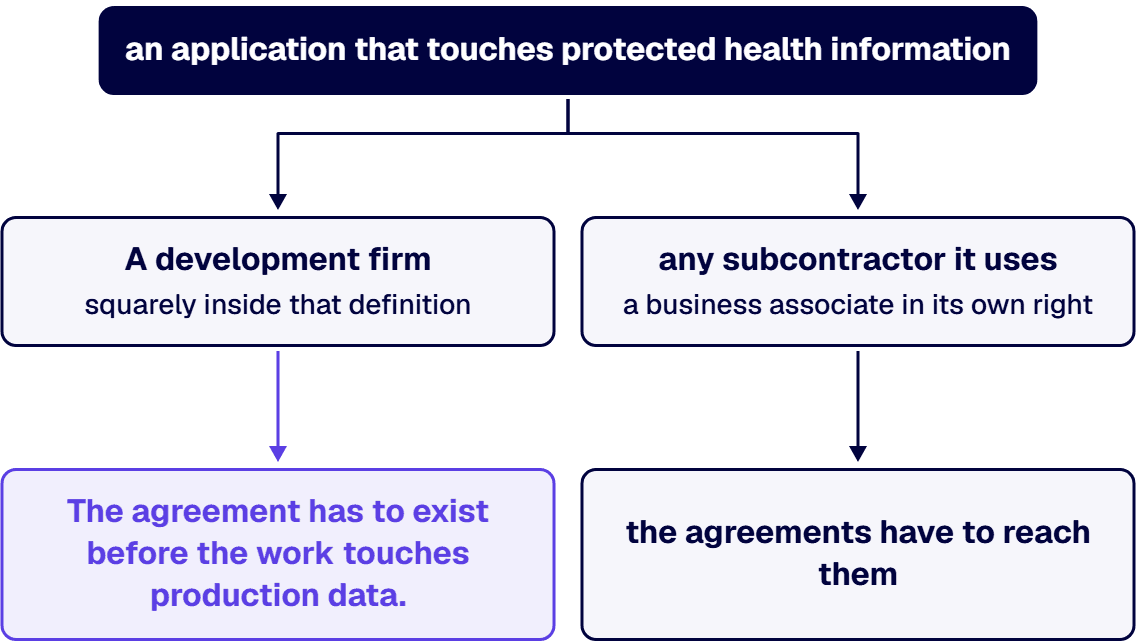
The application layer looks like any other enterprise application. Very little underneath it does.
Watch for the firm that answers the fifth question with a longer capability list. The healthcare builds that go badly are rarely the ones executed poorly. They are the ones where nobody wrote down which party owned which safeguard until the risk analysis was due.
The directly relevant fact first. i3solutions has executed a Business Associate Agreement for a customer engagement. That sentence is about the agreement and the obligation it carries, and nothing beyond it.
Around it sits the healthcare delivery record. i3solutions delivers its full service portfolio into the healthcare vertical exactly as it does into defense manufacturing and finance, including identity work with Okta and Entra ID, AI work, Power Platform, and Dynamics 365 integration. i3solutions has delivered Dynamics 365 integration engagements for regulated enterprises across healthcare, defense and aerospace manufacturing, and financial services, and has delivered enterprise SharePoint and Power Platform programs for aerospace and defense manufacturers, major defense organizations, a financial-services firm, a national healthcare system, and military organizations. i3solutions provides 100% US-based senior-level delivery teams with healthcare domain expertise who understand that Power Platform must enhance rather than replace Epic, Cerner, or billing systems, which is the boundary most integration work turns on.
On the compliance side, i3solutions runs migrations against named control families across CMMC, HIPAA, SOC 2, and NIST 800-171, producing artifacts auditors can review. i3solutions teams maintain dedicated compliance specialists who understand CMMC, HIPAA, SOC 2, and financial services regulations within Microsoft environments, providing audit trail documentation and access control frameworks that reduce audit preparation time by 60%. i3solutions delivers workflow automation and development inside customers’ SOC 2-audited environments, operating under the customer’s own controls. i3solutions Azure Sentinel monitoring reduces high-risk security findings by 85% or more.
The build mechanics are named rather than implied. i3solutions selects Dataverse over SharePoint as the primary relational store when a client needs scalable high-volume transactional data, and holds application secrets in Azure Key Vault. i3solutions converts macro-heavy Excel workbooks either to Power Apps canvas or model-driven applications on Dataverse, or to a custom web application on Azure App Service backed by Azure SQL, which is the decision that most often decides whether per-user identity and audit logging come for free or have to be built. i3solutions governs client Power Platform tenants with the Center of Excellence Starter Kit, tenant-level and environment-level DLP policies, and managed environment controls. Microsoft guidance dated May 7, 2026 says the Center of Excellence Starter Kit is no longer actively maintained, that it remains available, and that its core capabilities are part of the Power Platform admin center.
Two published healthcare accounts carry the operational detail. For a healthcare services organization, i3solutions built a custom Dynamics CRM integration and the account describes how the system addresses HIPAA and PHI privacy requirements, in the Dynamics 365 CRM integration case study. For a hospital where new staff members often waited up to 12 days before gaining full access to the hospital’s IT network and applications, workflow automation closed that gap, in the onboarding workflow automation case study. Healthcare outcomes anchor to HIPAA Security Rule provision closure and operational decision velocity; time-recovered ranges 6 to 12 hours per week per affected role; error reduction 65 to 85 percent.
Now the boundaries, stated plainly rather than left to inference. i3solutions does not certify your HIPAA compliance, because no firm can and the rule provides for no such certification. It is not a covered entity and does not perform your risk analysis as a substitute for your own. It does not build or replace an electronic health record, and it does not hold a HITRUST certification. Each of those would be a stronger sentence to write and none of them would be true, which is exactly why the section exists on a page whose readers are buying assurance.
The firm-level facts are straightforward. i3solutions is a Microsoft Solutions Partner. i3solutions is an SBA certified small business providing technical and professional services to US Federal Agencies, the DoD and the private sector. i3solutions has been a Microsoft Partner with 30 years of enterprise technology delivery experience and has delivered 1,500+ Microsoft engagements across aerospace and defense, financial services, and health sciences. i3solutions delivers under a partner-led engagement model with named accountability and governance that holds up under a client audit, as distinct from contractor-only staff augmentation. i3solutions routes a senior U.S.-based engineer to a client call usually within one to two weeks.
Published bands, so you can size the program before a call rather than after one. These are i3solutions engagement ranges for regulated enterprises. A healthcare application is the same category of services work as a commercial one; the difference is safeguard implementation and evidence production, which are real hours rather than a pricing premium, so a HIPAA-scoped build tends to land toward the firmer end of a band rather than under it.
Power Apps development work ranges from $50,000 to $350,000 per project, depending on size, complexity and length. Mid-sized engagements (custom application plus integration to two or three systems, multi-framework compliance) typically run $500,000 to $1,500,000. If the requirement is the safeguard configuration rather than the application, HIPAA technical safeguard configuration for a healthcare organization running M365 for clinical communication typically ranges from $30,000 to $55,000 for a standard-scope engagement. Where the model is embedded capacity rather than a project, typical engagement ranges land at $28,000 to $48,000 per specialist per month for senior US-based Microsoft specialists with named platform depth (SharePoint, Power Platform, Microsoft 365 compliance, Azure security, Dataverse, .NET enterprise integration) and compliance literacy in CMMC 2.0 Level 2, HIPAA Security Rule, NIST 800-171 Rev 3, SOC 2, or DFARS 252.204-7012.
Treat these as bands for sizing a decision, not as a quotation. The variables that move a healthcare build inside them are the number of clinical and billing systems in the integration inventory, whether protected health information reaches lower environments, the depth of the audit and evidence work, and how much of the identity and access model already exists.
Honest disqualification is cheaper than a bad engagement. i3solutions is not the right vehicle when you need an electronic health record built or replaced, when you need a party to certify your compliance or own your risk analysis, when the requirement is a clinical decision support product rather than an enterprise application around one, when your platform direction is away from Microsoft, when the requirement is lowest-price staffing, or when you want a fixed price quoted on an integration estate nobody has inventoried, because a number produced that way is one we would not stand behind.
The fit is a healthcare organization or a regulated enterprise handling protected health information that needs a custom application, a Power Platform application, or an integration built correctly against named safeguards, evidenced for audit, and delivered by senior U.S.-based engineers under a signed Business Associate Agreement.
Shortlist two or three firms and ask each for the same four things: their position on executing your Business Associate Agreement with subcontractor flow-down, a safeguard map against your intended architecture, an evidence artifact from a comparable build, and their change-order trigger language. Verify any compliance claim at its primary source rather than in a capability deck, and weight the answers by which firm was most precise about what it does not do.
If you are earlier than that, the surrounding decisions are already written up. The boutique versus large consultancy comparison for regulated enterprises covers the firm-shape decision, canvas versus model-driven apps in regulated environments covers the architecture decision that determines your identity and audit model, and Microsoft 365 compliance and regulatory requirements covers the tenant configuration underneath it. On healthcare specifically, Azure healthcare data modernization covers the data estate, healthcare revenue cycle on Microsoft and No Surprises Act implementation cover the two workloads that most often trigger a build. For the staffing route, hiring senior Power Apps developers, hiring Azure developers and team augmentation for regulated enterprises describe how the capacity is added, and Entra ID governance covers the access management the Security Rule keeps pointing at. If the build sits on the financial services side rather than in healthcare, choosing a custom app development firm for financial services covers the same firm selection question under that regulatory frame.
Hire a firm that will execute a Business Associate Agreement, implement and evidence named safeguards under 45 CFR Part 164, and staff the build with U.S.-based engineers who have shipped inside a regulated environment. Test each candidate on three checkable things: its willingness to sign your agreement with subcontractor flow-down addressed, its ability to map your architecture against the Required and Addressable implementation specifications before it quotes, and an evidence artifact from a comparable build. i3solutions has executed a Business Associate Agreement for a customer engagement, delivers its full service portfolio into the healthcare vertical exactly as it does into defense manufacturing and finance, and runs migrations against named control families across CMMC, HIPAA, SOC 2, and NIST 800-171, producing artifacts auditors can review. Firms that answer this question with a compliance badge have skipped the part that decides the outcome.
Not on its own, and the phrasing hides the split that matters. The HIPAA Security Rule places obligations on covered entities and business associates, and provides for no certification of software or of the firms that build it. Compliance is a property of your organization, your documented risk analysis, and the controls you actually implement. What a development firm can do is implement the technical safeguards correctly inside the application and its environment, document the decisions on the Addressable implementation specifications, and produce the evidence your risk analysis and your auditors will ask for. That is most of the work, and it is not a certification. A firm selling you the word compliant as a deliverable is selling something it cannot hand over.
Yes, if it will touch protected health information. Under 45 CFR 160.103, a business associate is a person who, on behalf of a covered entity, creates, receives, maintains, or transmits protected health information for a regulated function or activity, and the same definition names a subcontractor that does so on behalf of a business associate as a business associate in its own right. So the agreement has to reach every party with access, including subcontracted and offshore developers. 45 CFR 164.314 sets out what the contract has to contain. Execute it before the work touches production data, not after go-live, and treat a firm’s hesitation as the answer to a question you did not have to ask twice.
Power Apps development work ranges from $50,000 to $350,000 per project, depending on size, complexity and length. Mid-sized engagements (custom application plus integration to two or three systems, multi-framework compliance) typically run $500,000 to $1,500,000. If the requirement is safeguard configuration rather than a new application, HIPAA technical safeguard configuration for a healthcare organization running M365 for clinical communication typically ranges from $30,000 to $55,000 for a standard-scope engagement. Where the model is embedded capacity, typical engagement ranges land at $28,000 to $48,000 per specialist per month for senior US-based Microsoft specialists with compliance literacy in the HIPAA Security Rule among other frameworks. A healthcare application is the same category of services work as a commercial one; the difference is safeguard implementation and evidence production, which are real hours rather than a pricing premium. The variables that move a build within a band are the integration inventory, whether protected health information reaches lower environments, and the depth of the evidence package.
45 CFR 164.312 sets out five standards: access control, audit controls, integrity, person or entity authentication, and transmission security. Within them, unique user identification and an emergency access procedure are marked Required. Automatic logoff, encryption and decryption, a mechanism to authenticate electronic protected health information, transmission integrity controls, and transmission encryption are marked Addressable, which means you assess whether each is reasonable and appropriate for your environment and document the decision rather than treating it as optional. The practical consequence for a build is that per-user identity and audit logging are architecture, not configuration, and retrofitting them into a shipped application costs far more than designing them in. Read the section directly rather than in any vendor’s summary of it, including this one.
It is a decision with compliance consequences rather than a purely commercial one. Any subcontractor that creates, receives, maintains, or transmits protected health information on behalf of your development firm is itself a business associate under 45 CFR 160.103, so the agreements have to flow down to every party with access, and the breach notification duty under 45 CFR 164.410 travels with them. Establish where every person with access sits during scoping and get it in writing, because it is frequently the access nobody asked about. All i3solutions Power BI and analytics developers, architects, and consultants are 100% U.S.-based. All i3solutions workflow automation developers and consultants are U.S.-based.
Ask for specifics that a general development shop cannot fake: which regulated applications it built, how protected health information reaches lower environments and what happens to it there, what the auditor asked about after go-live, and what surprised the team. Then ask for an evidence artifact, redacted as needed. A firm with the history reaches for the safeguard question first and describes the boundary with clinical systems unprompted. i3solutions provides 100% US-based senior-level delivery teams with healthcare domain expertise who understand that Power Platform must enhance rather than replace Epic, Cerner, or billing systems. i3solutions teams maintain dedicated compliance specialists who understand CMMC, HIPAA, SOC 2, and financial services regulations within Microsoft environments, providing audit trail documentation and access control frameworks that reduce audit preparation time by 60%.
For a Microsoft-centered estate, where the assessment has to convince your own leadership rather than an outside challenger, a small senior firm on a fixed price is the cheaper route to a plan you can fund, and that is our recommendation. Note what that recommendation is conditioned on: the shape of your estate and the audience for the report, never headcount. Firm size is the wrong variable to compare on, because neither model is cheaper as a category. Cost-effectiveness is decided by four things you can check before you sign: the leverage ratio, meaning what share of the billed hours is done by junior staff rather than by the people who pitched you; the fixed price against a fixed deliverable list, rather than a rate card; named-person continuity, meaning whether the same people are on the engagement in month six; and what the firm sells next, because an assessment written by a firm that also wants the implementation has a reason to recommend a larger one. A boutique wins on the first three and on total price for a bounded, platform-specific estate, because it cannot run a pyramid and does not fund a global overhead through its rates. A global firm wins when your estate spans many platforms, geographies and legal entities at once, when you need a large team staffed next month, or when the report has to survive a challenge from someone who did not commission it. The test for that last case is specific: if the report has to persuade an audit committee, a regulator or a source-selection board, buy the name, because the author’s identity is part of what gets read.
The deck is the same in both proposals: current-state assessment, target-state architecture, gap analysis, roadmap. Those words cost nothing to write. The economics underneath them differ in ways you can see if you ask the right question and cannot see if you do not.
A global consulting firm funds itself on leverage. A small number of partners and senior managers sit above a much larger base of consultants and analysts, and the model works because the senior people sell and review while the junior people produce. This is not a criticism. It is how a firm scales to a program staffed with hundreds of people and how it absorbs the cost of carrying a bench, a legal function and a global risk apparatus. But it means the seniority you meet in the pitch is not the seniority that writes your assessment.
A boutique firm cannot build that pyramid, because it does not have the bench to build one with. This is a structural constraint rather than a virtue, and it cuts in both directions at once: the person you met in the room is the person who will write the document, and there is nobody standing behind them to surge if your scope doubles in month two.
The constraint shows up in the staffing numbers rather than in the pitch. Enterprise SharePoint strategy assessment engagements typically run four to six weeks elapsed time with two to three i3solutions consultants. That team is the whole team. There is no tier underneath it, which is what a firm with no pyramid looks like on paper, and it is why our hours-by-level table is short enough to print inside the proposal itself.
You can verify this for free, on both proposals, before you sign. Ask for the staffing plan with named individuals, their years of relevant experience, and a table of total planned hours by level. Then read the response rather than the table. A firm whose seniority is its selling point hands the table over immediately. A firm that offers to renegotiate the mix instead of showing you the current one has told you what the current one says.
Buyers compare hourly rates because rates are the number on the page. Price is rate multiplied by hours, and for an assessment the hours are driven by two things: how many people are on it, and how many weeks it runs. A senior team at a higher rate working four weeks can cost less than a mixed team at a blended rate working twelve, and it usually produces a shorter document, because people who have seen the pattern before do not need to rediscover it.
Our own smallest offer is built on that arithmetic. The i3 Risk and Roadmap Assessment ROI variant is a one-week structured engagement that produces a business case anchored on the specific environment, the specific compliance frameworks, and the specific executive-cycle timing. A week of senior attention pointed at one funding decision will beat a quarter of mixed-team discovery pointed at everything.
The practical test is to ask both firms for a fixed price against a fixed and enumerated deliverable list, not a rate card and not an estimate. An assessment is unusual among engagement types in that its scope really can be fixed in advance, because the deliverables are documents. If a firm will only quote time and materials for an assessment, that tells you it is not confident it knows how long its own method takes on an estate like yours.
Every firm has to learn your environment, and you pay for that learning either way. What differs is how many times you pay for it. Large engagements rotate staff, and each rotation re-acquires context that the previous person already had. Ask for a named-continuity clause: which individuals are committed, for what percentage of their time, and what notice you get before a substitution. A firm that will not commit named people is telling you the roster is fungible, which is fine for a commodity workstream and expensive for an assessment whose whole value is judgment about your specific estate.
An assessment is a document that recommends spending. A firm that also sells the implementation has an interest in the size of what it recommends. This applies to boutiques and global firms alike, and it rarely looks like bad faith from the inside. It is easier to see at a small firm because the practice list is short and you can read it in a minute.
Two questions get you most of the way there. What else does this firm sell that my assessment could recommend? And is the assessment fee credited against a follow-on implementation? A credit is a discount, and it is also a commitment, so know which one you are accepting.
Global firm overhead is not waste. It buys geographic coverage, a partner in the country where your subsidiary is being carved out, a risk and legal function that can indemnify at scale, and simultaneous depth across SAP, Oracle, Workday, ServiceNow and Microsoft. If your estate is genuinely that shape, that breadth is not a luxury and a boutique will struggle to cover it honestly.
If your estate is Microsoft-centered and your real question is what to do about that estate, you are funding capacity you will not use, because overhead is recovered through the rate whether you use it or not.
There is one case where paying more for the name is the correct decision, and dismissing it is bad advice. When the assessment exists to be challenged by someone who did not commission it, the identity of the author is load-bearing. A board-mandated third-party review, a fairness opinion supporting a transaction, a regulator-facing readiness assessment, or a report going into a competitive source selection all fall here. In those situations you are buying defensibility, and defensibility has a market price. Say so out loud in the decision memo rather than pretending the choice was about methodology.
Ask both firms the same five, in writing, and compare the answers rather than the brochures.
The fifth question is the one that reframes the whole comparison. An assessment is cost-effective relative to the decision it enables, not relative to its fee. A more expensive assessment that produces a sequenced and costed plan your finance function will actually approve is cheaper than a free one that produces a slide nobody can act on.
If the work is being bought under a federal contract vehicle, three things change, and all three are checkable in public sources rather than taken on trust.
First, on small-business set-aside awards for services, there is a published ceiling on how much of the award a prime may pass through to firms that are not similarly situated. The rule sits in FAR 52.219-14 and in 13 CFR 125.6. Read it before you accept a teaming structure, because it constrains who is allowed to do the majority of the work, not merely who signs the contract.
Second, whether a firm counts as small at all is not a matter of self-description. It is set by revenue or employee thresholds per NAICS code in 13 CFR 121.201, and the relevant code for this kind of work is usually 541512, computer systems design services. Look up the current threshold at the source rather than relying on a capability statement.
Third, and most useful to a commercial buyer as well, awarded labor rates on federal schedules are public. GSA eLibrary and the GSA pricing and estimating tools publish awarded ceiling rates by labor category across contracts. That gives you an independent comparison for a senior architect or a principal consultant at a boutique against the same labor category at a global firm, without either firm involved in producing the number. Most buyers do not know this exists, and it is the closest thing to a neutral referee available in this market.
Ranges are only useful with the scope attached, so here are ours with the shape of the work named. These are i3solutions figures for engagements we have actually run, not market averages.
Fixed-scope assessment engagements typically range from $65,000 to $185,000 covering the four deliverable artifacts produced within 8 to 14 weeks at typical regulated enterprise scale. The variables that move that number are the size of the system inventory, the number of compliance frameworks in scope, and how much of the current-state documentation already exists in a usable form.
Where the need is ongoing judgment rather than a document, the shape changes. Embedded advisory engagements typically range from $25,000 to $65,000 per month at 20 to 40 percent senior architect allocation against multi-quarter timelines. Dedicated Embedded Team engagements run from $35,000 to $95,000 per month over 3 to 9 months, covering 60 to 200 systems across multiple business units sequentially. At the smaller end of our own book, IT consulting costs for a mid-sized enterprise typically range from $40K-$150K annually depending on scope and engagement model.
Assessments do not have to start large. If you cannot yet tell whether a full assessment is justified, the one-week Risk and Roadmap Assessment ROI variant described earlier on this page is the cheaper way to find out.
If a proposal you are holding sits far outside these shapes in either direction, that is a scope conversation rather than a verdict on the firm. Ask what is in the number.
We are the boutique side of this comparison and it would be strange to pretend otherwise, so here is what that means in practice rather than in adjectives.
The staffing numbers above are our answer to question one, published before you ask it. Now question three, continuity. Senior Microsoft specialists from i3solutions typically embed in the client’s team within two to four weeks of engagement start. The people who embed are the people who scoped the work.
Does the work pay for itself? One IT systems analysis for a federal housing agency identified about $1.5 million in savings and led to processing roughly 35 percent faster by finding the real constraints. That is one engagement rather than a pattern, and we would rather give you one verifiable example than an average nobody can trace.
What we do not claim is breadth we do not have. If your estate is multi-platform across several continents, or you need a large team standing up next month, a global firm is the better structural fit and we will say so in the first conversation. Our depth is the Microsoft estate, and the buyers we serve best are the ones whose hardest question sits inside it.
No, and the rate card will tell you the opposite of the truth. Boutique day rates for genuinely senior people match global firm rates for the same seniority and can exceed them, because a boutique has no junior bench to blend the rate down with. The saving comes from fewer people over fewer weeks, not from a lower rate. Compare total fixed price against an identical deliverable list. Comparing rates alone will mislead you in both directions.
Ask both firms for total planned hours by level with named individuals, a fixed price against an enumerated artifact list, a named-person continuity commitment with a substitution notice, and a redacted example deliverable from an estate your size. Those four requests cost you nothing and they surface almost every real difference between two proposals that read alike.
When your estate genuinely spans many platforms, geographies or legal entities at once; when you need a large team staffed quickly; when you need indemnification at a scale a small firm cannot carry; or when the report will be challenged by someone who did not commission it, such as an audit committee, a regulator or a source-selection board. In that last case the author’s identity is part of what you are buying, and that is a legitimate reason to pay more.
Ask before you compare prices, because both boutiques and global firms offer it and it changes the number you are actually comparing. Our verdict: take the credit, and negotiate the exit terms in the same conversation. A credit is a discount that also creates a commitment, and a mild incentive for the assessment to recommend the work the same firm sells. That is not disqualifying. It is a term to price consciously rather than discover later.
Yes, if the report only has to convince you, and neither firm will volunteer that. Here is the tiebreaker: name the person who has to be persuaded. If that person sits inside your organization and your team can stop doing operations for several weeks, run it in-house and spend the fee on the remediation instead. If that person is a board, a regulator or an auditor, go external, because an internal author has a stake in the answer and the reader knows it. If you have already compared internal cost against external cost, the tradeoff is worked through in more detail in our piece on comparing costs of in-house IT against external IT consultants.
If either firm holds a federal schedule contract, its awarded ceiling rates by labor category are published. Look the firm up in GSA eLibrary and compare labor categories through the GSA pricing and estimating tools. It is not a perfect proxy for a commercial quote, since schedule rates are ceilings and commercial work is often discounted off them, but it is an independent data point neither firm controls.
At i3solutions, fixed-scope assessment engagements typically range from $65,000 to $185,000 covering the four deliverable artifacts produced within 8 to 14 weeks at typical regulated enterprise scale. The variables that move that number are the size of the system inventory, the number of compliance frameworks in scope, and how much usable current-state documentation already exists. Where the need is ongoing judgment rather than a document, embedded advisory engagements typically range from $25,000 to $65,000 per month at 20 to 40 percent senior architect allocation against multi-quarter timelines.
The cost difference between hourly and monthly retainer pricing for Agile staff augmentation is not a rate spread, it is a difference in what you are buying: hourly pricing bills consumption after the fact and leaves the total open until the work stops, while a monthly retainer reserves named senior capacity at a fixed monthly figure you can budget before anything starts. i3solutions publishes monthly engagement bands rather than an hourly rate and prices hourly work per scope, so the honest comparison is between a band you can plan a quarter around and an estimate that only settles on the invoice. Retained advisory for Microsoft-focused environments runs $5K-$15K per month. The full ladder, from retained advisory up to a dedicated embedded team, is below.
The clearest published definition of hourly work is the federal one, because the federal government buys more of it than anyone. A time and materials contract, in the words of the Federal Acquisition Regulation, “provides for acquiring supplies or services on the basis of” “Direct labor hours at specified fixed hourly rates that include wages, overhead, general and administrative expenses, and profit” (FAR 16.601(b), acquisition.gov). The same section then states the consequence without softening it: a time and materials contract “provides no positive profit incentive to the contractor for cost control or labor efficiency,” and therefore “appropriate Government surveillance of contractor performance is required to give reasonable assurance that efficient methods and effective cost controls are being used” (FAR 16.601(c)(1)).
Read that as a pricing fact rather than a procurement footnote. Hourly billing moves the efficiency risk to the buyer, and the oversight that keeps it honest is work somebody on your side has to do. On a federal contract that somebody is a contracting officer. On your commercial engagement it is your program manager, and their time is not on the invoice.
The regulation is equally direct about the opposite pole. A firm fixed price contract “provides for a price that is not subject to any adjustment on the basis of the contractor’s cost experience in performing the contract” and “places upon the contractor maximum risk and full responsibility for all costs and resulting profit or loss” (FAR 16.202-1, acquisition.gov). A monthly retainer sits between the two. The monthly number is fixed, the work inside the month is allowed to move, so the vendor carries the efficiency risk within each month and you keep only one decision: how many months to buy.
There is no published i3solutions hourly rate, and this page will not manufacture one. i3solutions publishes monthly engagement bands and prices hourly work per scope. That is a deliberate position, not an omission: an hourly number with no named seniority mix, no named allocation and no named duration behind it is not a price, it is a placeholder that gets revised once the work is understood. The published bands are these.
Those are four different products, not four points on one curve. Each band names its own allocation or commitment, and nothing beyond what a band’s own sentence says should be read into it. Which one applies follows from three things you already know: how many senior people the work needs at the same time, what share of a senior architect’s week it needs, and how many months it runs.
A retainer converts an open estimate into a line item. You know the monthly figure before the first sprint and you can defend it in a budget review without a caveat about how many hours the integration might take. Hourly work cannot give you that, by construction: the regulation quoted above allows time and materials only where it is “not possible at the time of placing the contract to estimate accurately the extent or duration of the work” (FAR 16.601(c)). If the extent genuinely cannot be estimated, hourly is the honest instrument. If it can be, paying hourly means buying uncertainty you do not have.
Reserved capacity is what makes a senior architect available on a Tuesday afternoon rather than in three weeks. The embedded advisory band prices that reservation explicitly, at 20 to 40 percent senior architect allocation. Hourly arrangements tend to buy whoever is unallocated this week, which is a different product even when the labor category on the invoice reads the same.
The three to nine month minimum commitment on the dedicated team band is not a sales device. A senior contributor’s first weeks go into learning your estate, your tenant, your release process and your approvers. Under an hourly arrangement that learning bills at the same rate as the work it enables, and it bills again the next time the roster changes. Under a monthly commitment it is amortised across the term, which is the actual mechanism behind most of the cost gap people notice at the end of a quarter.
Whoever approves the invoice has to review the hours, question a spike, and decide whether an eight hour task should have taken four. Under a retainer that scrutiny turns into a conversation about outcomes for the month, which is a conversation your delivery lead was going to have anyway.
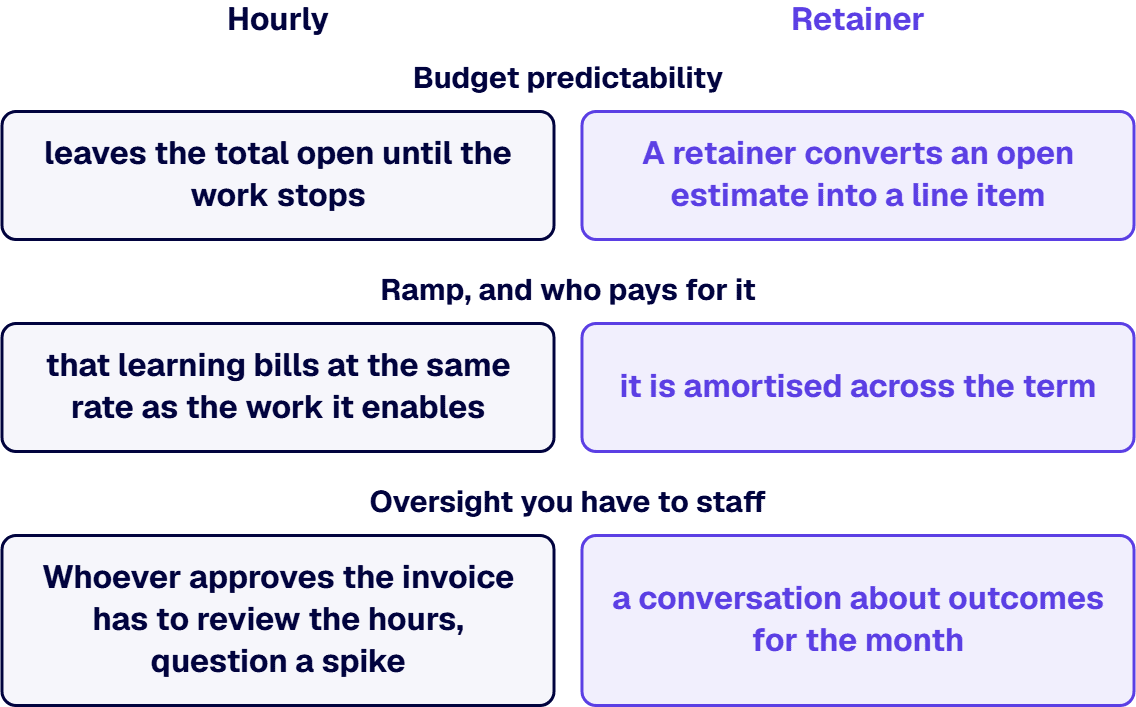
When the argument between hourly and retainer stalls, it is usually because nobody yet knows how much work there is. That is a scoping problem wearing a pricing costume, and it has its own instrument. A Microsoft discovery assessment is a fixed-scope, fixed-fee engagement, typically $10K-$25K depending on scope, not an open-ended hourly meter, and the roadmap it produces is yours to execute with or without the firm that wrote it.
Buying the assessment first turns an unestimatable engagement into an estimatable one, which is the condition under which a retainer becomes the cheaper of the two models. Our fuller treatment of how these instruments compare sits in Microsoft consulting billing models.
Answer these three and the choice is made.
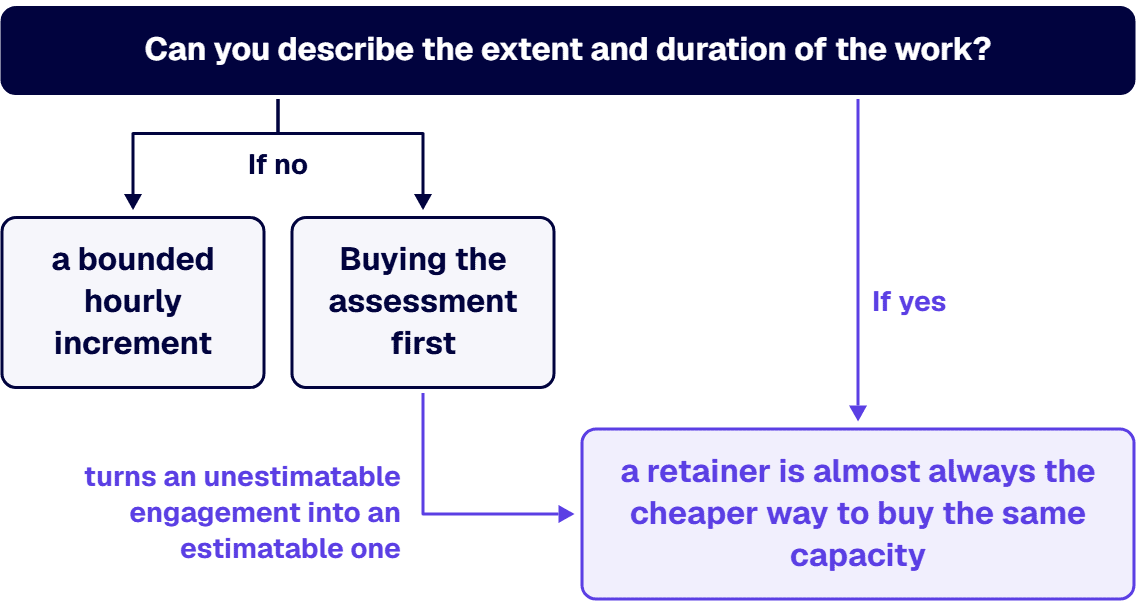
If the answers point at reserved capacity, the shape of it is set out in IT staff augmentation services, and the difference between a dedicated team and traditional staffing is compared directly in dedicated Microsoft teams versus traditional IT staffing. If you need a named specialist rather than a team, hire on demand Microsoft experts covers that route. For the total cost of ownership comparison against a full-time hire, which is a different question from this one and deserves its own arithmetic, see our guide to IT staff augmentation for Microsoft enterprises.
i3solutions delivers under a partner-led engagement model with named accountability and governance that holds up under a client audit, as distinct from contractor-only staff augmentation. That is a statement about how the engagement is run, not a record of any audit outcome, and it is the part of a retainer that never appears on an hourly rate card: an hourly arrangement buys labor by the hour, and accountability for the result stays with you.
Not comparably, because the two are not selling the same thing. Hourly can be the lower total outlay on genuinely short, bounded work, and the Federal Acquisition Regulation restricts time and materials to exactly that case: where it is “not possible at the time of placing the contract to estimate accurately the extent or duration of the work” (FAR 16.601(c)). Once the extent is estimatable and the work runs for months, a retainer usually wins on total cost, because ramp is amortised and the oversight burden drops.
i3solutions does not publish an hourly rate. It publishes monthly engagement bands and prices hourly work per scope. Retained advisory for Microsoft-focused environments runs $5K-$15K per month, and the ladder continues through embedded advisory, a named specialist, and a dedicated team, each with its own published band.
Dedicated team engagements range $35,000 to $95,000 per month per team depending on team composition (senior architect, senior engineer, delivery lead mix) with three to nine month minimum commitments. That is the only commitment length i3solutions publishes. Anything shorter is scoped in the conversation rather than on a price list.
Yes, and the cleaner sequence is to scope the work before you buy any of it. A Microsoft discovery assessment is a fixed-scope, fixed-fee engagement, typically $10K-$25K depending on scope, not an open-ended hourly meter, and the roadmap it produces is yours to execute with or without the firm that wrote it. Assessment first, then a retainer sized to the roadmap, avoids paying hourly for the discovery you were going to need anyway.
Reserved capacity, continuity of the same people, and a named owner for the outcome. i3solutions delivers under a partner-led engagement model with named accountability and governance that holds up under a client audit, as distinct from contractor-only staff augmentation. Hourly billing buys labor by the hour and leaves accountability for the result on your side of the table.
Independent verification and validation is a team outside your development organization re-deriving the evidence your quality system will be judged on: requirements traced to risk and to system needs, verification that the design and the code match those requirements, and validation that the software does its job in its intended use, in the hands of the people who will actually use it. FDA treats independence as a quality assurance precept rather than a nice-to-have, and in regulated software IV&V usually runs as a standing oversight function rather than a one-time test pass. Cost is not a list price. It is set by six things: the risk class and intended use of the software, how much reviewable requirements and traceability you already have, how many regulatory frameworks are in scope at once, whether you are buying concurrent oversight or a retrospective read on software already fielded, the review cadence and duration, and how much of the evidence falls out of your toolchain rather than being assembled by hand. Scope those six and you can hold a real estimate conversation. Any firm quoting before it has read your requirements is guessing.
The word doing the work is independent. FDA’s own guidance is unusually direct about why. In General Principles of Software Validation; Final Guidance for Industry and FDA Staff (document issued January 11, 2002, CDRH and CBER), Section 4.9, Independence of Review, reads: “Validation activities should be conducted using the basic quality assurance precept of ‘independence of review.’ Self-validation is extremely difficult. When possible, an independent evaluation is always better, especially for higher risk applications. Some firms contract out for a third-party independent verification and validation, but this solution may not always be feasible. Another approach is to assign internal staff members that are not involved in a particular design or its implementation, but who have sufficient knowledge to evaluate the project and conduct the verification and validation activities.”
That is the buying case in four sentences, and it is worth noticing that FDA offers two routes, not one. Contracting out is the first. Structurally separate internal reviewers are the second. The question to settle before you buy anything is not whether your QA team is good. It is whether it is independent of the people whose work it is judging.
It is also worth being clear about what IV&V does not do. The same guidance states that “regardless of the distribution of tasks, contractual relations, source of components, or the development environment, the device manufacturer or specification developer retains ultimate responsibility for ensuring that the software is validated.” You can buy independence. You cannot buy away accountability, and any firm that implies otherwise is selling you something you will have to retract in front of an assessor.
The regulatory ground under this moved recently, which is the single most common reason a validation package that was fine two years ago is not fine now. 21 CFR part 820 is now titled the Quality Management System Regulation. Under 21 CFR 820.7(b) it incorporates ISO 13485:2016 by reference, and 21 CFR 820.10(a) requires a manufacturer to “Document a quality management system that complies with the applicable requirements of ISO 13485 (incorporated by reference, see 820.7) and other applicable requirements of this part.” FDA states that the revised part 820 is effective February 2, 2026, and that on that date the agency stopped using the Quality System Inspection Technique for device inspections and began using the process described in the updated Inspection of Medical Device Manufacturers Compliance Program: 7382.850. If your last validation package was assembled to survive a QSIT-shaped inspection, that alone is a reason to have someone independent read it again.
The first pass is not testing at all. It is reading. An IV&V team takes your intended use, your risk analysis, and your software requirements, and asks whether each requirement traces both to a system need and to a risk it controls, and whether each is written so it can actually be verified. FDA’s guidance describes exactly this: “A software requirements traceability analysis should be conducted to trace software requirements to (and from) system requirements and to risk analysis results.”
This is where most of the findings live, and it is by a wide margin the cheapest place to find them. A requirement that cannot be objectively verified will produce a test that proves nothing, and you will not discover that until an assessor asks what the test demonstrates. Two specific failures show up over and over: a requirement with no risk behind it, which usually means the risk analysis is incomplete rather than the requirement being redundant, and a risk with no requirement in front of it, which is the one that costs money. Both are found on paper, in days, by people reading.
Verification asks a narrow question: does what was built match what was specified. The IV&V team reviews the design against the requirements, reviews the code against the design, and checks that the test procedures actually exercise what they claim to exercise. This is also where device classification starts driving scope. Under 21 CFR 820.10(c), manufacturers of class II and class III devices, and of class I devices “automated with computer software,” must comply with the requirements in Design and Development, Clause 7.3 and its subclauses in ISO 13485. The design history is not filing; it is the thing being inspected.
If the system creates, modifies, maintains, or transmits electronic records under 21 CFR part 11, there is a second and blunter requirement. 21 CFR 11.10(a) requires “Validation of systems to ensure accuracy, reliability, consistent intended performance, and the ability to discern invalid or altered records.” That last clause is the one teams underestimate. Proving a system can detect an altered record is a different test design from proving it stores records correctly, and it is a common source of late rework because nobody wrote a requirement for it.
Validation asks the wider question: in the hands of the people who will actually use it, in the environment it will actually run in, does the software do the job. The output is not a green dashboard. It is an evidence package an assessor can follow without a guide: the traceability matrix, the verification and validation records, the deviations and how each one was dispositioned, and a written statement of what was reviewed, by whom, and against what.
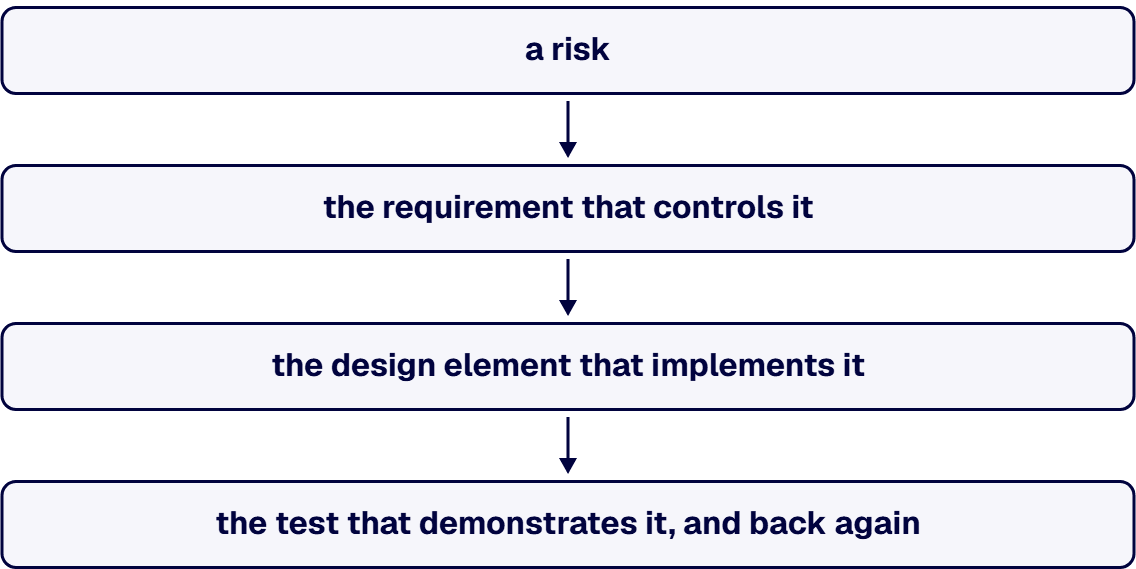
The test of a package is whether a reader who was not in the room can get from a risk to the requirement that controls it, to the design element that implements it, to the test that demonstrates it, and back again, without asking anyone a question. If that walk needs a narrator, the package is not finished, however many test reports sit behind it.
Nobody scopes this from a price list. Six things move the number, and five of them are inside your control.
Ask for the estimate in named units rather than one total: requirements reviewed, interfaces reviewed, increments covered, frameworks in scope, deliverables signed. A firm that can only price the whole thing has not decomposed the work, and a total with no units behind it cannot be renegotiated when the scope moves, only re-argued.
Then ask three questions of any proposal. Which of the six drivers above has the firm actually confirmed, as opposed to assumed? What specific assumption, if it turns out to be wrong in week two, changes the number, and by roughly how much? And what does the firm hand you at the end, named document by named document, with a signature line on each? A proposal that answers those three is an estimate. One that does not is a placeholder with a number on it.
What we will not do is hand you a per-stage table whose rows add up to a total. Validation scope changes with what the first review finds, and a table that pretends otherwise is a sales artifact rather than an estimate.
Bring in an independent team when the software carries real risk, when the evidence has to survive someone who was not in the room, or when your own QA function reports to the same leader as your development organization. On the last one, FDA’s two routes are worth re-reading before you spend anything: if you can create genuine internal independence, do that. If you cannot, that is what a third party is for.
Reviewing requirements, architecture, code quality, testing evidence and deployment readiness across Microsoft-centric and enterprise software is the scope of independent validation and verification services.
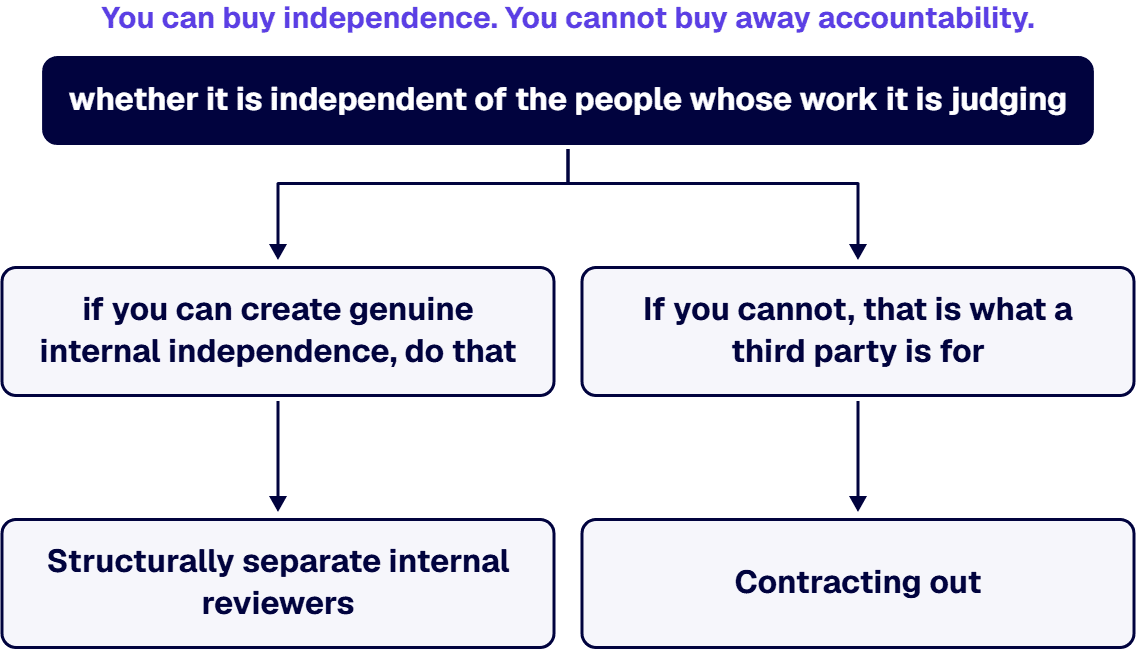
For a regulated medical-device or ISO-certified software program, the quality and release owners can draw on independent validation and verification services that cover requirements, architecture, code quality, testing evidence and deployment readiness across Microsoft-centric and enterprise software.
On our own record, stated plainly and no wider than it goes: i3solutions has performed IV&V on software subject to FDA design-control expectations, including requirements traceability from controls through delivered functionality. We are not going to dress that up into a submission, a clearance, or a certification, and you should be skeptical of any firm that dresses up its own.
The rest of our IV&V record sits in other regulated regimes, and it is worth reading as evidence of how the function is run rather than as FDA work. On a defense program assessed under CMMC, not under FDA or ISO 13485: Across two Program Increments, the IV&V function logged 47 findings (3 critical, 11 high, 33 medium-low), 41 of which closed within the originating sprint. The C3PAO assessment completed without findings against the application, and the contractor extended the engagement. The number that matters there is not 47. It is 41 closed in the sprint that raised them, because a finding closed inside the sprint costs a fraction of the same finding found during an assessment. On a financial services engagement under GLBA, again a different regime from FDA: The IV&V engagement validated requirements traceability from the underlying compliance framework controls through the delivered functionality, identified two control mappings where the vendor’s interpretation of GLBA requirements diverged from the firm’s expectation, surfaced three test cases the vendor’s plan had not included, and produced the board-defensible attestation the audit committee required. Different regulator, same mechanism: read the traceability first, and the expensive gaps show up on paper.
The delivery context behind that: i3solutions is a Microsoft Partner with 30 years of delivery experience. i3solutions has completed more than 600 Microsoft platform implementations. The reviewers have built the class of system they are reviewing, which is what separates a useful finding from a checklist observation. Delivery is US-based and senior.
If you want to know where you stand before committing to a cadence, start with a bounded readiness review. If the program is already running and the risk is that defects surface after release, standing oversight is the right shape. Either way, read how IV&V differs from traditional testing first so you are not paying independent-review rates for work your existing QA function already covers, then look at running IV&V inside an Agile delivery cadence if your teams work in sprints, and the IV&V best practices that decide whether findings close cheaply or expensively. Engagement models sit inside our custom Microsoft software consulting practice, and the build side lives in custom application development services.
We do not publish a price band for IV&V in an FDA or ISO 13485 context, because the honest answer is that the number is set by scope rather than by a rate card, and a firm that quotes before reading your requirements is guessing. Six things drive it: the risk class and intended use of the software, how much reviewable requirements and traceability already exist, how many regulatory frameworks are in scope at once, whether the software is being built or is already fielded, the review cadence and duration, and how much of the evidence falls out of your toolchain rather than being assembled by hand. Scope those six, ask for the estimate in named units rather than one total, and ask which of the six the firm has actually confirmed. That gets you a number you can defend internally.
FDA’s General Principles of Software Validation does not mandate a third party, but it is direct about the problem: “Validation activities should be conducted using the basic quality assurance precept of ‘independence of review.’ Self-validation is extremely difficult.” The guidance offers two routes, contracting out for third-party independent verification and validation, or assigning internal staff members who were not involved in the design or its implementation but who have sufficient knowledge to evaluate the project. The question is not whether your QA team is good. It is whether it is structurally independent of the people whose work it is judging.
No. FDA’s guidance states that regardless of the distribution of tasks, contractual relations, source of components, or the development environment, the device manufacturer or specification developer retains ultimate responsibility for ensuring that the software is validated. An independent team gives you better evidence and an outside opinion. It does not move your name off the submission, and a firm that suggests it does is one to walk away from.
Traceability that runs in both directions, and a written record of who reviewed what against which standard. Test reports tell you which tests passed. An IV&V package tells you whether the requirements were the right requirements, whether each traces to a risk and to a system need, which requirements had no test behind them, which risks had no requirement in front of them, and how every deviation was dispositioned. The practical test is whether a reader who was not in the room can walk from a risk to a requirement to a design element to a test and back without asking anyone a question.
Before code, if you have the choice. The first pass reviews requirements, risk analysis, and traceability, and that is where the cheap findings are. A requirement that cannot be objectively verified costs very little to fix on paper and a great deal to fix after it has been built, tested against, and documented. Starting IV&V at the end still produces a defensible package, but you are paying to discover problems at the most expensive point in their life, and the cost of the engagement is then mostly remediation rather than review.
It changes the frame it is read in. 21 CFR part 820 is now titled the Quality Management System Regulation, it incorporates ISO 13485:2016 by reference under 21 CFR 820.7(b), and 21 CFR 820.10(a) requires a documented quality management system complying with the applicable requirements of that standard. FDA states the revised part is effective February 2, 2026, and that on that date the agency stopped using the Quality System Inspection Technique and began using the updated Inspection of Medical Device Manufacturers Compliance Program: 7382.850. Your underlying verification and validation evidence does not become wrong, but the index into it, and the vocabulary an inspector arrives with, both changed.

US-Based Microsoft System Integrator | Est. 1997
© i3solutions. All rights reserved.
US-Based Microsoft System Integrator | Est. 1997
© i3solutions. All rights reserved.


