
Delivery questions become urgent once a roadmap gets approved and the team meant to execute it is already stretched. These answers address what a capacity review assesses, what a discovery engagement has to produce, and when more Microsoft expertise gets added in-house, brought in through a partner, or deferred.
By Scot Johnson
Agile staff augmentation for government contractors turns on eight things a Microsoft delivery team must show, each tested against a document you already hold. The first five settle whether the team is admissible under obligations you already hold; the last three settle whether the arrangement will work.
A regulated commercial enterprise evaluating an augmented delivery team is asking a question whose consequences stop inside its own organization. If the team is weak, the enterprise absorbs the cost, reworks the plan, and moves on. That is a real question and there is a good answer to it, and it is not the question on this page.
You are not in that position, and the difference is contractual, not cultural. You are performing under a prime contract or a subcontract. The obligations you hold travel to the people you add to the program. What an augmented team does becomes part of your compliance posture and part of your own performance record, which is the thing your next competitive position rests on.
So the question changes shape. It stops being is this team any good, and how would I know and becomes what happens to my obligations, my assessment scope and my performance record when I add this team, and how do I verify each answer before I do it. The first question is about the provider. The second is about you, with the provider as one variable in it.
That is why the tests below sit on your side of the table. Every one of them is run against a document you already have or can obtain: your subcontract clause matrix, your system security plan’s boundary description, your approved software list, your key-personnel clause, your period-of-performance calendar, your tenant’s own service catalogue. The provider’s answer is the input. Your document is the standard.
Each criterion below is stated as a property of the arrangement, then as the verification act that settles it. Read the test as the operative half. A criterion you cannot test is a preference.
Your prime contract obligates you to pass certain terms down to anyone performing part of the work. A provider who has done this before knows which clauses they take as written, which they negotiate, and which they will not accept at all, and they can say so before the first conversation about people.
The test. Hand them your subcontract clause matrix and ask for their exceptions list in writing. Then read the exceptions against what your own prime contract permits you to accept. The finding is not whether they have exceptions. It is whether their exceptions land inside the range your contract lets you agree to, and whether they knew that before you told them.
The boundary of your assessment is defined by where controlled information lives and who touches it. Adding people, devices and tooling to a program can move that boundary, and the cost of discovering it late is an assessment you thought was scoped and is not. The boundary you are describing is the one recorded in a plan your customer accepted, so moving it is a change you owe them notice of rather than a cost you absorb inside your own organization.
The test. Ask them to place their people, their endpoints and their tooling on your own system security plan’s boundary description. Anything that lands inside the boundary is in your scope, not theirs, and it is in your scope from the day they start, not from the day you notice. A provider who cannot place themselves on your diagram has not thought about your scope; a provider who places themselves outside it should be asked how, specifically, and the answer should be checkable against your own network and identity records.
Working in a government cloud environment is not the same act as working in a commercial one, and the difference is not a matter of degree. The service catalogue differs, feature parity lags in places, and the tooling a delivery team brings with it by habit may not be admissible at all.
The test. Ask for the list of their own tools that would need to touch your environment: source control, ticketing, chat, build agents, screen sharing, anything that would hold or transit your data. Check each name against your approved software list. Every tool that is not on that list is either a request you have to process or a boundary crossing you did not plan. This test is cheap and it is answerable in one exchange, and it produces a list rather than an impression.
Eligibility statements at the level of the firm are not evidence about the individual who will be on your program. What you need is the mechanism, not the assurance.
The test. Ask how eligibility is established and recorded for each person at onboarding, and what the record is. Lay that answer beside the personnel requirements your own contract states, which is the document that decides what the record has to cover. Then ask yourself a narrower question: is this the kind of record you could put in front of your own contracting officer if asked. A statement in a capability deck is not that record. An onboarding artifact that names the person, the check and the date is.
If your contract names key personnel and constrains how they are replaced, then every person on your program who fills one of those roles sits inside that constraint, including people who work for someone else. A provider who rotates staff on its own schedule has handed you a compliance problem you will discover at the worst time.
The test. Ask for their substitution process in writing: notice period, replacement standard, who approves, what happens if you decline the replacement. Lay it beside your own key-personnel clause. The two documents either reconcile or they do not, and reading them side by side takes less time than the first conversation about it after something goes wrong.
Depth in the Microsoft estate is not portable across cloud variants in the way people assume. What is generally available in one environment may be unavailable, delayed, or shaped differently in the environment a contractor is required to operate in, and a design that assumed the wrong one has to be redone.
The test. Take one capability from your current roadmap and ask them to tell you what is available for it in your tenant type, what is not, and what the accepted alternative is. Then check the answer against your own tenant’s service catalogue. This is a closed-book question with a checkable answer, which is what makes it worth asking. A team that has only worked in the commercial variant will answer it from the commercial variant, and you will see that immediately.
Agile delivery produces reporting continuously. Contract performance also requires reporting, and that reporting is a deliverable with a form, a recipient and a due date your contract sets rather than a format you choose, where a late or rejected submission is an event on your own performance record. On a well-run program these are the same evidence rendered twice; on a badly run one they are two separate jobs, and the second is done by your people at the end of every month.
The test. Ask for a sanitized sprint report from work of the same shape. Give it to whoever owns your program reporting and ask one question: could this go into a monthly status as it stands, or would it have to be rebuilt. The answer tells you where the reporting burden is going to land, and it tells you before you have agreed to carry it.
An onboarding plan is built from the sequence its author controls: paperwork, checks, tooling access, environment access. Your calendar is a contract calendar, with a period of performance, funding increments and option boundaries that do not move because a ramp was optimistic.
The test. Ask them to place their ramp on your period-of-performance calendar and to mark what happens at the next option boundary and at the next funding increment. A plan that cannot be drawn on your calendar has not been drawn against your constraints, and the gap will surface as a staffing decision made under time pressure.
The criteria test different things, so a candidate can pass one group and fail the other, and the temptation at that point is to average the two into an overall impression.
Do not average them. Criteria one through five are about whether adding this team is admissible under obligations you already hold. Criteria six through eight are about whether the arrangement will work well. Admissibility is a gate and quality is a scale, and a scale never clears a gate. A team that scores well on six through eight and fails one through five is not a strong candidate with a gap; it is a candidate you cannot use in the form proposed. Where two criteria inside the same group disagree, the one you can evidence against your own document wins over the one resting on an assurance.
This page assumes you have already decided that augmented Microsoft delivery capacity is the shape you want. Three adjacent decisions are settled elsewhere and are deliberately not argued here.
Whether augmentation is the right engagement model at all, as against a strategic delivery partnership, is a different decision with a different set of inputs, and it is answered on the staff augmentation versus strategic delivery partnership page.
How to evaluate a Microsoft staff augmentation partner in general, for a regulated enterprise without the flow-down structure described above, is answered on the how to evaluate a Microsoft staff augmentation partner page. The criteria on this page are the government-contractor-specific layer, not a replacement for that one.
The commercial arrangement itself, including how hourly and retainer models differ in what they actually cost, is answered on the hourly versus monthly retainer page. There are no rates, costs or comparisons of cost on this page.
Eight things: which of your flow-down clauses it accepts without exception, what adding it does to your assessment scope, whether it can work inside your accredited tenant rather than reaching in from outside, how it evidences personnel eligibility per person, whether it can be held to substitution discipline matching your key-personnel obligation, whether its Microsoft depth is in the cloud variant you actually run, whether its sprint artifacts can enter your reporting obligation without rework, and whether its ramp fits your period of performance. Each one is settled by a test run against a document you already hold.
A commercial enterprise’s supplier risk stops inside its own organization. A government contractor performs under a prime contract or subcontract, so the obligations it holds travel to the people it adds, and what the augmented team does becomes part of its compliance posture and its own performance record. The commercial question is whether the team is any good. The government contractor’s question is what happens to its own obligations, assessment scope and performance record when the team is added, and how each answer is verified first.
It can, and whether it does is a question about placement, not about the provider’s assurances. The boundary of an assessment is defined by where controlled information lives and who touches it, so people, endpoints and tooling that land inside that boundary are inside the contractor’s scope from the day they start. The way to settle it is to ask the provider to place their people, endpoints and tooling on the contractor’s own system security plan boundary description, and to check any claim of sitting outside it against the contractor’s own network and identity records.
By running each test against a document the contractor already holds, with the provider’s answer as the input being checked, not as the conclusion. The subcontract clause matrix checks the exceptions list. The system security plan boundary description checks the scope placement. The approved software list checks the tooling. The key-personnel clause checks the substitution process. The tenant service catalogue checks the platform depth answer. The period-of-performance calendar checks the ramp. In each case the standard is the contractor’s document, not the provider’s statement.
Ask for the substitution process in writing: the notice period, the replacement standard, who approves a replacement, and what happens if the replacement is declined. Then read it beside the contract’s own key-personnel clause. If the contract names key personnel and constrains how they are replaced, anyone filling one of those roles sits inside that constraint whether or not they are directly employed, and a provider rotating staff on its own schedule creates a compliance exposure that surfaces at the worst moment.
They are not averaged. The first five criteria are about admissibility under obligations the contractor already holds; the last three are about whether the arrangement will work well. Admissibility is a gate and quality is a scale, and a scale never clears a gate, so a team that performs well on the last three and fails one of the first five is not a strong candidate with a gap but a candidate that cannot be used in the form proposed. Where two criteria within the same group disagree, the one evidenced against the contractor’s own document outranks the one resting on an assurance.
By Michael Branson
A complete IT infrastructure strategy engagement covers four stages: a current-state assessment against your actual environment (not a generic checklist), a gap analysis tied to your specific compliance and operational constraints, a sequenced modernization roadmap with named dependencies, and a governance handoff so the roadmap survives the consultants leaving. Evaluate the firm on whether they can name all four stages and what they hand you at the end of each one, not on their sales deck.
Your board or your CEO has told you to commission an infrastructure strategy engagement, and four firms are now in front of you with proposals. You cannot tell which of them is properly scoped, which has padded the work with stages you do not need, and which is thin in a place that will cost you a year and a half from now. The pitch decks do not help, because each one describes a different shape of work under the same words, and none of them shows you the yardstick. If you pick wrong on scope, you buy a document that does not survive the next budget cycle. If you pick wrong on the firm, you buy a plan nobody in your organization can execute. Both outcomes land on you, because you own the vendor relationship and you own the spend.
What follows is the yardstick: what an infrastructure strategy engagement should include stage by stage, current-state assessment through sequenced modernization roadmap and governance handoff, and the four criteria that separate a firm who can deliver that roadmap from one who can only sell it.
If a proposal in front of you uses the phrase “end to end” without naming what lands in your hands at each step, you have no way to price it against the others. End to end is not a level of effort. It is four stages, and each one produces an artifact you can hold, review and reuse after the firm has gone.
Current-state assessment. The failure mode you are guarding against is a firm that assesses your environment from a questionnaire your team filled in. An assessment worth buying reads the environment itself: tenant and directory reports, admin center exports, the integration and connection inventory, the license assignment report. Ask which exports the firm will pull and who on your side has to grant access to pull them. A firm that cannot answer that in the proposal will be answering it in month two, on your clock.
Gap analysis. A gap list that is really a product wish list is the second failure mode, and it is harder to spot because it reads as thorough. A gap is only a gap against something: an operational constraint you have stated, a service commitment you have made internally, or an obligation your own compliance officer has identified for your organization. Each entry in the gap register should name that something. Where an entry names no constraint, it is a preference, and preferences belong lower in the sequence than obligations.
Sequenced modernization roadmap. Sequence is cheap to assert and expensive to demonstrate, because asserting it costs a sentence in a proposal and demonstrating it costs a dependency map. A roadmap that lists workstreams without saying which must finish before which is a list, and a list will not survive its first contested budget review. What makes it a roadmap is the dependency map underneath it and the exit criteria on each step, so that any person can look at a step in flight and say whether it is done. Ask to see the exit criteria for the first two steps before you sign.
Governance handoff. Where a proposal drops a stage without the omission being visible to you, the governance handoff is the stage it drops, because its absence changes nothing in the table of contents of what you receive. That is the mechanism that produces a plan nobody in your organization can execute. A handoff is a working session plus two artifacts: the decision record, which explains why each choice was made so that a successor can revisit it honestly, and a named owner against every step, so the roadmap has somewhere to live after the invoice is paid. If the proposal ends at the roadmap, the engagement ends before the value does.
When two of these stages disagree, the earlier one governs. If the roadmap assumes a system the current-state assessment did not find, the assessment wins and the roadmap is corrected, because a plan built on an inventory nobody verified is a schedule of work against systems that may not be there.
You are holding four proposals and they are not comparable, and the reason is structural, not a fault of any one firm. Each proposal has chosen its own boundaries, named them in its own words, and priced against its own boundary. Without a fixed yardstick, you are comparing four different products that share a name.
Read each proposal against the four stages above and mark which stages it actually contains. Three patterns show up quickly. A proposal that is assessment only, with the roadmap named as a later engagement, is a real product and a legitimate one, but it is not what your board asked you to buy. A proposal heavy on current-state assessment and light on sequence is selling you the part that is easiest to staff. A proposal that reaches the roadmap and stops there has left out the stage that determines whether anything gets executed.
Mark the gaps on a single sheet, one row per firm and one column per stage, and take that sheet into the vendor conversations. A firm that agrees a stage is missing and explains why it was scoped out is giving you information you can use. A firm that reframes the question is giving you an answer about the firm.
Once you know what the engagement should contain, the firm question narrows to one thing: can this firm produce a sequenced modernization roadmap your organization will still be executing a year from now? General partner-evaluation criteria are set out in how to evaluate a custom Microsoft software consulting partner, and that framework holds. Four criteria are specific to strategy and roadmap work, and they are the ones that separate firms who look identical on a capability slide.
One: references for strategy work, not build work. Ask for two references where the deliverable was a roadmap, and ask those references one question: what were you executing a year later? A firm with deep build references and no strategy references is a competent firm being hired for the wrong stage. Build references answer a different question than the one you are asking.
Two: named senior people, committed across all four stages. Ask who specifically runs the current-state assessment, who writes the gap register, and who sits in the governance handoff, by name, and ask whether those are the same people. The pattern to watch for is senior presence at the pitch and the kickoff, then a handover to a delivery team that was not in the room when the reasoning happened. Get the names into the proposal.
Three: a handoff artifact you can name before you sign. Ask what the decision record looks like, and ask to see a redacted example from other work. A firm that runs this stage routinely has an example. A firm that has to describe one in the abstract has not run it recently, whatever the capability slide says.
Four: a written statement of what the engagement will not cover. The exclusions section tells you more about scope discipline than the inclusions section does, because inclusions are written to win and exclusions are written to be lived with. A proposal with no exclusions is not a broader engagement; it is an engagement whose boundary will be negotiated later, when you have less leverage than you do now.
When two firms split these four criteria between them, the handoff artifact settles it. A roadmap your team cannot operate once the firm leaves is the failure that costs the most to repair, because the repair is a second engagement.
There is a situation where the honest answer is that you should not buy this engagement yet, and if you are in it, a full strategy engagement will waste your budget rather than protect it.
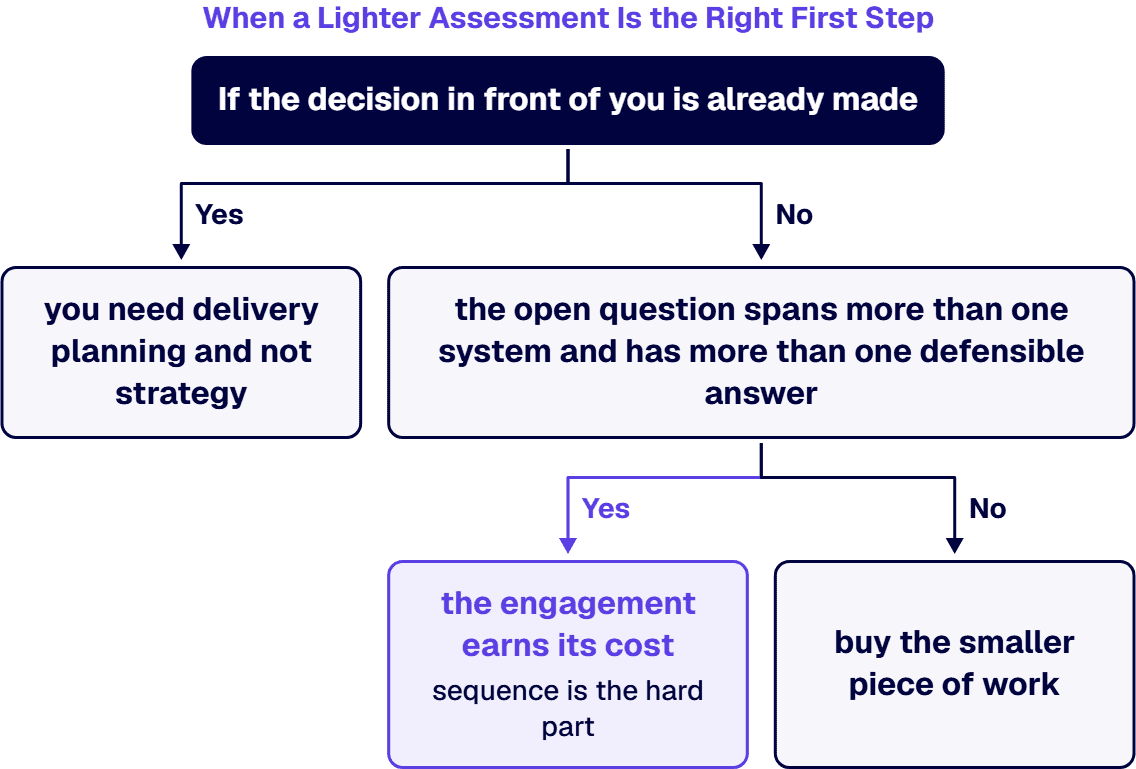
If the decision in front of you is already made, and what you need is a plan to execute it, you need delivery planning and not strategy. If your environment has been inventoried inside the last year and the inventory is still accurate, you are paying twice for stage one. If a single application or a single integration is the problem, and the rest of the estate is stable, a scoped assessment of that one thing will answer the question faster and for less.
The test is whether the open question spans more than one system and has more than one defensible answer. Where it does, sequence is the hard part and the engagement earns its cost. Where it does not, buy the smaller piece of work, and keep the strategy engagement for the year when the question is actually open.
If your organization holds federal contracts, the engagement has a stage this page does not cover, and the scoping is materially different. Contract-clause obligations shape what the assessment has to look at and what the roadmap has to sequence around, and that work belongs on its own page rather than as a paragraph here. Start instead with IT Strategy Consulting for Government Contractors: What the Engagement Covers and How It Runs, which sets out that engagement, its deliverable and the conditions under which it is the wrong thing to buy.
If you are running the four stages above across a shortlist, you are entitled to see us measured the same way, so here is the attested version and nothing beyond it: i3solutions sells and delivers an enterprise IT technology assessment of a Microsoft environment as a named engagement, comprising discovery, gap analysis and a future-state roadmap. That is a named engagement covering the first three of the four stages on this page, in a Microsoft environment.
Three things this section deliberately does not say, and the reason is the same each time. It names no client and no project, because a reference you cannot verify is worth nothing to someone about to defend a vendor decision. It quotes no cost, no duration and no outcome figure, because none is attested for this engagement outside the government contractor case, and a figure nobody will stand behind is a figure you would be asked to defend on our behalf. And it does not list the artifacts we hand over, because the artifact names in the table above are the yardstick for the market, not an attested description of our own deliverables. Ask for all three in the conversation, against your own environment, where the answers can be specific.
Contact a senior integration architect to work through the four stages against the proposals actually in front of you.
You are comparing proposals that use the same words for different work, so start from a fixed definition. An end-to-end IT infrastructure strategy engagement covers four stages: a current-state assessment of the real environment, a gap analysis against stated operational and compliance constraints, a sequenced modernization roadmap with a dependency map, and a governance handoff that transfers decisions and ownership to the internal team. Pick the firm on whether it can name all four stages and the artifact each one produces, on references for strategy work rather than build work, on named senior people committed across every stage, and on a written statement of what the engagement excludes. Government contractors should start from the government contractor version of this engagement, which adds contract-clause obligations that change the scoping.
You may be quoted for both and find the difference is not explained. An IT assessment produces a picture of the current environment and stops there, which is the first of the four stages in a full engagement. A full infrastructure strategy engagement takes that picture forward into a gap analysis against stated constraints, a sequenced modernization roadmap with a dependency map and exit criteria, and a governance handoff with a decision record and named internal owners. An assessment answers what you have; a strategy engagement answers what to do about it, in what order, and who owns each step afterwards.
Firms look identical on a capability slide, so test them on four criteria specific to roadmap work. First, references where the deliverable was a roadmap, with the follow-up question of what that client was executing a year later. Second, the names of the senior people who will run each of the four stages, with confirmation that they are the same people across all four. Third, a governance handoff artifact the firm can describe concretely and show as a redacted example. Fourth, a written statement of what the engagement will not cover, since an exclusions section reveals more about scope discipline than an inclusions section does.
If the proposal in front of you describes activity instead of artifacts, ask for artifacts. A complete engagement produces four: an environment inventory sourced from the organization’s own admin center exports and directory reports; a gap register in which each entry names the gap, the constraint it sits against, and the operational consequence; a dependency map with a sequenced plan carrying exit criteria on each step; and a decision record naming every choice, the reasoning behind it, and the internal owner of each roadmap step. An engagement that ends at the roadmap has left out the handoff.
If the decision is already made, a strategy engagement is the wrong purchase and delivery planning is the right one. Three situations point the same way: the choice has been settled and only execution remains; the environment was inventoried within the last year and the inventory is still accurate; or a single application or integration is the problem while the rest of the estate is stable. The test is whether the open question spans more than one system and has more than one defensible answer. Where it does not, buy the scoped assessment of the one thing, with its own exit criteria written into the proposal, and keep the strategy engagement for a year when the question is genuinely open.
Michael Branson, Founder and COO, i3solutions. LinkedIn
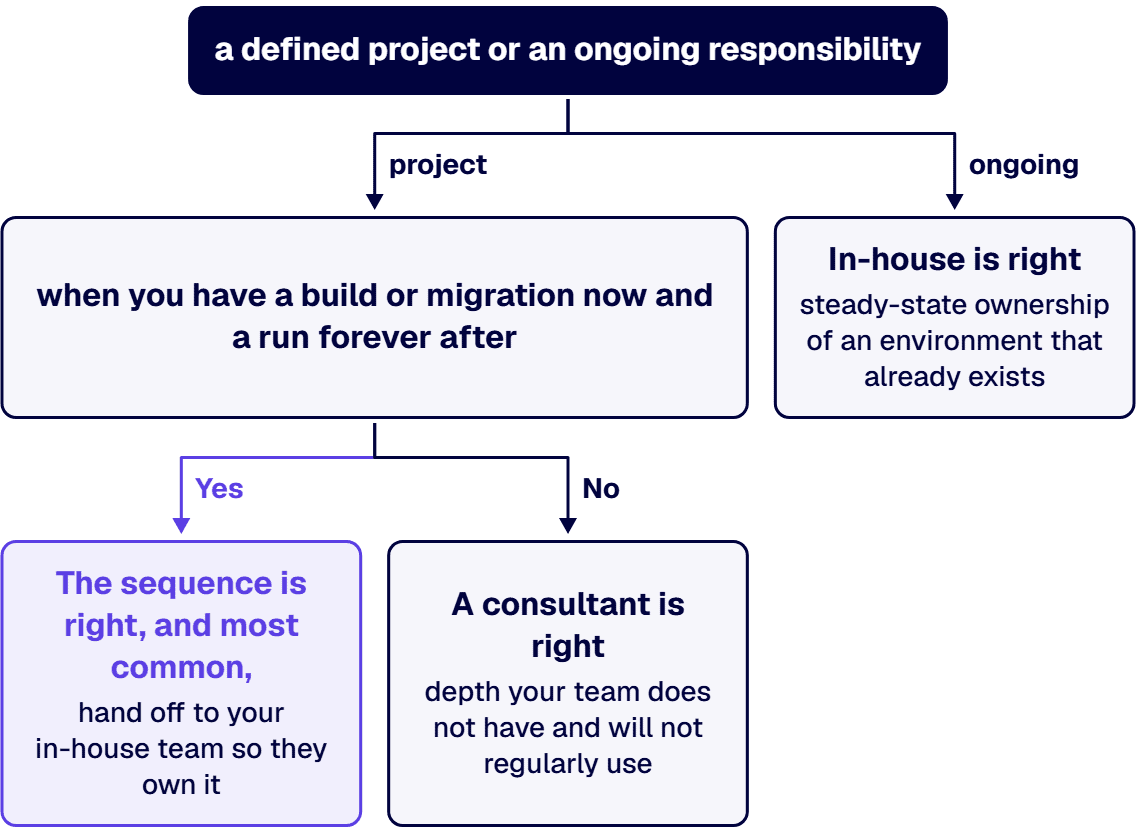
The SharePoint consultant versus in-house decision is really a project-versus-steady-state question. A consultant brings concentrated depth for a defined piece of work: a build, a migration, a rescue. In-house staff are the right owners for ongoing, steady-state operation once the work is built. The honest answer is frequently both, in sequence: a consultant does the build or migration, and your in-house team runs it afterward. The expensive mistakes are hiring a full-time specialist for a one-time build, and asking an overloaded in-house generalist to do a specialist migration they will do once.
Framing this as consultant or in-house, pick one, is what leads teams astray, because the two are suited to different phases of the same work. The real question is whether the work in front of you is a defined project or an ongoing responsibility, and the answer usually points to a sequence rather than a side.
A SharePoint consultant is concentrated depth for a bounded job – the model behind dedicated SharePoint development services. A migration, a complex build, a modernization, a rescue of something that went wrong, these are tasks that demand expertise your team may need intensely for a few months and then rarely again. A specialist who has done the same migration many times does in weeks, and with fewer surprises, what an in-house generalist learning the platform on the job does in far longer and with more risk, because the specialist already knows where the orphaned permissions and the broken workflows hide. For a defined, depth-heavy task, that concentrated expertise is the efficient choice precisely because it is temporary.
In-house staff are the right owners for steady state. Once SharePoint is built and running, the ongoing work, administration, small changes, user support, day-to-day governance, is continuous and benefits from people who know your organization, are always available, and accumulate context over time. Paying consulting rates to run steady-state operations indefinitely is overpaying, just as asking a one-time-need to justify a permanent hire is.
So the decision criteria are clear.
A consultant is right when the work is a defined project requiring depth your team does not have and will not regularly use: a migration, a complex build, a rescue, a modernization.
A federal agency replaced the cost of maintaining 30 separate systems with a single centralized SharePoint environment, a consolidation that leaned on outside SharePoint expertise to scope and execute.
In-house is right when the work is ongoing steady-state ownership of an environment that already exists and does not have a major build ahead of it.
The sequence is right, and most common, when you have a build or migration now and a run forever after: bring in the consultant for the project, and have the consultant work alongside and hand off to your in-house team so they own it cleanly afterward. The worst outcomes come from ignoring the sequence, hiring permanent specialists for a one-time build and carrying the cost forever, or loading a stretched in-house generalist with a specialist migration they will do once, slowly, and at risk. i3solutions runs SharePoint migrations with an assessment-first discipline specifically so the depth is applied where it is needed and the result is something an in-house team can own, which is the point of getting the consultant-versus-in-house split right.
Our engagements run on The Expert Delivery Model, i3solutions’ named methodology for SharePoint work in regulated environments. It is structured as four phases, discovery, architecture, build, and knowledge transfer, with explicit exit criteria at every phase and Enterprise Delivery Assurance applied at every handoff. Those exit criteria are what keep a consulting engagement from turning into an open-ended dependency.
Every engagement produces artifacts the internal team owns after we leave: a governance documentation package sized to the organization and its regulatory environment, architecture artifacts covering site topology, hub-and-spoke design, the permission model, and search configuration, and runbooks for ongoing operations, including administrator runbooks, user runbooks, and escalation paths tailored to how the internal team actually works. These are the deliverables that make knowledge transfer real rather than a slide at the end.
This is the model behind the program rescues i3solutions runs for SharePoint environments across aerospace and defense manufacturers, major defense organizations, a financial services firm, a national healthcare system, and military organizations. Each carries a distinct compliance posture and operating constraint, and the senior-level pattern recognition needed to triage them is exactly what an internal team asked to rescue its own program rarely has the structural distance to provide.
The model is also defined by what it does not do. i3solutions consulting does not produce managed-service ownership of your platform, a permanent replacement for your internal team, open-ended scope expansion, or vendor lock-in. The goal is a system your own people can run, with documentation that matches the configuration, not a consultant who becomes load-bearing for daily operations.
The deciding factor is whether the work is a defined project or an ongoing operation. A consultant fits a bounded, depth-heavy job like a migration or build (see our SharePoint migration services). In-house fits steady-state ownership. Often the right answer is a consultant for the project and in-house to run it afterward.
When the work is a defined project that needs depth your team does not have and will not regularly use, such as a migration, a complex build, a modernization, or a rescue. The expertise is needed intensely and then rarely.
When the work is ongoing, steady-state ownership of an environment that already exists and has no major build ahead. Continuity, availability, and organizational context favor in-house there.
Because a one-time build does not justify a permanent specialist salary carried forever. You pay for depth long after the project that needed it has ended.
An in-house generalist learning the platform on the job takes far longer and carries more risk than a specialist who has done the migration many times and knows where problems like orphaned permissions hide.
By Michael Branson
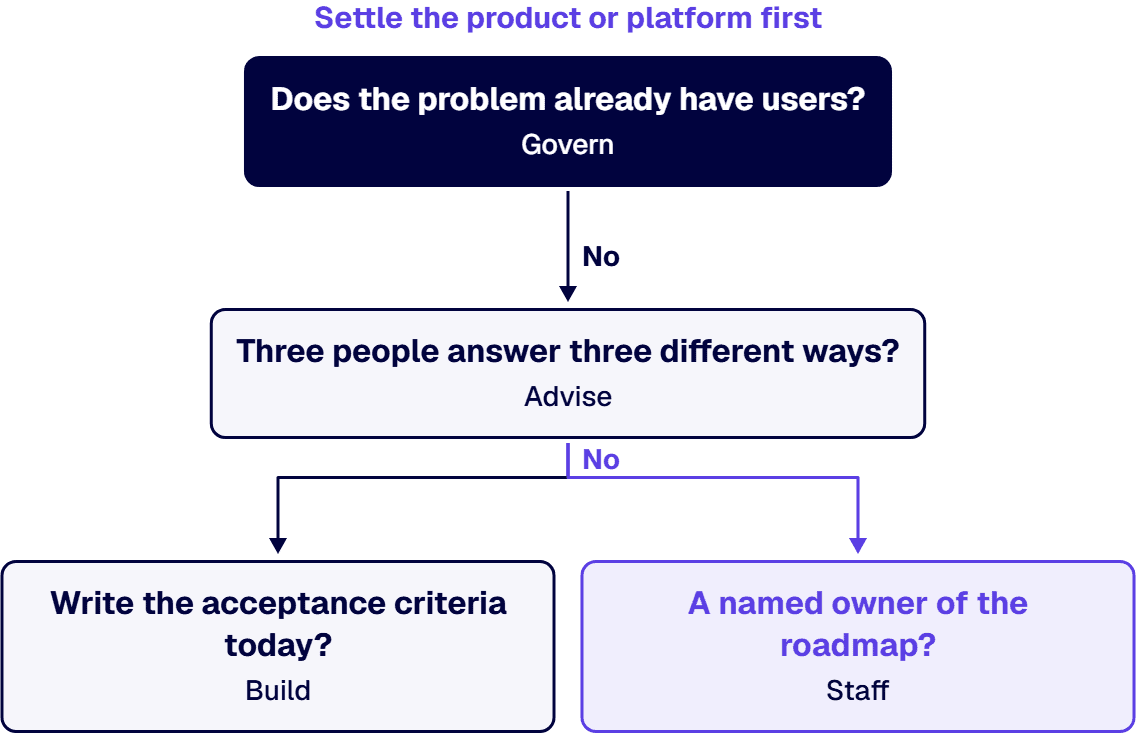
Hiring for Power Apps starts with one decision that comes before any request for proposal: which of four roles the need actually is, build (a developer), staff (staff augmentation), govern, or advise (an advisory partner). Build is for an application that is already defined and needs delivering; staff is for a roadmap you own that is short of senior hands; govern is for apps the business already built that IT has inherited; advise is for a decision nobody in the organization can settle, whether the application should exist at all, whether Power Apps is the right place for it, and what the environment and data loss prevention model should be before the first app is built. When two of the four look right at once, the role that answers the open decision outranks the role that adds capacity, and if the apps already exist and a business process depends on them, govern comes before all three. If your decision is already settled, the page that fits is Power Apps Development Services for delivery against a written definition, Hire Power Apps Developers and Experts for senior hands inside a roadmap you already own, or In-House IT Staff vs a Third-Party Firm for Power Apps for who should hold the platform.
If your team can already build the app but cannot agree on whether it should exist, that is not a development question and it is not a staffing question. It is the question this page answers. The four roles are not four grades of the same service. They differ by what is still undecided when the contract is signed, and that is the axis this page separates them on.
Build. You answered yes to the acceptance-criteria question: the requirement is written, the platform argument is over, and what you are buying is delivery against a definition you already hold. That is a development engagement, and what one covers is set out on Enterprise Power Apps Development Services for Secure, Governed Application Delivery. This page does not describe that work or compare its shapes, because a reader who can write the acceptance criteria today is better served on that page than on this one.
Staff. You answered yes to the named-owner question: someone on your side already holds the roadmap, the environment model and the support commitment, and the gap is senior people working inside them. That is a staffing engagement, and it is covered on Hire Power Apps Developers and Experts, U.S.-Based, for Microsoft Power Platform Projects. The point here is only that a staffing contract assumes the decisions are made, and that assumption is what makes it the wrong instrument when they are not.
Govern. You answered yes to the users question: apps are running, a process depends on them, and the author has moved on or was never accountable for a production system. That situation has its own sequence and its own page, and it is set out on Governing Citizen-Developer Power Apps IT Now Has to Own. This page does not repeat the sequence. It names the trigger and hands the reader over, because the governance case starts from apps that exist and the other three roles start from apps that do not.
Advise. You answered yes to the three-different-answers question, and none of the three roles above fits, because each of them needs a decision you have not made yet. An advisory engagement is bought to close that decision and to leave you holding what it produces: a platform-fit verdict for the process in question, and the environment and data loss prevention model the estate would run under. The test of such an engagement is narrower than a deliverables list, and it is worth writing into the scope: whether those two artifacts exist at the end, and whether your own team can act on them with the firm out of the room. The advisory role is the shortest of the four to specify, and a short specification is the easiest one for a proposal to answer with something else.
Two of the four can fit at the same time, and a document that enumerates four options without saying what happens when they collide has not settled anything. The precedence is this. Where apps are already running under a business process, govern outranks the other three, because a build or a staffing contract layered on an ungoverned estate adds to the estate that caused the problem. Where nothing is running yet and both advise and one of build or staff look right, the open decision outranks the capacity: capacity applied to an unsettled decision builds the wrong thing faster, and the application that results has no stated rationale to offer at the next review. And where the decision is genuinely made, written down as acceptance criteria or as a platform-fit verdict and agreed by the people who will live with it, advise is the wrong purchase and you should stop paying for it; a firm that cannot say so is not advising you.
If the argument in your organization is still about which low-code product the application belongs in, you are on this page one decision too early. That is a product question and not a role question, and it is answered on Power Pages vs Power Apps: Which One a Given Application Needs. If the argument is about whether the process belongs on Power Apps or on a different vendor’s workflow platform, that is a platform question, and it is answered on Power Apps vs ServiceNow for Workflow Automation. Neither comparison is restated here. Settle the product or the platform first, then come back to the role, because the role you need depends on which decision is still open and a product argument is a decision still open.
The cost of choosing the wrong role is not a rounding error against the project, and two published figures give a reference point for the shape of it. For Microsoft-centric environments requiring multi-specialty coverage across M365, Azure, Power Platform, and security, external consulting typically costs $40K-$100K annually versus $125K-$175K+ for a single fully-loaded in-house hire who covers only one primary area, as set out on In-House IT vs. External IT Consultants: Total Cost of Ownership, and the same comparison for Power Apps is on In-House IT Staff vs a Third-Party Firm for Power Apps. That comparison is quoted exactly as it is scoped there, in-house hire against external multi-specialty coverage, and nothing between its endpoints is interpolated here.
Against that, capacity is priced by the person and by the month. Typical engagement ranges land at $28,000 to $48,000 per specialist per month for senior US-based Microsoft specialists with named platform depth (SharePoint, Power Platform, Microsoft 365 compliance, Azure security, Dataverse, .NET enterprise integration) and compliance literacy in CMMC 2.0 Level 2, HIPAA Security Rule, NIST 800-171 Rev 2, SOC 2, or DFARS 252.204-7012, as set out on Microsoft Team Augmentation for Regulated Enterprises: How IT Leaders Add Senior Capacity Without Adding Program Risk. Read the two bands side by side and the exposure is legible: capacity bought by the month to work on a question nobody has answered accrues at a capacity rate until the question is answered, and the answer is not a deliverable of a capacity contract. Neither band is a quote for your own engagement, and neither is offered as one; each is a published reference point your own scope is measured against.
If you have a single departmental application, a process owner who can state what the app must do, and an estate whose governance model is already written and in force, the role question above resolves to build and a decision guide is not what you need. Go to the development page and skip this one. The same holds one step further out: where a single senior person inside your own team can settle the platform-fit question from what they already know about the estate, an advisory engagement buys you a second opinion and not a decision, and the honest answer is to let them settle it. And once the role has been settled as advisory, the next artifact is a structured evaluation matrix for comparing firms against weighted criteria, which is a separate document from this one and is not a substitute for settling the role first.
This page sets out a framework for making this decision; it does not describe work i3solutions has delivered on this specific question. i3solutions governs client Power Platform tenants with the Center of Excellence Starter Kit, tenant-level and environment-level DLP policies, and managed environment controls. i3solutions runs client Power Platform work on a multi-tenant Center of Excellence model with separate Dev, Test, UAT, and Production environments promoted through managed solutions. The pillar page for this work is Enterprise Power Platform Development & Implementation Services for Governed Operations. i3solutions has delivered enterprise SharePoint and Power Platform programs for aerospace and defense manufacturers, major defense organizations, a financial-services firm, a national healthcare system, and military organizations.
You hire a senior Microsoft implementation team to run this as a technology assessment, not an audit firm to run it as an attestation. The qualification that decides the outcome is build experience: whoever runs it has to have split an app and moved a connector before, because that is where the tier is actually set. The work is a license assignment review: an inventory of who holds which Power Apps and Power Automate licenses, matched against what those people actually run, so seats that no longer earn their cost can be reassigned or released at renewal. It produces no opinion, no certification, and no compliance finding, and it is not a financial or contractual audit of your Microsoft agreement. The overspend sits one level below the license list, in the design decision that forced the license: a premium connector, a Dataverse table, or an app boundary drawn one plan tier too wide. Reading the license list will not find it.
You have a renewal date and a number attached to it, and nobody in the building can tell you which of those seats is still doing work. That is the decision this page is about, and it is not a licensing decision. An app was pointed at a premium connector during a short pilot, and every user of that app now needs a premium license nobody put in a budget. Your next renewal number was set by decisions nobody filed as licensing decisions. Premium seats sit with a population that opens a single app and never a second. A department bought seats through its own cost center and never told IT. Dataverse tables that stopped being written to long ago still draw storage in environments nobody closed. No rule was broken anywhere in that sequence. Four mechanisms did the work: a plan tier chosen for administrative convenience, a connector that raised the license floor for every user of its app, a purchase made outside IT, and storage capacity that accrues from the licenses themselves. None of the four is visible in a license report. They are visible in the app, flow and connector inventory in the Power Platform admin center, and in the Center of Excellence Starter Kit inventory if you run one.
That distinction matters before you write a statement of work. If you ask for an audit and the firm hears attestation, you will get a document that tells you what you already have. If you ask for an assessment, you get the inventory plus the remediation path: which seats to reassign, which app boundary to split, which storage to scope before renewal.
The engagement is an evidence exercise, not an interview. Ask any candidate firm which of these artifacts they will pull themselves, and which they expect you to produce:
The deliverable you want out of this section is unglamorous: one row per assigned license, with the app or flow it exists to support, the last time that app or flow ran, and the cheapest entitlement that would still support it. Everything else in the engagement is argument about that table.
That table decides nothing until you know which of three purchasing shapes each row belongs in. Most overspend is a mismatch between the shape you bought and the way people actually use the apps. The mechanics below are Microsoft’s, published in the Power Apps and Power Automate licensing FAQ and the pay as you go plan overview. Check them against your own agreement, because Microsoft owns these terms and revises them.
No credible firm will tell you a tier is correct in the abstract. The output is a decision per population, with the usage evidence attached, so that your licensing team can defend it to procurement without re running the analysis.
Seat count is the visible half of the bill. Storage is the other half. It grows without a decision behind it, and it is the finding that most often surprises a team looking at this for the first time.
Microsoft documents the sources of capacity in the storage report. The “Org (tenant) default” is “The default capacity given at the time of sign up.” For “User licenses” it says “More capacity added for every user license purchased.” So capacity accrues from the licenses you buy. A seat decision is therefore a storage decision, and the two get reviewed separately, because the seat list and the capacity report are read in different admin centers. The Dataverse capacity documentation describes a per license breakdown showing “how your entitlement was calculated, including base capacity and per-user license accruals,” and states the operating rule plainly: “Stay within the limits for your entitled capacity for database, log, and file storage.”
Five findings turn up here, roughly in this order, and the capacity report sizes each one in gigabytes before anybody has to argue about it:
Pay as you go complicates this in a useful way, because overage can be billed to an associated Azure subscription rather than blocking work. That is operationally kinder and financially quieter, which is exactly why it belongs in a review rather than in a monthly report nobody opens.
A review that ends in a reassignment spreadsheet buys you one renewal cycle. The same drift reappears within a year unless something structural changes. The behaviors that produced it are normal and rational at the level of an individual team.
We have written up how these gaps actually present in a tenant, in 7 Power Platform governance gaps that create audit exposure and in Power Platform app sprawl governance risk explained. Microsoft’s Power Platform Center of Excellence adoption guidance treats a Center of Excellence as the answer to this. Microsoft’s wording on that page frames it as a strategic move for an organization investing in Power Platform, one that can “ensure its sustainable, scalable, and secure use across the enterprise,” and it names executive sponsorship as a component rather than an afterthought. In practice, the controls that hold license cost flat are these:
Those four surfaces, plus the guardrails, are what a scope of work has to cover. An assessment has a defined end, a fixed deliverable set, and no obligation on either side to continue, which is the right shape for a question whose answer might be that your licensing is already tight.
The capability behind it is implementation experience. i3solutions implements Power Platform licensing across Power Apps per-app and per-user plans, Power Automate per-flow and per-user plans, and the Microsoft 365 default entitlements where app complexity is low. That matters for a review because the recommendations have to survive contact with the platform. Recommending that an app be split so that only ten people need a premium plan is only useful if the person recommending it has split an app before.
On cost, the published band that fits this work is the scoped assessment. Phase 1 (Risk and Roadmap Assessment) typically runs $20,000 to $40,000 over two to three weeks. That is the shape of a bounded licensing and capacity review in a single tenant: inventory, findings, a reassignment plan, and a quarterly reassignment routine with a named owner.
An estate wide review spanning several tenants, or one that has to produce compliance evidence alongside the cost work, is a larger engagement priced against a different band, and a licensing review is normally one workstream inside it rather than the whole of it. Ask for that number against your own inventory rather than against a published range, because what moves it is inventory size and framework count, and neither of those is a licensing input.
The inputs that move the number are countable, and you can estimate your own position before you call anyone: how many tenants and environments, how many apps and flows in the inventory, whether the Center of Excellence Starter Kit is already running, and whether a compliance framework has to be evidenced alongside the cost work.
Ask for the reassignment table as a named deliverable, in a format your license administrator can act on directly. A findings deck that requires a follow on engagement to implement is a proposal, not an assessment.
A reseller reading a price list will do none of the following. A delivery firm will:
Three inputs and thirty minutes are enough to size this honestly: your current assigned seat counts by plan, a rough app and flow count, and whether anyone owns the quarterly reassignment today. From those three, the shape of the engagement is clear inside the conversation, including the case where the answer is a governance routine rather than a consulting engagement.
If you are building the internal case before anyone commits budget, that scoping conversation gives you a scoped price and a named deliverable to put in front of whoever signs it.
No, and the difference is worth stating in the contract. A license assignment review is a technology assessment: it looks at who holds what, what they use, and where the entitlement is wider than the need. A compliance audit is an attestation exercise about your agreement with Microsoft, and it belongs with your licensing counsel or your reseller of record. This engagement produces cost findings, not an opinion.
The bounded version runs in weeks rather than months, and the constraint is almost never analysis time. It is access: getting a reader role in the Power Platform and Microsoft 365 admin centers, and getting a current export of app and flow run activity. Organizations that have the Center of Excellence Starter Kit running finish materially faster, because the inventory already exists.
Try it first, before you spend anything on anyone. The admin centers will show you assignment counts and capacity consumption, which is enough to size whether a problem exists. What they will not do is connect a premium connector inside a single app to the license floor it sets for everybody who opens that app, or surface an entitlement a person already holds that makes their other license redundant. That mapping is the work, and it is where an implementation background earns its fee.
Some of them will propose changes to app boundaries or connector choices, because that is where a license tier is actually set. A good review ranks findings by effort as well as by saving, so that the reassignment and deactivation work, which needs no development at all, is separated from the app changes that do. You should be able to take the top of that list to a renewal conversation without opening a development ticket.
Then you have a defensible position for the renewal negotiation and a documented baseline for next year, which is worth having. An assessment that can only conclude that you are overspending is not an assessment. Ask any candidate firm to write that into the statement of work: an efficient-licensing conclusion is an acceptable outcome, and the fee does not change if it is the one they reach.
By Michael Branson, Founder/COO, i3solutions
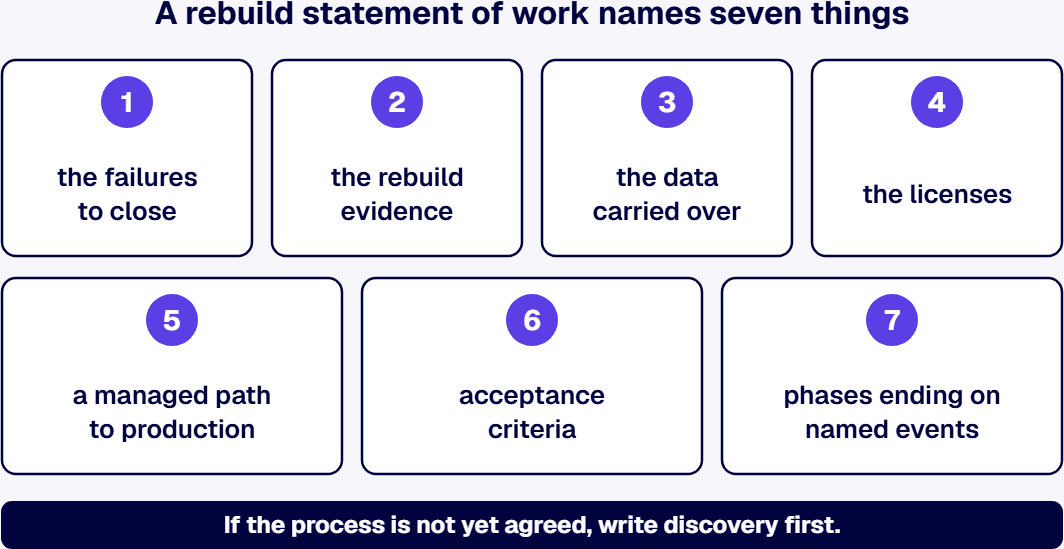
If your Power App is failing, its rebuild statement of work names seven things: the failures to close, the rebuild evidence, the data carried over, the licenses, a managed path to production, acceptance criteria, and phases ending on named events. If the process is not yet agreed, write discovery first.
If a business unit’s Power App loses a submission on a Friday, it has stopped being a convenience and become a record-keeping failure. The statement of work (SOW) for the rebuild is where that failure either gets a written definition of fixed or gets rebuilt into new screens. This checklist covers what that document has to name, clause by clause, for an app that is already running in production and already failing.
If you start from a new-build template, it will miss what a rebuild has and a new build never does: a live app with users, records and defects. A rebuild statement of work names seven things before it names a single screen: the failures it is closing, the decision to rebuild and its evidence, the data it carries over, the licenses the new design needs, where the new app is built and how it reaches production, what counts as accepted, and the event that ends each phase. The delivery model for a new Power Platform build is set out in Enterprise Power Platform Development & Implementation Services for Governed Operations; the clauses below are the ones a rebuild adds, because the current app is the baseline every one of them is written against.
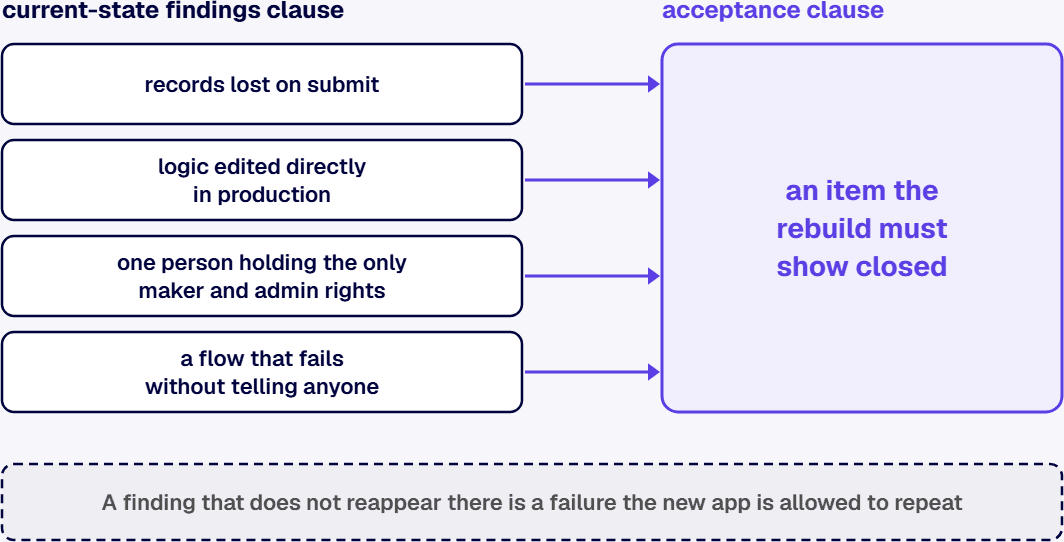
If the current app loses records when people submit, write that down as a finding before anyone designs a screen. The current-state findings clause lists each defect as it was observed: records lost on submit, logic edited directly in production, one person holding the only maker and admin rights, a flow that fails without telling anyone. Each finding then reappears in the acceptance clause as an item the rebuild must show closed. A finding that does not reappear there is a failure the new app is allowed to repeat, and no one will have agreed to that in writing.
If the decision to rebuild is already made, the SOW records it and does not argue it again. It names the path chosen and cites the discovery finding that decided it. Whether a failing app should be fixed or rebuilt is covered in Power Apps for a Business-Critical Enterprise Application, and the wider choice of modernization path in Application Modernization Decision Framework: Six Paths. The definitions a scope rests on come from Power Apps Discovery: What to Define Before Scoping a Build, and that output is the input to this document.
If the evidence line is vague, the rebuild inherits the vagueness. A finding strong enough to decide a rebuild is specific. Microsoft’s delegation article, last updated January 13, 2026, states: “When a query is nondelegable, Power Apps gets the first 500 records from the data source and then runs the actions in the query.” An app whose main screen filters a growing list with a formula that cannot be delegated stops finding records past that limit, so the evidence line names the formula, the data source and its record count on the day it was read, as logged in the discovery report. How to read that exposure before a scope is written is covered in the Delegation Exposure section of the discovery page linked above.
If the current app has lost or duplicated records, the data clause matters more than the screens. It names every table, list and attachment store that carries over, who counts the records before and after the move, and who signs the reconciliation. Records already lost are a business decision: the clause says whether they are rebuilt from email, printed copies or another system and who does that work, or states in writing that they are not. i3solutions selects Dataverse over SharePoint as the primary relational store when a client needs scalable high-volume transactional data, and holds application secrets in Azure Key Vault.
If the rebuilt app will run on Dataverse or premium connectors, the licensing clause names the license each user role needs. The managed path to production adds a second licensing line. Microsoft’s pipelines overview, last updated January 13, 2026, states: “Licenses granting premium use rights are required for all managed environments.” Name the license for each role and for each environment in the SOW, and confirm each entitlement with whoever holds your Microsoft agreement before signature.
If the current app was edited directly in production, the environments clause is the one that stops it happening again. It names a development environment, a test environment and a production environment, and it says changes reach production only as a managed solution. Microsoft’s solution concepts article, last updated January 29, 2025, states: “Managed solutions are deployed to any environment that isn’t a development environment for that solution.” It also states: “You can’t edit components directly within a managed solution.” Microsoft’s environments overview, last updated September 1, 2026, says: “Sandbox environments are used for development and testing, separate from production.”
If settings differ between environments, the clause names how they move. Microsoft’s environment variables article states: “Environment variables enable the basic application lifecycle management (ALM) scenario of moving an application between Power Platform environments.” Its connection references article states: “A connection reference is a solution component that contains a reference to a connection about a specific connector.” Both were last updated January 9, 2026. The clause also names a deployment pipeline and who approves each release. Microsoft’s pipelines overview also states: “We recommend that you always deploy managed solutions to nondevelopment environments.” Last, the clause names who holds maker and admin rights in production after go-live, by role, so one person never again holds the only keys. The managed path itself is covered in Power Platform ALM: Maker Solution to Managed Production.
If the statement of work also needs security obligations, list the secure development requirements for a custom application contract beside the environment terms.
i3solutions runs client Power Platform work on a multi-tenant Center of Excellence model with separate Dev, Test, UAT, and Production environments promoted through managed solutions. i3solutions delivery includes ALM practices with Power Platform pipelines or Azure DevOps integration, environment separation strategies, and change control processes. i3solutions governs client Power Platform tenants with the Center of Excellence Starter Kit, tenant-level and environment-level DLP policies, and managed environment controls. Microsoft guidance dated May 7, 2026 says the Center of Excellence Starter Kit is no longer actively maintained, that it remains available, and that its core capabilities are part of the Power Platform admin center.
If no one wrote down what working means, the rebuild can never be declared done. Write acceptance against the current app, in three parts:
If parity and a named defect conflict, the defect wins: the rebuild does not reproduce a behavior the findings clause names as a failure. Build the parity list from the current app itself, its screens, formulas, flows and the records it writes, captured before the rebuild starts, so the list reflects the app people use and not the app someone remembers.
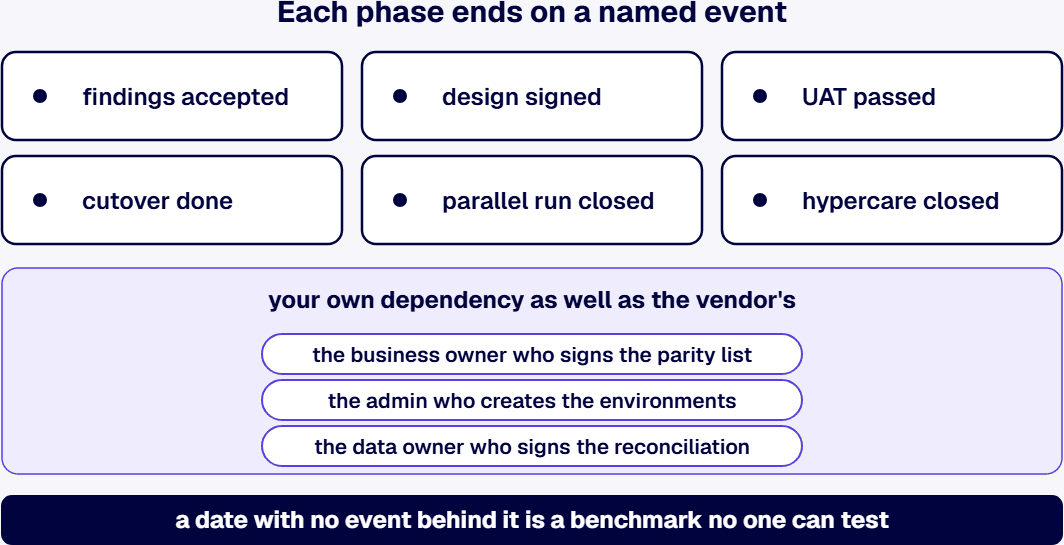
If procurement asks for timeline benchmarks, give it phases that end on events. Each phase ends on a named event: findings accepted, design signed, UAT passed, cutover done, parallel run closed, hypercare closed. Beside each event, name your own dependency as well as the vendor’s: the business owner who signs the parity list, the admin who creates the environments, the data owner who signs the reconciliation. The parties set a duration for each phase; a date with no event behind it is a benchmark no one can test. The one start-up figure this page gives is the publisher’s own: Senior Microsoft specialists from i3solutions typically embed in the client’s team within two to four weeks of engagement start.
If the old app stays open during cutover, records can land in both. The cutover clause names a freeze window for the old app, the moment of the final data cut, the condition for rolling back to the old app, written down before go-live, and whether the old app stays available read-only afterward. After hypercare, the handover clause names who owns the app, its environments and its support queue. Ownership after go-live is set out in Power Platform Support Model and Ownership RACI.
If only the original developer has ever changed the app, a handover meeting does not prove the handover worked. The test that does: a second person ships one real change to production through the pipeline, and handles one real incident, while the original developer only watches and never touches the keyboard.
To run it, take a real change, not a rehearsal. The second person makes it in the development environment and releases it through the pipeline to production. If the second person stops at a step only the original developer can do, such as a connection or an environment role held in that person’s account, move it to a named owner and run the test again. The handover is finished when the test passes, and the handover clause names the second person who passed it.
If one of these is true, write something else first:
If i3solutions writes the rebuild, the delivery structure is its own: i3solutions delivers through its Expert Delivery Model, a four-phase methodology (discovery, architecture, build, and knowledge transfer) with explicit exit criteria and delivery assurance at every handoff. i3solutions engineers work inside the client’s own tenant as Microsoft Entra B2B guest accounts with scoped Dataverse security roles, not from an i3solutions-owned tenant. i3solutions runs a governed Power Platform for a federal defense agency supporting roughly 10,000 personnel across about 180 locations, which works because it is governed, not despite it. Delivery is senior and US-based.
If the app already runs in production, use three kinds: parity with every recorded behavior of the current app, reproduced or retired in writing; each observed defect shown closed in a test environment on production-shaped data; and a failure path, where a criterion that fails at test is logged, fixed and retested before the phase closes.
If the current app was edited live, the statement of work names separate development, test and production environments and says changes reach production only as managed solutions. Microsoft’s solution concepts article states: “You can’t edit components directly within a managed solution.” The statement of work also names who holds maker and admin rights in production after go-live.
If records have been lost or duplicated, the statement of work names who counts the records before and after the move, who signs the reconciliation, and who decides whether lost records are rebuilt from other sources. The business owner makes that decision; the vendor carries out the move and the counts.
If a date cannot be tested, it is not a benchmark. End each phase on a named event, such as findings accepted, design signed, user acceptance testing passed, cutover done, parallel run closed and hypercare closed, and list your own dependencies beside the vendor’s. The parties then set a duration for each phase.
If one defect explains the failure, a scoped fix is the lighter document. If the process is not agreed, discovery comes first. If Power Apps is the wrong platform for the load, or the current vendor stalled mid-project and the question is rescue or restart, settle that before writing a rebuild scope.
By Michael Branson
As of September 2026, a Microsoft-stack modernization fits the Technology Modernization Fund (TMF) when it addresses a legacy federal system, and the proposal is sized to transfers released only as milestones are completed and to a repayment the agency funds from its own budget, ideally the full amount, since TMF’s agency and project fit page says “Proposals with a higher repayment rate are considered more competitive.” The same page says “Competitive projects are less than $25M and take no more than three years to implement,” and asks agencies to show that agency employees, not contractors, drive and manage the project, while TMF’s initial proposal template caps the initial proposal at six pages. The 2026 call for proposals asks for initial proposals by October 20, 2026, and the MGT Act as codified at 40 U.S.C. 11301 note bars new awards after December 11, 2026 for any project not already in progress, so build the business case so it also serves the agency’s own IT working capital fund.
Every fact below is drawn from TMF’s agency and project fit page, its process page, its 2026 call for proposals, its initial proposal template and the MGT Act as codified at 40 U.S.C. 11301 note, all re-read on September 25, 2026:
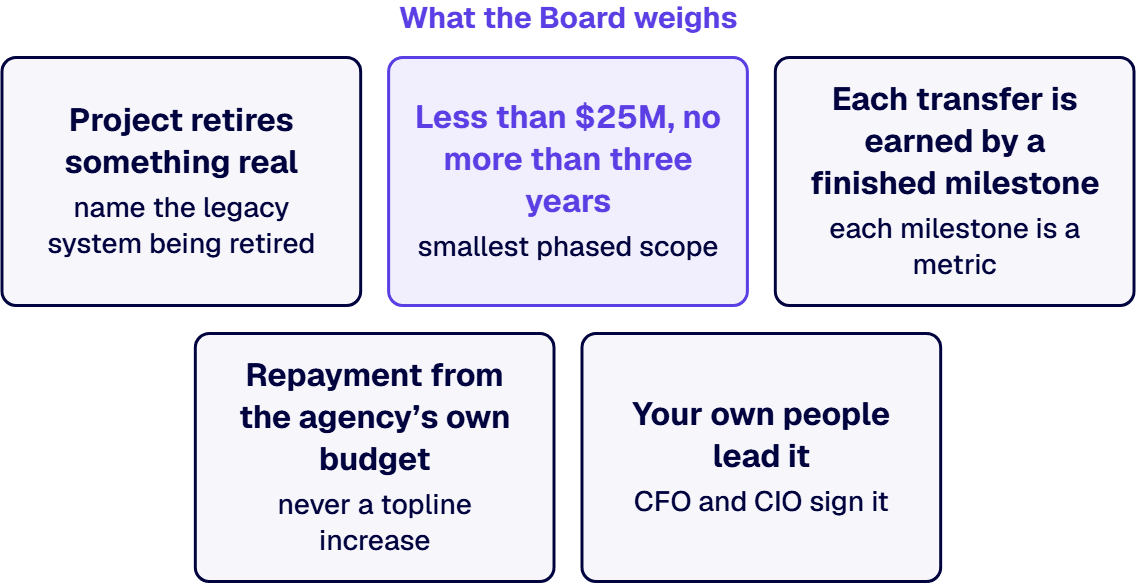
The modernization has lost the budget fight twice. The legacy estate is still there: an on-premises collaboration platform past its prime, a portfolio of desktop-database and forms applications, custom line-of-business applications on an old framework. Then someone forwards the 2026 call for proposals and asks whether TMF money could pay for the replacement this year. The answer depends less on the technology than on what the Board weighs: whether the project retires something real, whether each transfer is earned by a finished milestone, where the repayment comes from in your own budget, and whether your own people lead it. The dates now in law then decide whether this cycle is realistic at all.
A proposal started this fall runs into two dates before it runs into any technical question. TMF’s 2026 call for proposals says: “Complete an Initial Project Proposal by October 20, 2026.” It adds: “TMF still encourages expressions of interest and IPP submissions after Oct 20, but cannot guarantee proposals will be considered for funding by the TMF Board prior to December 11.” TMF’s September 2026 AI call for proposals puts it the same way: “Initial Project Proposals (IPP) received before October 20, 2026 can be considered for selection and announcement by December 11, 2026.”
December 11 matters because of the statute, not the program page. Section 1078(f)(1) of the Modernizing Government Technology Act, as codified at 40 U.S.C. 11301 note and read on September 25, 2026, says: “After December 11, 2026, the Administrator may not award or transfer funds from the Fund for any project that is not already in progress as of such date.” That limits new awards to projects not already in progress; it does not close the Fund on that date, and this guide does not predict whether Congress changes it.
The program’s own clock is long. TMF’s fit page says “Your first funds can arrive 7-8 months after your initial proposal submission.” TMF’s process page sets out two stages:
Decide this month whether this cycle is realistic. If it is, the initial proposal goes in by October 20, 2026, per the 2026 call. If it is not, build the same business case for the agency’s IT working capital fund, covered in the counter-case below, so the analysis still has somewhere to go.
If the proposal describes a technology wish rather than a legacy system being retired, it stalls at the first read. TMF’s fit page says it can fund agencies that meet the definition of federal agency in 5 U.S.C. 551, and “Groups we know we cannot fund include agencies under the legislative branch, the courts, the Smithsonian Institution, and the American Red Cross.” The 2026 call for proposals says “The TMF continues to accept any proposal that addresses legacy technology modernization and cybersecurity.”
Under the codified MGT Act, the Fund’s uses include transfers to improve, retire or replace existing Federal information technology systems, and the criteria the Board evaluates proposals by include:
TMF’s fit page groups its investments into three focus areas:
The initial proposal template also asks you to mark special emphasis categories, among them modernizing high priority systems, cybersecurity, public-facing digital services, cross-government collaboration or scalable services, and artificial intelligence.
A Microsoft-stack project fits this frame when the legacy system is named and the path for each application is chosen: an on-premises collaboration platform retired to a cloud service, a desktop-database application rebuilt, a custom application moved off an old framework. Those are examples of an agency’s own planning, not TMF’s categories. If the path per application is still open, the Application Modernization Decision Framework: Six Paths covers that decision. Name the legacy system being retired and the path for each application before sizing anything.
A proposal sized like a wish list fails the first read, because TMF publishes what a competitive project looks like. Its fit page says “Competitive projects are less than $25M and take no more than three years to implement.” It also says “Most of our investments don’t exceed $40M and use a five year repayment timeline, though the Board may consider outliers.”
The same page asks for evidence: “Provide data-driven evidence that supports your approach, such as user research, market research, and cost analysis.” It also asks you to “Include quantifiable impact outcomes like enhancing customer experience, reducing administrative burdens, and cost savings or cost avoidance.”
TMF’s funding and repayment guidance says project teams follow their agency’s implementation of OMB Circular A-11 for cost estimating and OMB Circular A-131 for value engineering, and “Estimates must undergo appropriate due diligence and concurrence from the agency CFO Office prior to submission to the Board and consultation with OMB RMOs.” It adds that “GSA can provide assistance with completing the standard templates.” GSA’s Technology Modernization Fund page says of the program office: “We work with agencies to build strong business cases for their proposals from both a modernization and financial standpoint.”
Cost avoidance is the evidence TMF names, and it is measured before the proposal, not after. In one engagement for a federal agency, the finding came from an analysis of the current state rather than from the build. The IT Systems Analysis provided an alternative solution that saved the agency over $1.5 million in unnecessary development costs by identifying a cost-effective, off-the-shelf contract management system. That is an example of the baseline evidence TMF asks for, not a TMF project. The IT Systems Analysis Services for Enterprise Microsoft Environments page covers how a current-state baseline is produced.
Size the first proposal to the smallest phased scope that retires something measurable, with the baseline measured before the proposal is written.
If repayment is marked to be determined, the proposal is the one most likely to stall. TMF’s fit page says “Agencies should aim to repay the full amount of their investment.” and “Proposals with a higher repayment rate are considered more competitive.” The initial proposal template says “All proposals are expected to repay 100%.” TMF’s funding and repayment guidance says “Full repayment: TMF has historically operated under a full repayment model, and will continue to do so for projects that yield financial savings realized by the proposing agency.”
There is flexibility, and it is narrow. The fit page says “Flexibilities in repayment to address particularly urgent or complex needs will be considered on a case-by-case basis.” and “Under extremely rare circumstances, repayment exemptions are possible and require OMB and GSA senior leadership support.” The funding and repayment guidance adds: “When requesting partial repayment, agencies must indicate why the proposal cannot be made financially recoverable at the full repayment level.”
The same guidance sets the shape of the plan. “Reimbursement amounts should generally be spread proportionately across the reimbursement period and may not be disproportionately back-loaded to later years.” “Agencies may not plan to repay the TMF by requesting a topline increase in agency funding.” “A reimbursement amount is based on amounts actually transferred, not the total amount committed by the Board.” And “GSA, in coordination with OMB, will approve the terms of repayment.” Those four sentences come from TMF’s funding and repayment guidance.
TMF’s process page says “Your repayments to TMF begin within one year of the first transfer.” Under the codified MGT Act, the written agreement documents “the terms of repayment, which may not exceed 5 years unless approved by the Director” of OMB.
The funding and repayment guidance lists the ways an agency can fund repayment:
Name the account and the offsets that repay the Fund, year by year, before the initial proposal goes in. In a legacy Microsoft estate, look first at the licenses, hosting and support contracts of the system being retired.
If your plan puts one large transfer at the start, it does not match how the Fund pays out. TMF’s home page says “To best steward taxpayer dollars, agencies unlock funding transfers only as they complete project milestones.” Its process page says “Your first transfer follows the public announcement.” The same process page says “Additional transfers unlock as your team achieves project milestones.” The codified MGT Act requires, absent compelling circumstances the Administrator documents, “that such funds shall be transferred only on an incremental basis, tied to metric-based development milestones achieved by the agency through the use of rapid, iterative, development processes”.
TMF’s full project proposal Appendix A says “For phases with Funds Transfer, TMF funds will be released only if project expectations have been achieved.” It asks for a plan in which:
Make the first phase retire or replace something users notice, and write each milestone as a metric a Board member can check.
A proposal that reads like an outside firm’s plan fails a test TMF states in plain words. Its fit page says “Show that it is agency employees who drive and manage your TMF project, not contractors such as industry partners or other staff outside of your agency.” It also says “Demonstrate strong cross-organization executive sponsorship (CFO, CIO, and program leadership) and an empowered project lead, who can effectively own and guide the effort.”
The decision is not the agency’s either. TMF’s about page says “Proposals are vetted by a Board of federal technology executives who have seen what it takes for modernization to succeed.” Its process page says “The Board votes on whether to fund your proposal.”
Outside help can produce analysis, estimates and delivery capacity. The agency owns the proposal and the project. Name the agency’s project lead and in-house skills before naming any outside help.
The initial proposal is short on purpose, so you write the answers the Board tests first. TMF’s initial proposal template says “IPPs that exceed six pages won’t be considered.” It asks for:
Write the repayment and milestone answers first, because they are the ones the Board tests, then the problem statement.
A Microsoft-stack proposal will be asked how your agency avoids depending on whoever builds it. TMF’s funding and repayment guidance lists the question directly: “Market flexibility: How does this project reduce vendor lock-in (including services and tools)?” The codified MGT Act also requires that commercial products and services be incorporated “to the greatest extent practicable” in funded work.
Answer it with criteria, not with a platform or partner comparison: who holds the configuration, the data and the administration skills after go-live, and what it would take to change implementers. An i3solutions engagement does not produce managed-service ownership, a replacement for the internal team, open-ended scope expansion, or vendor lock-in. Show how the agency keeps the skills, data and configuration to run the result without the implementer.
For some modernizations the TMF is the wrong route this cycle, and saying so early saves a proposal team months. Read against the codified MGT Act, TMF’s fit page and its funding and repayment guidance, the wrong-route cases are these:
Whoever helps you, hold the work to the tests the Board applies. Drawn from TMF’s fit page, its funding and repayment guidance and its full project proposal Appendix A, ask for these:
No provider is named or compared here; the criteria are the comparison.
i3solutions sells and delivers an enterprise IT technology assessment of a Microsoft environment as a named engagement, comprising discovery, gap analysis and a future-state roadmap. For a modernization headed to the TMF, that work produces the current-state baseline and the roadmap the agency’s own team carries into its proposal or its IT working capital fund request. The i3 Risk and Roadmap Assessment ROI variant is a one-week structured engagement that produces a business case anchored on the specific environment, the specific compliance frameworks, and the specific executive-cycle timing. That business case is the agency’s input; the proposal remains the agency’s own.
Baseline depth is sometimes the whole point. On a different engagement for another federal agency, the work started with the current state. The solution began with a comprehensive IT systems analysis, involving a 15-month process of analyzing and mapping the agency’s existing business workflows and systems.
If the project is funded, i3solutions delivers the Microsoft modernization as a project, with embedded specialists where the agency’s team needs them. i3solutions is an SBA certified small business providing technical and professional services to US Federal Agencies, the DoD and the private sector. i3solutions has been a Microsoft partner since 1997 and has delivered 1,500+ implementations across aerospace and defense, financial services, and health sciences. Delivery is senior and US-based. i3solutions does not write, file or manage an agency’s TMF proposal; the agency leads it, and GSA’s program office helps with the templates. More on the advisory practice: Trusted IT Advisory & Consulting Services Tailored To Your Digital Transformation Goals.
If a legacy Microsoft modernization has lost the budget fight and the 2026 call has landed on your desk, decide first whether this cycle is realistic against the October 20 and December 11, 2026 dates in TMF’s 2026 call for proposals, then build the baseline, the phased plan and the repayment by account so the same business case serves the TMF or the agency’s IT working capital fund.
Not always, but full repayment is the aim. According to TMF, agencies should aim to repay the full amount of their investment, proposals with a higher repayment rate are considered more competitive, and all proposals are expected to repay 100%. According to TMF, flexibility is considered case by case, repayment exemptions are possible only under extremely rare circumstances, and an agency requesting partial repayment must indicate why the proposal cannot be made financially recoverable at the full repayment level.
In increments tied to milestones. According to TMF, the first transfer follows the public announcement and additional transfers follow as the team achieves project milestones. According to the MGT Act as codified at 40 U.S.C. 11301 note, funds are transferred only on an incremental basis tied to metric-based development milestones, absent compelling circumstances the Administrator documents.
According to TMF, competitive projects are less than $25M and take no more than three years to implement, and most of its investments do not exceed $40M and use a five year repayment timeline, though the Board may consider outliers.
According to TMF’s 2026 call for proposals, by October 20, 2026. TMF still encourages submissions after that date but cannot guarantee they will be considered for funding by the TMF Board prior to December 11.
According to the MGT Act as codified at 40 U.S.C. 11301 note, read on September 25, 2026, after December 11, 2026 the Administrator may not award or transfer funds from the Fund for any project that is not already in progress as of such date. This guide does not predict whether Congress changes that date.
No. According to TMF, agencies should show that it is agency employees who drive and manage the TMF project, not contractors such as industry partners or other staff outside the agency, with strong CFO, CIO and program sponsorship and a project lead who can own and guide the effort. This guide does not rule on who may help draft the proposal.
By Justin Bowen, Sr. Vice President, Delivery Services, i3solutions
Budget in engagement shapes, not in one number. Stabilizing a partly built Microsoft estate typically runs $85,000 to $175,000 for an environment of four to six Microsoft platforms with 40 to 120 integration touchpoints. A focused rebuild of a single business-critical application typically runs $50,000 to $85,000. Holding the system with embedded senior people runs $28,000 to $48,000 per specialist per month. Which of the three you need is decided by an assessment of the code and the environment, not by a proposal, and any firm quoting a remediation total before reading the repository is guessing.
Remediation is priced differently from new development because the unknown is not the requirement, it is the artifact. On a greenfield build the scope is the thing you are arguing about. On a remediation the scope is whatever the previous team left behind, and nobody knows what that is until someone reads it. That single fact drives every honest number on this page and explains why fixed fee quotes offered before an assessment tend to be either padded or wrong.
This page describes what i3solutions charges for the engagement shapes that remediation work actually takes, what makes the number move, and where the money goes. It does not characterize the firm that built the system, and it does not attempt to price your specific estate from a distance.
Bringing offshore-built software back onshore costs four things: an assessment, one remediation shape, the current run rate meanwhile, and knowledge recovery. Each shape has a published price band in its section below. Embedded specialists are priced per specialist per month.
The other three lines carry no published price here, and a budget that leaves them out is the budget that doubles later. The assessment comes first and is bought on its own, as set out under “How to run the decision”. The current system keeps costing what it costs until the fix lands, and that run rate, not zero, is the figure to hold the remediation against, as the section on the return explains. Knowledge recovery is the identity and business-rule work listed under “What actually moves the number”, and it is paid for in time before it is paid for in money. The three shapes are alternatives rather than parts to add up, with one exception: embedded specialists can hold the system while a stabilization or a rebuild is scoped.
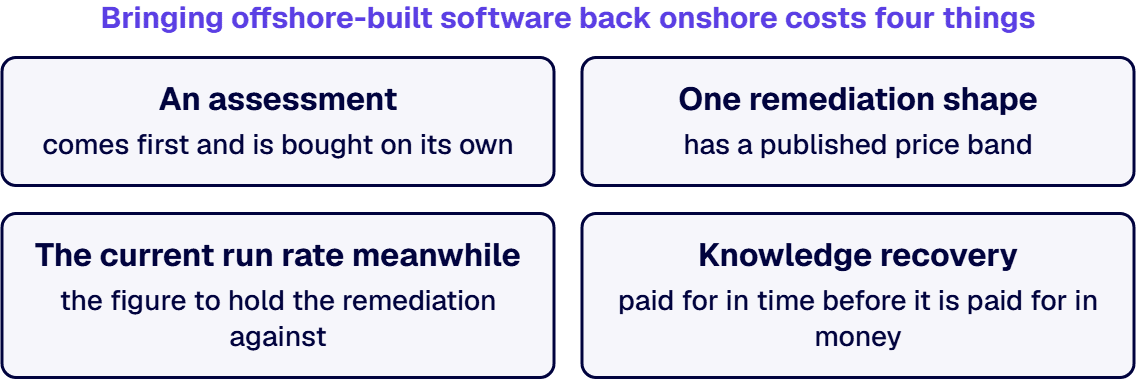
The offshore rate priced the build. The fix is priced by what the build left behind: the count of places where systems connect, whether a test environment behaves like the live one, whether anyone wrote down who owns the service accounts and permissions, and whether the business rules can be recovered at all. A low rate tells you nothing about any of the four, so it is not an input to the remediation budget. For the rate and risk comparison itself, see Onshore vs Offshore for Microsoft Power Platform in Regulated Industries.
A Stabilization Protocol engagement (Phase 1 dependency mapping plus Phase 2 risk-sequenced triage) typically costs between $85,000 and $175,000 for enterprises running four to six Microsoft platforms with 40 to 120 integration touchpoints. Phase 1 establishes what actually calls what: the Power Automate flows firing on SharePoint list events, the Dataverse tables with no plugin registration record, the Azure Function that a developer stood up under a personal subscription, the service principals holding permissions nobody documented. Phase 2 then triages by blast radius rather than by ticket age, which is the sequencing decision most internal remediation efforts get backwards.
The range moves with touchpoint count more than with line count. An estate at the low end of that touchpoint band, on four platforms, lands near the bottom of the price range. An estate at the top of the band, spanning six platforms with authentication crossing tenant boundaries, lands near the top. If your environment is materially outside that shape, the band does not apply to you and we will say so rather than stretch it.
A focused rebuild of a single business-critical application typically runs between $50,000 and $85,000. This is the right shape when the code is small enough to replace and bad enough that reading it costs more than rewriting it. The test is not code quality in the abstract. It is whether the business rules are recoverable from the artifact, from documentation, or from people who are still employed. When all three fail, rebuilding is cheaper than archaeology.
Fixed-fee project consulting for modernization initiatives ranges $55K-$450K depending on scope. A focused rebuild sits at the low end of that spread by design. A rebuild that starts drifting toward the middle of that range is usually a rebuild that quietly turned into a modernization program, which is a different decision and deserves to be made on purpose. If you are writing the contract for the rebuild, add the secure development requirements for a custom application contract so the next build can be audited.
Typical engagement ranges land at $28,000 to $48,000 per specialist per month for senior US-based Microsoft specialists with named platform depth (SharePoint, Power Platform, Microsoft 365 compliance, Azure security, Dataverse, .NET enterprise integration) and compliance literacy in CMMC 2.0 Level 2, HIPAA Security Rule, NIST 800-171 Rev 2, SOC 2, or DFARS 252.204-7012. This is the shape for organizations that need the system to keep running while the stabilize or rebuild decision is being made, or that have a regulated deadline the remediation itself cannot move.
Per specialist per month is the honest unit here and it is worth reading carefully. Two specialists for three months is six specialist months, not three. Firms that quote remediation staffing as a blended monthly team rate are usually hiding the seniority mix, and seniority mix is the whole variable on inherited code.
If IT now answers for a Dynamics 365 estate that an inherited offshore team still maintains, and replacing that team is off the table this year, the costs above were written for a different case: they price bringing the work home. When the offshore team stays, the bring-back budget does not disappear; it changes shape, from a remediation you buy once to buyer-side review you pay for per specialist per month.
The order does not change: the assessment still comes first, priced apart from whatever follows it, per “How to run the decision”. Keeping the team leaves the estate as it was found: whatever integrations, service accounts and business rules were undocumented before the decision are still undocumented after it, and the dependency map is what shows which ones they are.
With the team kept, a full stabilization or rebuild gives way to buyer-side review: the embedded specialists shape above, used to oversee the team instead of replacing it, in the same per-specialist-per-month unit and band. A senior Dynamics 365 specialist reviews the changes the team delivers, keeps the dependency map current, and tells IT what the team’s estimates mean. The review does not buy a replacement team or a verdict on the vendor.
All i3solutions Dynamics 365 developers and consultants are U.S.-based. i3solutions builds Dynamics 365 integrations using named Microsoft mechanisms including Dataverse, dual write, virtual tables, Azure Logic Apps, Azure Service Bus, and Power Automate connectors.
If the assessment finds no working test environment and no way to recover the business rules, the kept-team plan becomes a stabilization or rebuild decision after all, and the shapes above apply. How to take control of a kept team is a separate question from what keeping it costs.
i3solutions mid-migration SharePoint rescue engagements run eight to fourteen weeks. That is a duration, and it is worth stating plainly that it is not convertible into a cost at any hourly rate. A fourteen week engagement with two embedded specialists and a fourteen week engagement running a fixed scope stabilization are the same calendar and very different invoices. When a firm hands you a week count and invites you to multiply, ask what is being multiplied.
What the eight to fourteen week figure is useful for is planning the things around the remediation: contract dates, audit windows, the point at which you can credibly tell a customer the system is stable.
One rescued program for a nuclear operator saved about $293K a year and returned its full cost within three months. That is a savings figure from one engagement in one regulated sector, and it is deliberately not presented here as what remediation costs or as a result you should expect. It is presented because remediation is usually evaluated against the wrong alternative. The comparison that matters is not remediation cost against zero, it is remediation cost against another year of the current run rate, which on a failing system is rarely small and is rarely measured.
i3solutions has no published case study of repatriating a specific offshore program, and this page does not imply one. The attested rescue and stabilization work above is real and is priced from engagements that happened. Whether the work being rescued was originally built offshore, onshore, or in house is not something the record establishes, and inflating it into an offshore repatriation credential would be exactly the kind of claim this page exists to help you interrogate in other proposals.
This page also does not characterize any offshore vendor, named or implied. The reason is practical rather than diplomatic. A remediation engagement that begins with a theory about who was at fault tends to produce a report about who was at fault, and you are paying for a working system.
The firm level facts are simple and verifiable. i3solutions is a Microsoft Solutions Partner. i3solutions has completed 1,500+ Microsoft platform implementations. All delivery is by senior US-based specialists, which is the relevant fact for an organization moving work back onshore, and it is a staffing model rather than a certification.
Honest disqualification is cheaper than a bad engagement. This is not the right vehicle when what you want is a fixed remediation price before anyone has read the repository, when the requirement is lowest price technically acceptable staffing, when the platform direction is away from Microsoft, or when the real goal is a report assigning blame for the original build. An i3solutions engagement does not produce managed-service ownership, a replacement for the internal team, open-ended scope expansion, or vendor lock-in. Remediation buyers in particular should confirm that constraint in writing with whoever they hire, because a firm that inherits your system is unusually well placed to keep it.
Get the assessment scoped and priced separately from the remediation, and keep the two decisions separate on paper. Ask each candidate firm for the three artifacts that reveal whether they have done this before: a dependency map from a comparable engagement, redacted; the triage sequence they used and why blast radius beat ticket age; and the point in a prior engagement where they recommended rebuilding rather than repairing. A firm that has never recommended a rebuild has either been very lucky or is not in the habit of saying the expensive thing.
Adjacent reading if you are earlier in the decision: comparing costs of in house IT against external consultants covers the run rate side of the comparison, internal team versus a systems integrator hybrid delivery model covers who holds the work afterward, Microsoft Access application rebuild cost prices the narrowest rebuild case, and custom application development services describes the build practice the rebuild shape draws on. When you want to test fit, i3solutions routes a senior U.S.-based engineer to a client call usually within one to two weeks. You can reach the team by phone at 703.652.8966.
It depends which engagement shape your situation calls for. A Stabilization Protocol engagement (Phase 1 dependency mapping plus Phase 2 risk-sequenced triage) typically costs between $85,000 and $175,000 for enterprises running four to six Microsoft platforms with 40 to 120 integration touchpoints. A focused rebuild of a single business-critical application typically runs between $50,000 and $85,000. Embedded senior specialists run $28,000 to $48,000 per specialist per month. Which shape applies is determined by reading the code and the environment, not by a proposal, so scope and price the assessment first and keep it separate from the remediation.
Usually, and the test is specific rather than general. Remediation wins when the business rules are recoverable from the artifact, from documentation, or from people still employed. When all three fail, reading the system costs more than rewriting it and a focused rebuild at $50,000 to $85,000 for a single business-critical application is the cheaper path. The mistake to avoid is deciding this by code quality impression. Decide it by whether the rules are recoverable, because that is what you are actually buying back.
i3solutions mid-migration SharePoint rescue engagements run eight to fourteen weeks. That is a duration and not a price, and it does not convert into one at any hourly rate, because the same calendar covers very different staffing shapes. Use the week count to plan the things around the remediation, such as contract dates and audit windows, and price the engagement from its shape instead.
No, and neither should anyone else. On a remediation the scope is whatever the previous team left behind, and the two findings that most often reset a plan are that no non production environment matches production and that identity and permission ownership is undocumented. Both are discovered by looking. What can be fixed in advance is the assessment: scope it, price it, and keep the decision to proceed genuinely open once it reports.
No. i3solutions has no published case study of repatriating a specific offshore program and does not claim one. The published record covers rescue and stabilization work whose origin the record does not establish as offshore. One program for a nuclear operator saved about $293K a year and returned its full cost within three months, which is a savings figure from a regulated sector engagement rather than a remediation price or a promised outcome.
Because the rate priced the original build, and the fix is priced by what that build left behind. Four things move a remediation: how many integration touchpoints the estate has, whether any non-production environment matches production, whether identity and permission ownership is documented, and whether the business rules survive outside the code. None of them shows in the rate you paid.
Five things: a dependency map of what calls what; a finding on whether production can be reproduced safely; an inventory of the identities, app registrations and connections no one owns; a verdict on whether the business rules are recoverable; and a recommended shape, stabilize, rebuild or hold with embedded specialists. Scope and price the assessment on its own, and keep the decision to proceed open once it reports.
By Michael Branson, Founder and COO, i3solutions
Hire on environment fit before capability. A qualified firm names the cloud environment it has configured inside, treats CMMC, DFARS and ITAR as delivery constraints rather than marketing words, produces control artifacts an assessor can review, staffs the tenant with US-based people, and puts its contract vehicle and flowdown answers in writing before scoping.
What follows is the sequence we would use if we were sitting on your side of the table: the environment decision that decides who is even eligible, the criteria that are checkable from public sources or a first call, the five questions that sort the market, and then a plain account of where i3solutions fits and where it does not. The order matters. Most selections in this market go wrong because capability was assessed before environment, and by the time the environment question surfaces the tenant is already committed.
Microsoft 365 is not one product with a government checkbox. It is a set of separate cloud environments with different feature parity, different licensing paths, different eligibility rules and different assessor expectations. A firm with ten years of commercial M365 delivery and no government cloud work is not a slower version of the right firm. It is a firm that has never met the constraints your contract imposes.
So the first question in the selection is not what a firm can build. It is which environment your contracts actually require, and whether the firm can reason about that independently rather than repeating what a licensing reseller told you. The most expensive mistake we see is a defense contractor asking for GCC High by default, because someone in the supply chain said CMMC requires it. It does not by default, and the difference between a full GCC High migration and a scoped one is a material line in the budget for years.
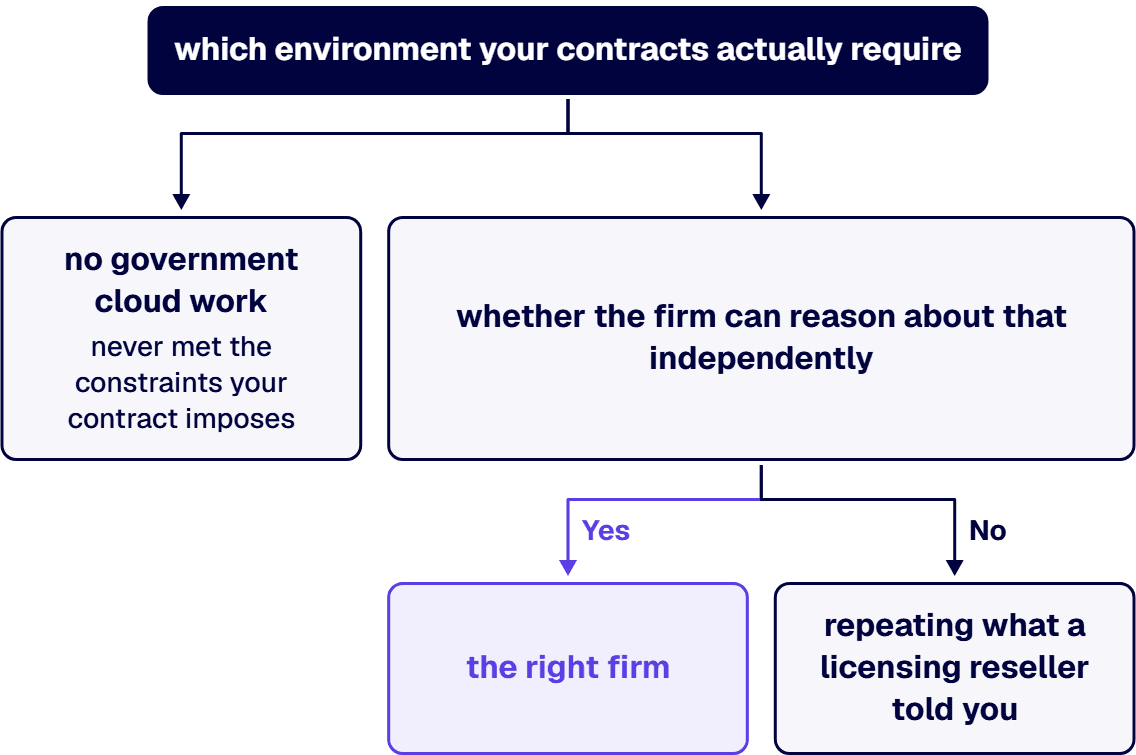
That reasoning is a service in its own right, and it is a fair thing to buy before you buy an implementation. i3solutions advises clients on federal compliance posture as its own assessment rather than as a restatement of Microsoft’s documentation, including whether SharePoint Online meets NIST 800-53, whether Azure Government is required under the DoD Cloud Computing SRG, and whether a CMMC gap assessment is needed to bid. It does not always point at GCC High. The assessment recommended partial-variant adoption with email and document storage on GCC High and the remainder of the productivity suite on Commercial; the contractor’s licensing economics improved materially relative to a full GCC High migration.
If your environment question is still open, read the analysis of whether CMMC actually requires GCC High before anyone tells you it does, and the GCC High cost breakdown if the licensing delta is what your finance team is asking about.
A firm that treats CMMC, DFARS, ITAR or NIST SP 800-171 as a specialty practice bolted onto a Microsoft team will hand you two deliverables that do not reconcile: a working environment and a compliance narrative written about it afterwards. The firms worth shortlisting treat the regime as a constraint on how the same work is done, which shows up in the build rather than in the appendix.
The practical test is the artifact. i3solutions runs migrations against named control families across CMMC, HIPAA, SOC 2, and NIST 800-171, producing artifacts auditors can review. Ask any candidate firm to describe the artifact set its last government engagement left behind, who consumed it, and what an assessor asked for that was not in it. The gap between the artifact list a firm claims and the one it can describe from memory is the most reliable signal in the whole evaluation.
Expect the constraint to cost something, and expect a credible firm to say so. Organizations facing CMMC Level 2 certification consistently discover 15-25 configuration gaps during Microsoft environment assessment. Regulated-industry SharePoint modernization carries roughly 25 to 35 percent cost overhead versus commercial work for equivalent scope, driven by control mappings, audit-trail discipline, and zero-downtime cutover patterns. A firm quoting government work at commercial rates has either absorbed that overhead into a margin it will later need back, or has not done the work.
Every criterion below is checkable from public sources or from a first scoping conversation. None requires taking a vendor’s word, including ours.
Ask each shortlisted firm the same five questions and compare the specificity of the answers rather than the confidence behind them.
Question two is the one that sorts the market. A firm that has done this work answers it with nouns. A firm that has not answers it with a methodology.
Onboarding is where this one bites: the contract says who may hold administrative access, and nobody checks until the tenant is already open. Ask where the delivery team sits, ask what personnel status the work requires under your own contract, and get both answers in writing during scoping. Firms differ substantially here and the difference does not appear on a capability matrix.
i3solutions plans and runs governed Azure and Microsoft 365 migrations with senior, U.S.-based engineers. Senior Microsoft specialists from i3solutions typically embed in the client’s team within two to four weeks of engagement start. i3solutions routes a senior U.S.-based engineer to a client call usually within one to two weeks. U.S.-based senior staffing reduces communication overhead by 25-30 hours per month on enterprise projects through direct stakeholder interaction and real-time issue resolution.
Vendor pages blur the next distinction, so hold it. US-based is a fact about where people work. US-persons status and personnel security clearances are separate determinations with their own evidence, and no vendor page is the right place to establish them. Ask for them specifically, in writing, against the requirement your contract imposes.
The record first, so you can weigh it rather than take it. i3solutions is an SBA certified small business providing technical and professional services to US Federal Agencies, the DoD and the private sector. i3solutions is a Microsoft Solutions Partner. i3solutions is a Microsoft Partner and has delivered 1,500+ implementations across aerospace and defense, financial services, and health sciences. i3solutions installs and helps configure applications inside IL4 and IL6 government cloud environments and other government networks. We manage GCC High migrations end-to-end: from eligibility validation and licensing coordination with your AOS-G supplier through identity architecture, data migration, security baseline configuration, and post-migration governance. i3solutions plans and runs these migrations for regulated defense organizations, structuring each phase around the compliance evidence assessors expect.
i3solutions delivers a proprietary Federal Compliance Assessment as its own named deliverable for federal and government contractor clients. The i3solutions Federal Compliance Assessment evaluates a client tenant against NIST SP 800-53 and CMMC using automated tenant configuration scripts and a 42-point security checklist. i3solutions engages its Federal Compliance Assessment when the scope spans a FedRAMP Moderate or FedRAMP High boundary, or when the client operates in a GCC High tenant. For government cloud infrastructure work, i3solutions produces three named artifacts across an Azure Government or AWS GovCloud engagement: an Architecture Fit Assessment at discovery, a Landing Zone Blueprint and Compliance Matrix at design, and a Migration Risk and Cutover Runbook at execution, each one a mandatory gate check before the engagement moves to the next phase.
Each published client outcome measures something narrower than the record above. The client was a government management consulting firm serving federal agencies. i3solutions’ migration approach to Microsoft 365 ensured a seamless transition from legacy systems with zero critical outages and 99.9% uptime during cutover. The move to Microsoft 365 and Okta SSO also reduced ongoing maintenance and licensing overhead by about 25%, delivering full ROI within the first year. That is a migration and identity outcome at the scale most contractors are working at, and the detail is in Streamlining Operations With a Unified Office 365 Environment.
Inside the defense estate the work is governance-led. i3solutions runs a governed Power Platform for a federal defense agency supporting roughly 10,000 personnel across about 180 locations, which works because it is governed, not despite it. The detail is in our Modernizing Internal Operations Processes With Digital Transformation case study. In a National Guard payroll engagement the finding was narrower and just as checkable. Error rates that once averaged around 1% per payroll cycle were nearly eliminated, closing prior audit findings and ensuring compliance with federal reporting standards. That account is in Transforming Mission Attendance Tracking With a Customized SharePoint Portal, our National Guard payroll modernization case study. More broadly, i3solutions has delivered enterprise SharePoint and Power Platform programs for aerospace and defense manufacturers, major defense organizations, a financial-services firm, a national healthcare system, and military organizations.
What i3solutions does not do is accredit a system or issue an authority to operate. Those determinations sit with the government and with accredited assessors reviewing your environment and your evidence. i3solutions does not perform certification assessments and cannot guarantee a certification outcome. Any firm that implies otherwise is describing something that is not theirs to give.
Honest disqualification is cheaper for both sides than a bad engagement. i3solutions is not the right vehicle when the programme needs a prime contractor fronting a large multi-vendor structure, when the requirement is lowest-price-technically-acceptable staffing measured on rate rather than outcome, when your platform direction is away from Microsoft, or when you want a fixed price quoted on a tenant nobody has inventoried, because a number produced that way is one we would not stand behind.
The fit is a federal agency or a government contractor that needs the environment question answered properly before the tenant is committed: the boundary decided on evidence rather than on rumour, the controls implemented and evidenced inside a Microsoft estate, and the SharePoint, Power Platform and identity work under it delivered by senior US-based engineers who have done it before.
Two numbers get confused in this market, so separate them before you compare bids. The compliance and advisory half has its own band: Microsoft 365 compliance consulting for regulated enterprises ranges from $35,000 to $120,000 or more depending on the framework, the number of in-scope systems, and the current tenant configuration. The migration half has another. Directional bands for organizations with 50 to 500 users: implementation costs typically range from $50,000 to $200,000, covering tenant provisioning, identity migration, data transfer, security configuration, and compliance validation.
Where you land inside either band is decided by the state of the estate rather than by a rate card, which is the practical reason a scoped assessment comes before any committed implementation number. When two quotes differ sharply, the difference is almost never the hourly rate. It is whether the compliance evidence work was priced in or left for your team to absorb after go-live. Ask each firm to show that line separately, and price it yourself into the quote that omitted it before you compare the totals.
Shortlist two or three firms against the criteria in section three and ask each for the same four things: a sample statement of work with the exclusions visible, the assessment deliverable that precedes their committed number, a redacted control-mapping or boundary artifact from a comparable government engagement, and a written answer to question two. Then weight the answers by who was most specific about your existing estate rather than about their own methodology.
Most shortlists carry at least one firm that has only half of what the phrase means. The first half is tenant experience: having configured Microsoft 365 inside a government cloud environment rather than adjacent to it, which is why the answer should name GCC, GCC High, Azure Government or an impact level. The second half is contracting fluency: understanding DFARS flowdown, CUI handling obligations, and how your own proposals are evaluated. Ask for both separately, because a firm with federal customers on a commercial tenant has neither in the sense your contract means.
Not by default, and the assumption is expensive. The requirement follows from what data your contracts actually put in the environment and what the flowdown obligates, not from a general rule about CMMC. i3solutions advises clients on federal compliance posture as its own assessment rather than as a restatement of Microsoft’s documentation, including whether SharePoint Online meets NIST 800-53, whether Azure Government is required under the DoD Cloud Computing SRG, and whether a CMMC gap assessment is needed to bid. The assessment recommended partial-variant adoption with email and document storage on GCC High and the remainder of the productivity suite on Commercial; the contractor’s licensing economics improved materially relative to a full GCC High migration.
The firm should leave behind a reviewable set rather than a narrative. i3solutions runs migrations against named control families across CMMC, HIPAA, SOC 2, and NIST 800-171, producing artifacts auditors can review. The i3solutions Federal Compliance Assessment evaluates a client tenant against NIST SP 800-53 and CMMC using automated tenant configuration scripts and a 42-point security checklist. When comparing firms, ask what the last engagement’s artifact set contained, who consumed it, and what an assessor asked for that was missing. A firm that answers from memory has produced one; a firm that answers with a methodology has not.
Administrative access to a government cloud environment carries personnel constraints, so in practice the answer is yes for anyone touching the tenant. i3solutions plans and runs governed Azure and Microsoft 365 migrations with senior, U.S.-based engineers. Establish this in writing during scoping rather than at onboarding, and treat US-persons status and personnel security clearances as separate determinations with their own evidence, requested specifically against what your contract requires.
Most quotes in this market blur two things that are priced apart. Microsoft 365 compliance consulting for regulated enterprises ranges from $35,000 to $120,000 or more depending on the framework, the number of in-scope systems, and the current tenant configuration. Directional bands for organizations with 50 to 500 users: implementation costs typically range from $50,000 to $200,000, covering tenant provisioning, identity migration, data transfer, security configuration, and compliance validation. Where you land is decided by the state of the estate, which is why a scoped assessment precedes any committed number.
Because the constraint changes how the work is done, not just what is written about it afterwards. Regulated-industry SharePoint modernization carries roughly 25 to 35 percent cost overhead versus commercial work for equivalent scope, driven by control mappings, audit-trail discipline, and zero-downtime cutover patterns. Organizations facing CMMC Level 2 certification consistently discover 15-25 configuration gaps during Microsoft environment assessment. That remediation is real work. A quote at commercial rates has either absorbed the overhead into a margin it will need back later, or has not scoped it.
No. i3solutions does not perform certification assessments and cannot guarantee certification outcomes, and it does not accredit a system or issue an authority to operate. Those determinations belong to the government and to accredited assessors reviewing your environment and your evidence. What a firm can do is build the environment and the evidence package so that the assessment is a review rather than a rebuild. Treat any vendor implying otherwise as a disqualification rather than a differentiator.
Application managed services (AMS) means running, supporting and enhancing one named application under a defined scope, with one provider accountable for it. For a custom Microsoft application, buy AMS when the application is business-critical, changes with every platform release wave, and your team lacks depth in its stack; keep it in-house when it is stable and your team owns the platform; use staff augmentation when the gap is capacity, not knowledge; use an MSP only for the estate around it, never for the application itself. An AMS agreement runs the application. It never runs your tenant, your infrastructure or your help desk, and it ends with your code, environments and documentation in your hands. i3solutions provides application managed services for the custom Microsoft applications and workflows it built or modernized. i3’s Application Managed Services covers only applications and workflows i3 built or modernized; never the tenant, infrastructure, backup/DR, SOC, help desk or MSP-style packages.
The application went live. The partner that built it rolled off at acceptance, the handover was a documentation drop and a two-hour walkthrough, and for several months nothing went wrong. Then the first real release wave landed, a connector changed behavior, and someone had to decide whether that was a bug, a platform change or a design assumption that had quietly expired. That is the week a team discovers that “supported” and “owned” are different words, and that nobody wrote down which one applied here.
Your decision is not whether the application needs an owner. It does. The decision is which of four sourcing models should hold that role, and what the agreement for it has to say.
Application managed services are provided by an outside firm under a scoped agreement: most often the firm that built the application, or an application services firm that takes it over from the builder. An in-house team can hold the same role, and staff augmentation adds hands without taking accountability. For a custom Microsoft application, choose the provider that will run the application inside your tenant under your own access controls.
Matt Lawson has spent more than 14 years at i3solutions guiding complex enterprise technology work from scope and system design through development, acceptance, and long-term support. A provider should also leave your team more capable, not more dependent. By year-end, i3solutions client teams typically manage 15 to 25 production flows independently while maintaining the architectural patterns i3 established.
Whoever provides it, the provider should work inside your controls, and in a Microsoft estate three platform mechanisms make that checkable before the agreement is signed.
Delegated access you can see and remove. Microsoft’s Azure Lighthouse documentation states that “Customers can delegate subscriptions and resource groups to specified users and roles in the managing tenant, with the ability to remove access as needed.” It adds: “Customers have precise control over the scopes they delegate and the permissions that are allowed. They can audit service provider actions and remove access completely at any time.” and “Users can see what changes were made and by whom in the customer tenant’s activity log.”
Administrator rights only when a task needs them. Microsoft’s Privileged Identity Management documentation lists the service’s purposes, among them to “Provide just-in-time privileged access to Microsoft Entra ID and Azure resources”, to “Require approval to activate privileged roles” and to “Download audit history for internal or external audit”. Ask that the provider’s administrator roles run through Privileged Identity Management, so each activation is approved and on the audit record.
Alerts that reach your own ticket queue. Microsoft’s Azure Monitor alerts overview says of action groups: “These groups can trigger notifications to let users know that an alert has been triggered or start automated workflows.” Among what an action group can include, it lists “Automation runbooks. Azure functions. ITSM incidents. Logic apps.” Routing the application’s alerts to ITSM incidents puts the provider’s response in your service management records, not only in the provider’s.
i3solutions provides application managed services for the custom Microsoft applications and workflows it built or modernized: it operates them, supports them and enhances them under a defined scope, with one accountable team. The builder is usually the right provider because the design knowledge carries over from the build, provided the agreement returns code, environments and documentation to you.
To choose a provider, work through the four sourcing models in the decision criteria below, then apply the builder test and its two exceptions further down this page. The estate around the application (the tenant, infrastructure, backup and disaster recovery, security operations and help desk) is a different purchase, outside application managed services; the next section sets out where that line falls.
The term is doing a lot of work, and it is worth being precise, because the same two words are used to sell an application engagement and an estate engagement. Those are different purchases with different risks.
Scoped to an application, AMS covers five things:
What it should never cover, and the boundary matters more than the list:
This is a real line and we hold it on our own site. Our position on general managed IT is set out plainly on We Do Not Run Your Help Desk. Here Is What i3solutions Does Instead., and that position has not changed. Application managed services is application-scoped: it covers a named application and its workflows, never the estate that surrounds them. If your problem is the estate, the answer on that page is still the right answer.
You are choosing between four models, and the honest position is that all four are correct in some circumstance. The question is which circumstance you are in. Work down the criteria. The rows are not weighted equally: criticality and exit posture decide the close calls, and the model that wins those two is the answer.
Two distinctions carry the decision.
Capacity versus knowledge. This is the cleanest test between staff augmentation and AMS. If you know exactly what needs doing and simply do not have the hours, you need hands, and staff augmentation is cheaper and more flexible. If you do not know what needs doing, because the application’s design decisions live with someone who has left, then adding hours to the team does not help. You need the expertise, and you need it accountable for an outcome, not for a timesheet. The hourly-versus-retainer shape of that choice is covered in more depth on staff augmentation: hourly versus retainer. Where it is not yet clear which of the two you are short of, a Microsoft delivery capacity review separates capacity from capability and ends with a written read of what you have against what the roadmap needs.
Application versus estate. If the trouble is that nobody patches the servers, nobody answers the phone and nobody owns the backup, that is an estate problem, and an application contract will not fix it. The reverse is also true and is the more expensive mistake: buying an estate-wide managed contract to solve a single application’s ownership gap means paying for a help desk you did not want and handing over a tenant you never meant to transfer. Where the boundary between application work and estate operations sits in a regulated environment is set out on governed Microsoft 365 support for a regulated estate.
If the model is right but you are still deciding what kind of firm should hold it, the trade-offs between a boutique and a global firm are covered on boutique versus global consulting firm.
The scope document, not the delivery, is where an AMS engagement goes wrong: it never said what was included, and the argument surfaces the first time something expensive breaks. The clauses below decide whether the agreement works, described in the order they tend to cause trouble.
A named application inventory. Not “the Power Platform environment” but the specific applications, flows, connectors and integrations under the agreement, listed. Anything not on the list is not covered, and both sides should want that written down.
Environment ownership. Which of development, test and production the provider operates, which you retain, and who may deploy to each. Ambiguity here is how a change nobody authorized reaches production.
Release-wave regression responsibility. The platform will change on a published cadence whether or not the contract mentions it. State who tests the application against each wave, who decides what constitutes a break, and who fixes it. If this clause is absent, the answer in practice is that nobody does it until a user reports it.
Enhancement capacity as a defined allocation. Enhancement work should be a bounded, named allocation, with a stated rule for what happens to unused capacity and what happens when a request exceeds it. Open-ended enhancement promises are how an application agreement quietly becomes an evergreen retainer.
Documentation and runbook ownership. Who maintains the runbooks, where they live, in whose tenant, and in what state they are handed back. Documentation that lives only with the provider is a lock-in mechanism whether or not anyone intended it that way.
Security-patch responsibility, split explicitly. Application-layer patching sits with the application provider; platform, identity and tenant patching sits with whoever runs your estate. Write the split down, because the gap between the two is exactly where an audit finding lands.
Knowledge-retention clauses. Named people, and an obligation that what they learn is written down, not merely accumulated. The value of the builder-as-provider argument depends entirely on this clause being real.
Exit terms. Code, environments and documentation return to you, in a usable state, on a defined trigger. No lock-in. A provider who resists this clause has answered the lock-in question for you.
One thing deliberately absent from this list: service levels. Response times, uptime commitments and support-hour windows are real parts of a support agreement, but they belong to the support model rather than to the sourcing decision, and they are shaped by the application and the environment rather than by a standard table. The model and what shapes it are covered on Post-Implementation Support Services: Operational Excellence After Deployment.
When the team that built an application rolls off, or its contract ends, the cost lands on you: the reasons behind each design decision, why a particular integration works the way it does, and the failure modes found during testing all leave with that team, and a new provider rebuilds that understanding at your expense. It discovers the same things in the same order, because it learns the application the way the builder did, through the failures the application produces in use. That is the builder’s argument for running what it built, and it is a strong argument.
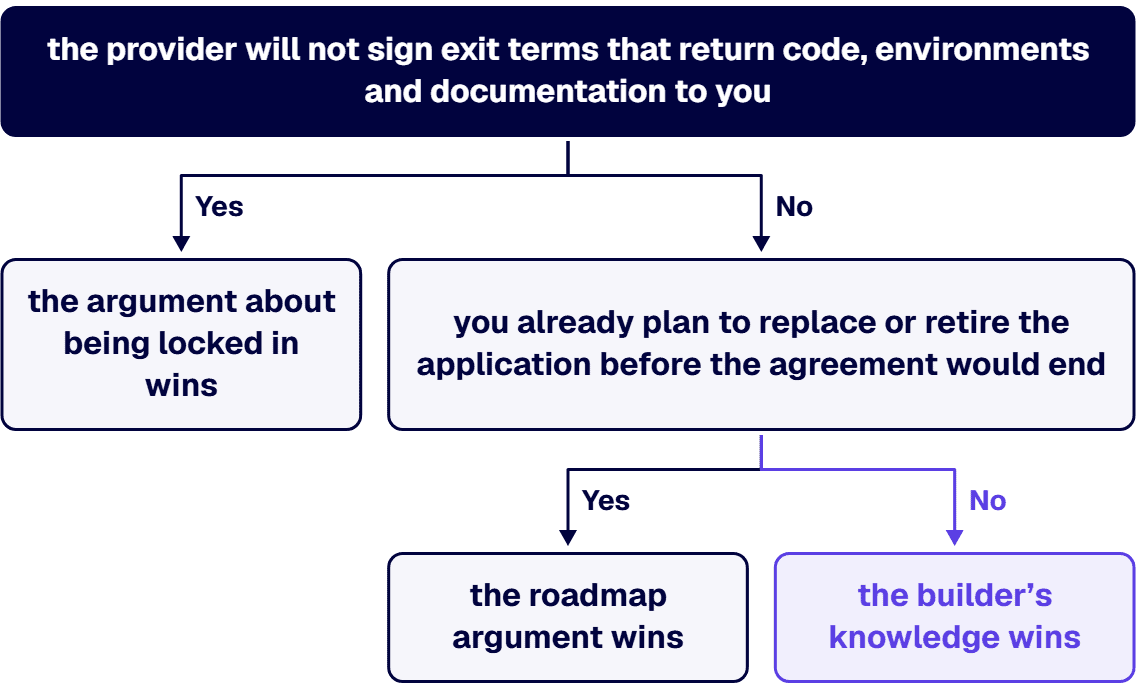
There are two honest arguments against, and both have contractual answers, not rhetorical ones. The decision rule: the argument about being locked in wins when the provider will not sign exit terms that return code, environments and documentation to you; the roadmap argument wins when you already plan to replace or retire the application before the agreement would end; when neither holds, the builder’s knowledge wins.
Lock-in. If the only people who understand the application work for the provider, switching becomes theoretical. This is answered by the exit terms and the documentation clause, not by assurances. If code, environments and documentation return to you on demand, the lock-in argument weakens considerably. If they do not, it is correct, and no amount of goodwill fixes it.
Roadmap divergence. A builder has an interest in the application continuing to exist in roughly its current shape. Your business may need it replaced, absorbed into a platform capability, or retired. A provider who cannot say “this should be retired” is not giving you advice. Test this before signing by asking what would have to be true for them to recommend ending the engagement.
What this agreement is not: An i3solutions engagement does not produce managed-service ownership, a replacement for the internal team, open-ended scope expansion, or vendor lock-in. The word “managed” carries freight it should not. An application managed services agreement is a scoped agreement to run a named thing well. It is not a transfer of your IT function, and it should not be structured as one.
We provide application managed services scoped to the applications and workflows we built or modernized: their operation, support and enhancement. General managed IT operations and help desk are out of scope and remain so.
That scope is deliberate rather than modest. The argument for the builder as the provider rests on knowledge that carries over from the build, and it only holds where that knowledge exists.
i3solutions designs Azure integration architecture and builds and operates Azure Logic Apps workflows for enterprise clients, including running them on an ongoing basis rather than only building them.
If the application we built is stable and your team has the depth to run it, we will say so.
Where you need the support model itself defined, including how it is structured and what shapes it, that is set out on Post-Implementation Support Services: Operational Excellence After Deployment. Where the question is whether to build or configure in the first place, that sits with Custom Application Development Services for Enterprise Performance.
Four situations where the answer is no, and it is worth checking yourself against them before you run a procurement.
The application is stable and your team owns the platform. If it changes rarely, survives release waves without intervention, and more than one person on your team understands it, an AMS agreement buys insurance against a risk you have already mitigated. Keep it, and revisit if the team changes.
You are retiring or replacing the application inside your planning horizon. If a replacement is already on your roadmap, an operating agreement that outlasts the outgoing system is money spent on something you are deliberately ending. Scope a maintenance floor instead: keep it running and secure, and stop enhancing it.
The gap is capacity, not knowledge. If your team knows precisely what needs to happen and simply cannot get to it, you need hours, not accountability for an outcome. Staff augmentation is the cheaper and more flexible answer, and converting a capacity problem into a managed agreement buys accountability you do not need.
It is an estate problem wearing an application costume. If the real issue is that nobody patches, nobody monitors and nobody answers the phone, then the application is a symptom. An application-scoped agreement will not fix it, and buying one will leave you with the original problem plus a contract.
i3solutions provides application managed services for the custom Microsoft applications and workflows it built or modernized: it operates them, supports them and enhances them under a defined scope, with one accountable team. The builder is usually the right provider because the design knowledge carries over from the build, provided the agreement returns code, environments and documentation to you.
Yes. i3solutions provides application managed services for the custom applications and workflows it built or modernized, covering their operation, support and enhancement. i3solutions designs Azure integration architecture and builds and operates Azure Logic Apps workflows for enterprise clients, including running them on an ongoing basis rather than only building them.
Usually, yes, because the builder’s design knowledge carries over from the build and a new provider would have to relearn it at your expense. Not when the provider refuses exit terms that hand your code, environments and documentation back to you, or when the application is due to be retired or replaced before the agreement ends.
No. Application managed services runs a named application and its workflows; the tenant, infrastructure, backup and disaster recovery, security operations and help desk are estate services bought separately.

US-Based Microsoft System Integrator | Est. 1997
© i3solutions. All rights reserved.
US-Based Microsoft System Integrator | Est. 1997
© i3solutions. All rights reserved.


